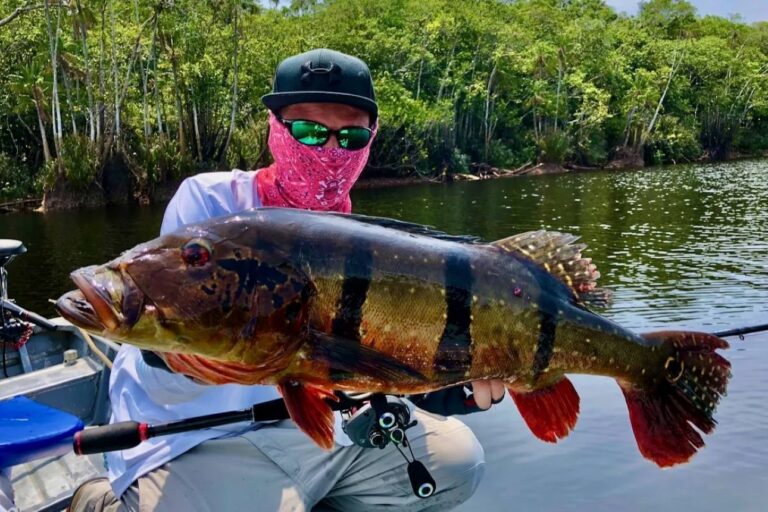


“Asu” is the Brazilian name for the largest species of peacock bass, the tukunare-asu (Cichla temensis). The word comes from the Tupi language, where “açu” means “big.” So “tucunaré-asu” literally translates to “big tucunaré.”
This word, by the way, has two meanings:
- as the species name—asu versus borboleta, popoki, and other, smaller tukunares;
- as the name for the coloration of this same species. Anglers refer to a fish in its spawning colors (golden, with three black stripes) as “asu,” and the same fish outside the spawning season (dark, with light spots) as “paka.”
In our article (“Tackle and Lures for Peacock Bass”), the term “asu” is used in its first meaning, as a synonym for trophy peacock bass.
The ultimate test for your tackle is the first run by the fish after it takes the bait. A fish weighing 8–10 kg that strikes the bait near a snag immediately darts back into cover, and at that moment, everything is put to the test: the rod, reel, line, knots, guides, and hooks.
The following are most likely to fail:
- hooks—they bend them back;
- wind-up rings—they get stretched or torn;
- fishing rods—they break if not used properly;
- The cord breaks if the friction clutch is engaged.
Small lures present a particular challenge. They’re equipped with small, thin hooks designed for a completely different kind of fish. So even if a perch takes a small lure, it’s rare to land a large fish with it.
The logic here is the same as when fishing for dogtooth tuna, which we wrote about earlier: you choose your gear based not on your experience as an angler, but on the strength of the fish. The Asu doesn’t go easy on beginners.

Fishing Rods: Casting and Short Blanks
The main tool for fishing for peacock bass is a casting rod with a multiplier reel. This setup allows you to place the lure precisely near snags and confidently work heavy surface lures with sharp jerks downward toward the water.
Optimal settings:
- length — 1.70–1.83 m;
- line class—20–40 lb (this refers to the line’s breaking strength, not the weight of the lure, and indicates the line strength for which the rod is designed);
- build — fast or extra-fast;
- The handle is made of cork, preferably with a wider grip: it’s comfortable to hold all day long.
The short rod isn’t there by accident. Most of the fishing involves precise casts from a boat toward submerged trees and bushes, where a long rod would only get in the way. Experienced anglers usually bring three sets.
Typical layout:
- Lightweight — a non-inertia reel and a rod about 2 m long for lures weighing 10–35 g, for jigs and small wobblers;
- medium — casting with lures weighing approximately 15–40 g;
- Heavy — for lures weighing up to 100 g, designed for large propeller-driven models.
You’ll need at least two fishing rods. Fishing rods tend to break in the Amazon, and the nearest tackle shop might be several hundred kilometers away.

Катушки
High-performance spinning reels are used for casting. One of the most popular models among anglers and videographers is the Shimano Curado 200–300. The Daiwa Lexa 300 and Abu Garcia Revo are also commonly used.
A size 4000 non-inertia reel with a fast gear ratio is suitable for a light setup.
The most important requirement for any reel is a powerful and consistent drag. Second is line capacity: there should be more than enough line to handle the first run of a big fish.
Leash and lead
The main line should be braided line only. Monofilament is not used for this type of fishing: it stretches too much and makes it difficult to control the line around snags.
Line strength: 50 to 80 lb. Brazilian guides typically use 50–65 lb, while American operators use 65–80 lb. The heavier the lures and the denser the snags, the stronger the line needs to be.
There is no consensus on this issue.
- a 40–50 lb fluorocarbon leader — protects the main line from being rubbed against branches and snags;
- No leader, just the line straight to the lure—supporters of this method believe that every additional knot is a potential point of failure.
You don’t need a steel leader: peacock bass don’t have sharp teeth. Although piranhas would most likely disagree with that statement—more on them below.
The main problem is a seized clutch
One of the most common causes of line breaks isn’t a weak line, but a drag that’s set too tight. The first powerful tug from a big fish can snap even a thick braided line as easily as a sewing thread if the drag is set too tight.
The rule is simple: the line should come off the reel by hand—but with noticeable resistance. This is enough to stop the fish, but not enough to break the rig.

Lures for peacock bass
All lures for the ace are divided into four groups. Each group has its own specific conditions, so the box should contain all four.
The main tool for fishing for peacock perch. These are loud surface lures with propellers on the nose and tail or with a “cup”-shaped indentation at the front. As they’re retrieved, they make noise, splash, and provoke aggression in the perch.
- weight — approximately 28–56 g;
- length — 13–17 cm;
- Quantity: at least 6 pieces in different colors.
It is precisely this type of surface lure that has caught the record-breaking piranhas of recent years. A strike on a propeller lure—that’s the splash many people travel to the Amazon just to see.
“Walking the Dog” Surface Wobblers
Long, propellerless wobblers that wiggle from side to side as you retrieve them. They work well in calm waters and on cautious fish, when loud lures only scare them away. Three or four will suffice.
Deep-diving wobblers
Wobblers 9–15 cm long that run 1–3 meters deep. They come in handy in clear water and when the fish are holding deeper and won’t rise to the surface. Bring 6–8 of them with different action patterns.
Jigs
According to many anglers, this is the most effective lure for peacock bass. A classic choice is the “baktel”: a jig head with a skirt made of deer fur or feathers.
- weight — 14–42 g;
- hook — heavy-duty, size 6/0 with a wide gap;
- colors—white, red and yellow, red and white;
- Quantity: 12–24 pieces.
You should retrieve the jig quickly, like a streamer, rather than slowly along the bottom: peacock perch attack moving lures.
A supply of 24 jigs might seem excessive—until you encounter piranhas. They bite off jigs one after another and can quickly deplete your supply. In rivers with piranhas, you’ll go through jigs even faster.
An alternative to the Bakteil is a 12–18 cm silicone vibrating tail on a 21–42 g jig head.
Which Lure to Choose

Hooks and Rings: Areas Where You Shouldn't Skimp
The standard hooks and rings on many lures are designed for freshwater fish. When fishing for asu, anglers replace them right away, while still at home.
What to replace:
- T-fittings—marine-grade, reinforced;
- wind-up rings—marine-grade, reinforced;
- For catch-and-release fishing—squeeze the barbs flat with pliers or use barbless hooks;
- If possible, replace treble hooks with single hooks: this causes less injury to the fish and allows you to release it more quickly.
About Safety
A propeller lure with two or three treble hooks lodged in the mouth of an 8-kg fish thrashing about is a classic cause of injury for anglers. That’s why it’s essential to have long-nose pliers and a fish gripper on the boat; it’s best not to reach for the lure with your hands. However, you shouldn’t lift a large pike vertically with just the gripper—you need to support its belly with your other hand.
In the Amazon, peacock bass can only be caught on a “catch-and-release” basis. For more details, see the article on fishing regulations in Brazil.
When it comes to this kind of fishing, there are no minor details. A thin ring that costs just a couple of dollars could cost you a fish that took ten years to grow.
Fly Fishing for Peacock Bass
Fly fishing for asu is a distinct discipline, and on some rivers, it is the only permitted method. On the Rio Maria, one of the best rivers for trophy asu, fishing is done exclusively by fly fishing and only with barbless hooks in sizes 2/0–6/0.
Fly-fishing kit:
- fishing rod — 9 feet, class 9–10;
- lines—floating and with a sinking tip (300–400 grains);
- backing—at least 200 yards, 20 lb and above;
- leader — 30–50 lb, fluorocarbon tippet — 50–60 lb;
- Flies—streamers 8–18 cm long, tightly tied, in white, yellow, chartreuse, and red; also poppers.
One American angler puts it this way: a Class 9 rod can handle 90% of the fish, but if you hook a 20-pound monster, you’ll have a much better chance with a Class 10 rod.
And here’s another quote from the same source: a fly reel isn’t something you should skimp on.

How to Use Bait
The peacock perch is a predator that needs to be provoked. That’s why the technique here is more aggressive than in typical perch fishing.
Basic Techniques:
- Move the lure quickly—the goal is to trigger the chase instinct;
- Work a surface lure with short jerks, pausing for 2–3 seconds, and a wobbler with slow, steady retrieves, pausing for 3–5 seconds;
- But if the fish have already taken the bait, don’t pause—just keep reeling in;
- Cast repeatedly at a promising spot—8–10 casts toward a single point with snags;
- In the morning, look for fish in shallow water; in the midday heat, fish in deeper water;
- If your partner gets a bite, cast behind his fish: other perch often follow the one that’s been hooked, so you can catch two at once.

What’s available on site, and what to bring with you. Tackle and lures for peacock bass
Many fishing lodges and floating hotels provide guests with fishing rods and reels. Fishing lines, leaders, lures, and flies are often charged separately or purchased on board.
Before your trip, you should:
- Check with the organizer to see what equipment will be available on site;
- Bring the gear you’re used to—especially your reels and favorite lures;
- Replace the hooks and rings on the lures in advance;
- Pack your hooks and lures in your checked luggage, not in your carry-on.
The peacock bass doesn’t forgive any weak links. A powerful cast, 50–80 lb braided line, a properly adjusted drag, saltwater hooks and guides, and a supply of lures designed to withstand piranhas—that’s the basic setup for fishing for peacock bass.
The rest depends on the river and the season: clear, dark, or murky water; low or high water levels; spinning or fly fishing. That’s why it’s best to put together a tackle list tailored to a specific river and lodge.
Contact us in any way that’s convenient for you, and the Boombastic Tours team will take care of everything to organize and guide you on your best fishing trip in Brazil.