

Many people are convinced that to catch a giant trevally, you need the biggest and loudest popper you can find in the store. The louder the splash, the more eagerly the fish will strike. With this in mind, anglers haul heavy suitcases full of lures and long tubes to the Maldives, only to end up paying extra for excess baggage.
On the reef, things are more complicated. In shallow water and along the edge, where GTs most often lie in wait for prey, a quiet stickbait usually catches more fish than a loud popper. A pause in the retrieve, when the lure slowly rises to the surface, makes all the difference. And an expensive wooden lure often loses out to a plastic one, which is about fifty grams lighter and flies farther.
In this article, we’ll explain which lures are best for fishing in the Maldives, which stickbaits and poppers to bring and how to fish with them, what we’re targeting around the Maldivian reefs, which four models consistently catch GT, how to work and rig them, and how many lures to bring for a week.

Giant Cormorant: Who Are We Looking For Near the Reef?
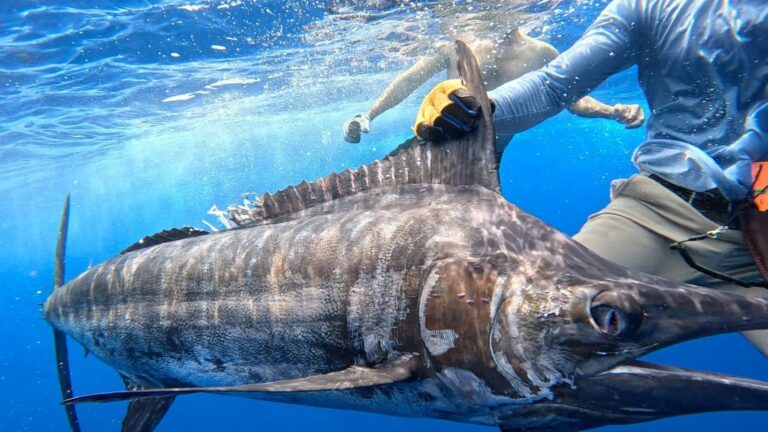
The giant trevally ( Caranx ignobilis), which everyone on board simply calls “GT,” can grow up to 170 cm and 80 kg, according to FishBase. The typical length of an adult fish is about one meter. In the Maldives, specimens weighing 10–20 kg are most commonly caught, and even a fish of this size will have you standing at the rail, bracing your rod against your belt, and keeping it well clear of the coral.
The GT lives on the outer slopes of reefs and in crystal-clear lagoons. It usually hunts alone for fish and crustaceans and often comes out to feed at dusk and at night. In the Maldives, they’re almost always caught at the surface, so you can see the entire attack—from the strike on the lure to the take.
Large GTs are released. Their flesh can accumulate ciguatoxin, and cases of poisoning have occurred, so the fish are photographed alongside the boat and returned to the water.
On those same reefs, groupers, snappers, and reef sharks can be caught on lures, and in open water, you might encounter yellowfin tuna. However, the tackle and techniques described in this article are tailored for GT.

Morning at the edge of the reef: time for stickbait fishing
A day of fishing usually begins at a reef inside the atoll or along its outer wall. The boat moves slowly along the edge; you cast your lure where the clear water above the coral drops off into the blue, and retrieve it back over the drop-off. This is where GTs are most often found.
On the shallows and near the edge, a stickbait works best. This streamlined lure has no blade; it doesn’t dive on its own and moves only with jerks of the rod. It makes very little noise, which is why it’s nicknamed the “silent killer.” At a depth of a couple of meters, the fish can hear every splash, and a loud popper is more likely to spook them there.
You can also cast a popper along the edge if you retrieve it as calmly as a stickbait. For this, use poppers with a small cup; when retrieved steadily, they make almost no noise.
When You Need the Sound of a Popper

When the boat moves away from the reef into deeper water or hovers above an underwater peak, the tactics change. The fish may be holding in the tens of meters below the surface, and they simply won’t notice a quiet stickbait. That’s when you need a popper. When you jerk it, its cup scoops up water, creating splashes and bubbles, and that noise can be heard from far away.
Above the peaks, anglers often use two lures. First, they use a popper to flush out the fish, and when a GT appears chasing the lure, they switch to a stickbait. This also gives your arms a rest, because the popper and stickbait place different strains on them, and by evening you can really feel the difference.
The rule “stickbait in shallow water, popper or stickbait in deep water” works well, but there are exceptions every week. That’s why they keep both rods assembled on board.

Size and color: 220 mm or 180
Around the Maldivian reefs, large stickbaits measuring 220–230 mm are more effective. They’re more visible in the water, and their size is closer to the prey that GTs feed on. You should fill most of your tackle box with these lures.
180-mm lures will also come in handy. There are days—especially toward evening—when the fish aren’t interested in large stickbaits but will readily take the smaller ones. A smaller lure is also suitable for those who want to fish with lighter tackle.
Color is simpler. Natural colors that resemble small reef fish work best. You can bring a couple of bright lures to experiment with, but the rest of your tackle box should consist of subdued colors.

Fishing Lures for the Maldives
There are many GT lures on the market, but a few models consistently perform better than others when fishing the Maldivian reefs.
Shimano Ocea Pencil 220F.A floating stickbait that’s 220 mm long and weighs 114 g. It flies straight and hardly wobbles in the air, which is valuable on windy days when you’re making hundreds of casts per shift. It catches fish during the pause; more on this in the section on retrieving techniques.
Maria Rapido F230.A stickbait 230 mm long and weighing 100 g. It features an internal magnetic weight transfer system, which allows the lure to fly farther. It’s harder to work than the Ocea Pencil, but you can vary the pace and force of your jerks to adapt to the fish.
Maria Loaded F180.A 180-mm-long, 75-gram stickbait—the best among compact models. It’s suitable for light tackle yet can handle large fish. In the evening, it often catches more fish than any other lure in the box.
Maria Duck Dive F230.A 230-mm-long, 95-gram popper with a small cup and a long-casting system. The small cup makes it easier to retrieve. Near the reef, it’s retrieved quietly, like a stickbait, while at depth, it’s made to make noise. In open water, yellowfin tuna also bite well on it. If you need a smaller popper, there’s a 190-mm version available.
Wooden lures from well-known manufacturers like Carpenter and Hammerhead are significantly more expensive than plastic ones and weigh 30–50 g more. On Maldivian reefs, the extra weight is a hindrance because plastic lures cast farther with the same tackle. Ten plastic lures instead of wooden ones will lighten your suitcase by almost half a kilogram.

How to Use a Stickbait
A stickbait doesn’t move on its own—the angler controls its movement. Beginners are often in too much of a hurry. If you retrieve the lure quickly and without pauses, it simply skims the surface, whereas the GT hunts wounded fish that alternate between diving and floating helplessly.
With the Ocea Pencil, the cycle goes like this: After casting, wait until the lure’s tail submerges and it settles at an angle. Then give it a short, moderate-force jerk to make the lure dive slightly. If you jerk it too hard, it will jump out of the water and lose its action. Beneath the surface, the stickbait will naturally follow an S-shaped path, wiggling from side to side; you just need to keep it on the line. When the lure surfaces, pause briefly and start the cycle over.

With the Rapido, it’s the same principle, but you should vary the pace and strength of your jerks. Make a few short, sharp jerks in a row, followed by a long pause, then a smooth, steady series of jerks. You’ll quickly figure out which approach the fish prefers today based on how it responds.
Off the Maldivian reef, a slow retrieve with pauses usually catches more fish than a fast one. If it seems like the lure is staying in one spot for too long, it’s better to wait another couple of seconds.

Where Do People Most Often Lose Their Fish?
The standard tackle on most Maldivian GT lures isn’t up to the task. Large fish bend weak hooks and snap thin swivels, so they’re replaced with reinforced ones before the trip.
For lures measuring220–230 mm—namely the Ocea Pencil 220F, Rapido F230, and Duck Dive F230—use Shout Curve Point 4/0 or BKK Raptor-Z 5/0 treble hooks. For the Loaded F180, the same models one size smaller—Shout Curve Point 3/0 or BKK Raptor-Z 4/0—are suitable. Those who prefer single hooks should use the BKK Lone Diablo 11/0 for large lures and 9/0 for 180 mm lures. Swivels and guide rings should be rated at 150–200 lb, all of the same strength.
Whether to choose a treble hook or a single hook is up to each angler. A treble hook sets more securely when the fish strikes, while a single hook is easier to remove and causes less injury to fish that are later released. Barbless hooks also release GTs more quickly, but when playing a fish with them, you can’t let the line slacken for even a second.
It’s not a good idea to buy tackle with a large size margin. Heavy hooks and rings make the stickbait’s tail heavier, causing it to move less effectively, so they should be selected based on the length and weight of the specific lure. The main tackle remains the same as for other types of Maldivian fishing. This includes PE 8–10 lines and 300 lb braided shock leaders, which can withstand both a GT’s run into the reef and friction against sharp corals.

A Week's Worth of Groceries: How Much to Buy and Why You Should Buy Extra
For a week of GT fishing, here’s the minimum setup: Six stickbaits, each220–230 mmmake up the core of the tackle box. Four stickbaits measuring180–190 mmwill come in handy in the evening and on days when the fish are finicky. Three poppers measuring180–200 mmare needed for deeper waters and underwater ridges.
Some of the lures are bound to get left behind on the reef over the course of a week. Large fish break the body and rip out the wire rings. Water gets into the cracked body, and the lure stops working properly. The line snaps on the coral when a GT heads into the reef, and in shallow water, the lure can snag on coral, making it impossible to retrieve.
That’s why it’s worth bringing spares of your tried-and-true models. Take the same lure in the same size and weight in two or three colors—that way, losing your favorite one won’t ruin your day. Plastic lures take up less weight in your tackle box than wooden ones, yet they cast just as well and catch just as many fish on the Maldivian reefs.
If you’re planning a trip to the far south of the Maldives, check out our article “Fishing in the South Maldives in November.” We covered catching large yellowfin tuna in the article “Fishing in the Maldives: How to Catch a Huge Yellowfin Tuna Here.” And when it comes to choosing the right lures for a specific season and atoll, a boat, a guide who knows exactly where the GTs are biting these days, and accommodations on the islands, those who fish here every season will be happy to help you.
Contact us in any way that’s convenient for you, and the Boombastic Tours team will take care of everything to organize and guide you through your best fishing trip in the Maldives.