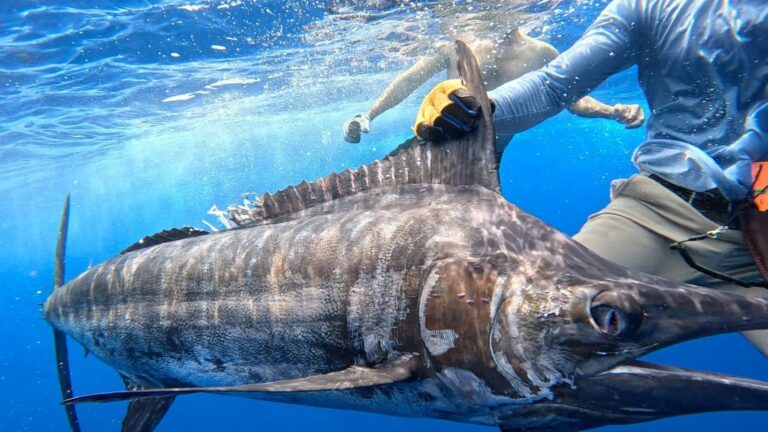


Yellowfin tuna is considered a common and affordable fish. It lives in all tropical seas, is sold in every supermarket, and almost every angler who has visited the Indian Ocean or the Caribbean has held one in their hands at least once. It seems that catching a large tuna is just a matter of time and choosing the right boat.
In reality, a 20-kg tuna and a 100-kg tuna are two completely different fish, even though they belong to the same species. The former travel in large schools and attack almost anything that falls into the water. The latter are found in small groups; they are cautious, strike during brief windows lasting just a few minutes, and can put up a fight for hours, exhausting not only the angler but the entire crew.
In this article, we’ll explore the anatomy of the large yellowfin tuna, the signs to look for when searching for it, the techniques and gear to use, and where to go during specific months so that your encounter with a trophy fish ends with a photo on board—not a snapped line. Fishing in the Maldives.
Yellowfin tuna: a fish that doesn't have a favorite bait
Yellowfin tuna ( Thunnus albacares) is a schooling, fast, and very powerful pelagic predator. It is found throughout the tropical belt, actively migrates hundreds of kilometers, and feeds at all water depths, which is why it is caught both at the surface and at depth. A single school can contain fish of a wide range of sizes, from a few kilograms to several puds, and no one on the boat knows in advance which fish will take the bait.
There is no single surefire method for catching yellowfin tuna. There are days when the school attacks any lure, regardless of size, shape, or color, and all you need for success is an accurate cast and the strength to fight the fish. And there are days when large yellowfin tuna feed on fry and squid just a couple of centimeters long and completely ignore classic poppers and stickbaits, even when swimming right underneath them.

The anatomy of the tuna explains why large specimens so often break free. It has a muscular, streamlined body with stiff fins and a very stiff tail capable of snapping a thick line or shock leader. At the same time, its mouth is small relative to its body, so the bait often bounces off at the moment of the strike, and the hook catches the fish from the outside. In yellowfin tuna weighing more than 50 kg, the jaws are so stiff and bony that even a thick monofilament shock leader can be severed if the lure goes deep into the mouth, and even the best hooks penetrate the jaw only very shallowly.
The current IGFA world record for yellowfin tuna is 193.68 kg. The fish was caught by Guy Yokom in September 2012, approximately 100 miles off Cabo San Lucas, Mexico.
Why a 50-kg tuna is in a class of its own
Experienced guides often classify large yellowfin tuna weighing 50 kg or more as almost a separate species. There are only a few such fish in a school, and even fewer that are active and ready to strike the bait. The search can take hours or even days before it becomes clear where and when the “adult” tuna appear. And the feeding window can be very short—anywhere from a few hours to a couple of minutes—after which the fish retreat to deeper waters, and the whole process starts over.
Large tuna are usually most active in the morning and evening. It’s harder to find them during the day, although a bite can happen at any moment. Sometimes large tuna feed at night as well, but catching them in the dark is possible in only a very few places around the world.
The real test begins after the fish takes the bait. On one fishing trip, reeling in a tuna weighing over 100 kg took nearly four hours, with at least six people taking turns. By the end of the struggle, everyone was exhausted. When the fish was finally pulled alongside the boat and the tension eased, the bait simply fell out of its mouth: the trophy was held on practically just one hook of the treble hook. For all those hours, the crew didn’t let the line slacken for a single moment, and that alone saved the catch.

Large fish also have an unexpected advantage. Schools of tuna are almost always accompanied by sharks—and fairly large ones at that. They intercept small and medium-sized tuna much more often during the fight than they do large ones, although there are no guarantees.
Searching for large tuna tests your character, while catching them tests your body. Usually, 80% of the time is spent searching and only 20% on the actual fishing.
There are exceptions, however—so-called “bonuses”—when a school is found quickly and there are plenty of fish. As a rule, there are few or no trophy-sized fish in such schools, so it’s wise to work your way up to large tuna gradually: first, practice casting and playing smaller fish, and then move on to the real battle.
Seven Signs That Tuna Is Nearby

None of these signs guarantees a large fish, and many of them apply to other pelagic species. But it is precisely these signs that help captains locate schools of fish, and often several of these signs coincide in the same place at the same time.
What to Watch For:
- Birds.A single seagull flying by means nothing, even if there are many of them and they’re flying low over the water. You need a flock that’s swirling, hovering over one spot, or moving along with the fish and constantly diving for food. What’s beneath them is also important: birds feeding near a reef or at depths of up to 50 meters usually indicate small fish, while those feeding at depths of hundreds of meters in the open sea are a serious sign. It’s also worth looking high into the sky. Frigatebirds—large black birds—are on the lookout for something big, and sometimes they get so bold that they dive at the bait, so you need to cast carefully near them.
- Tuna Leaps.Sometimes tuna chase after small fish or squid and leap high out of the water, their sides glistening in the sun. Large and very large fish often do this, and the birds haven’t had time to arrive yet. If you get to the spot before the school heads deeper, the chances of a bite are very high.
- Boils.This term refers to a school of fish gathered near the surface, feeding collectively. These schools form and disperse spontaneously and can move at speeds of 30–40 km/h. The captain must anticipate the school’s path and position the boat upstream of it so that every angler has time to make at least one cast. Boilers are usually dominated by small fish, but after the first few casts, monsters often surface and snap up everything in the water.
- Dolphins.Large tuna often feed alongside schools of dolphins, which herd small fish to the surface and are clearly visible from a distance. Meanwhile, the tuna stay deeper and may remain completely hidden. The captain steers the boat along the school’s path, while the anglers check the depth with noisy poppers. Usually, a few casts are enough to determine whether there are large fish in the area and whether they’re ready to bite. These casts pose no threat to the dolphins.
- Currents over the seafloor.Above underwater slopes, masses of water sometimes form distinct currents, resembling rivers in the middle of the ocean. Plankton and food gather in these currents, attracting tuna, wahoo, sailfish, and dolphinfish. Visually, the fish may not give themselves away at all, so these currents are surveyed over large areas, with test casts made periodically using various lures.
- Objects in the water.Floating debris, logs, and fishing buoys attract small fish, which in turn attract predators. This is a classic scenario for corifena, but large tuna also regularly patrol such areas. In the Maldives, the government has been installing anchored FADs for fishermen since 1981. These attract large numbers of small tuna, which in turn are hunted by larger ones. Local fishermen work near the buoys, generously casting live bait into the water, and thus become excellent indicators of fish presence themselves.
- Fish finder.In feeding grounds, tuna are clearly visible at depths of 40–100 m and can be caught very well with vertical jigging. But this requires a powerful transducer and a captain with extensive experience reading the screen.

Popping and Jigging: Fishing Without Trolling
Sport fishing for yellowfin tuna has become a veritable cult today, and the term is generally understood to mean anything other than trolling. Just ten years ago, catching a 100-kg fish on a popper seemed almost like a fantasy. Now, leading manufacturers produce rods, reels, and lures designed to handle such loads, and records for spinning are being set more and more often.
The most popular method is popping. The angler chooses the right moment, casts the line, and watches as the fish strikes the lure: an explosion on the surface, the screech of the drag, and long minutes as the reel spools out line. To anyone who has fished for tuna this way even once, passive trolling seems like a waste of time afterward.
When tuna stay at depth and ignore surface lures, it’s time for vertical jigging. The sensation is similar—it still comes down to the angler’s skill—but the bite occurs in the middle of the water column rather than at the surface. It makes sense to combine both methods on a single trip, because the fish behave differently every day.
Occasionally, tuna come within casting distance of the rocky shore, but these are localized spots and short-lived opportunities. In all other cases, you’ll need a high-speed boat capable of heading far out to sea and catching up with the schools.

From Casting to Landing: Rules for Fighting Large Tuna
When it comes to catching big tuna, there’s almost no room for error. A mistake at any stage can cost you the catch, and you don’t always get a second chance in a single day.
What determines the outcome:
- Long and accurate casts. When the boat catches up to a school of fish and comes to a sudden stop, the angler must take into account the boat’s momentum, the fish’s speed, and the distance to hit the target on the first try. This accounts for half the success.
- A leisurely retrieve. There’s no need to immediately speed up the lure across the surface. Its purpose is to remain in the fish’s active zone for as long as possible, and the angler adjusts the retrieve speed based on the situation.
- Setting the hook on the pull. You need to set the hook the moment you feel contact, not when you see a splash; otherwise, the lure will fly out of the fish’s mouth. It’s better to set the hook sideways than upward, and with large fish, it’s worth making two or three follow-up hooksets. On a recent trip to the Maldives, we caught four tuna weighing over 80 kg, and not a single hook set securely in the jaw.
- Keep constant tension on the line. The tuna may surge toward the boat; the angler gets tired; the hooks aren’t set deeply; and any momentary slack in the line results in a lost fish. That’s why reels with a high gear ratio are used for this type of fishing.
- The Pace of the Fight. The larger the fish, the calmer the fight, but while the angler rests, so does the tuna. It’s important to maintain a steady pace, watch the bend in the rod, and be aware of the maximum load on the tackle.
- Shark protection. You mustn’t let the tuna swim far out into deep water. At best, it will be eaten; at worst, the angler will be locked in a struggle with a shark for a couple of hours.
- Gloves. Even a small tuna at the boat’s side can injure your hand if you try to hold it by the shock leader.
It’s also a good idea to bring a spare set. If your lure breaks while you’re fishing and you don’t have time to tie on a new one, it’s easier to grab a second rod and fix the first one later.

Tackle That Can Handle a Trophy Catch
Tackle is selected not based on the fishing spot, but on the size of the fish and the conditions. Every component, from the reel to the guide, must be suited to the potential catch, and a “this will do” approach when fishing for an 80-kg tuna almost always ends the same way.
Spinning Set:
- Fishing RodRipple Fisher Big Tuna 86 for long-distance casting or Ripple Fisher Big Tuna 710 for fishing in deep pools.
- ReelShimano Stella SW 18000 HG; it’s a good idea to replace the standard spool with an OSM spool.
- LinePE 8–10; to be on the safe side, it’s better to choose PE 10.
- Shock leaderBraided from two strands of 150 lb monofilament tied together with 300 lb fluorocarbon.
Jig Set:
- Fishing RodRipple Fisher Ocean Arrow 5930.
- ReelShimano Stella SW 20000 with a standard spool.
- LinePE 6–8.
- Shock leader170–200 lb fluorocarbon.
This isn’t the only right choice—there are plenty of similar tackle options on the market. But if you need to save money, it makes more sense to go with a simpler rod and not skimp at all on the reel and line. The reel determines line capacity, smooth line lay, smooth drag operation, and mechanical reliability—and it’s the first component to give out after hours of fighting a fish.
A twisted shock leader made of two 150-lb strands tied to 300-lb fluorocarbon has saved quite a few trophy fish. Tuna cut through thick nylon like a thread, and right at the boat’s side, when the fish is being brought in for the gaff, such a shock leader is indispensable.

Lures: poppers, stickbaits, and jigs
There are no favorites when it comes to tuna, so people bring a variety with them.
For popping:
- Large popperswith wide cups, ranging from classic Halco models to rare brands like Amegari, Hammer Head, or FCLLabo.
- Stickbaits200–240 mm long from Shimano, Daiwa, Ya Maria, and other manufacturers. There are days when tuna ignore noisy lures and, though reluctantly, will only take stickbaits.
- Reinforced hardware.Replace the standard hooks and swivels with reinforced ones, such as those from BKK, but don’t go overboard with the size so as not to compromise the lure’s action.
For jigging:
- Shape and weight.Lures of medium width, up to 180 mm long and weighing 150–200 g, work best. Wide slow-pitch spoons and long, narrow jigs for tuna perform less effectively.
- Leaderswith leaders rated at 300 lb or higher.
- ColorsNatural colors: silver, pearlescent, blue, and pink—preferably with light-reflecting elements.
You have to experiment more with jig lures than with surface lures, because the weight and shape are chosen based on the depth, current, and the fish’s behavior on a given day.

Boat and Fishing Gear. Fishing in the Maldives

Where else can you catch tuna weighing more than 80 kg?
Yellowfin tuna are abundant throughout the tropical belt, but there are very few places where fish weighing more than 80 kg are caught not by chance but systematically.
Where to go:
- The Maldives, the remote southern atolls. Trophy-sized fish can be found both in the center of the archipelago and in the north, but the highest concentration of large fish is in the far south. Experienced captains and suitable boats operate there. The classic season runs from February through April. Few people know that large tuna are also found in November, December, January, and even in mid-June; it’s just that these months are inconvenient for many anglers.
- Oman, from Muscat to the southern tip of the country. There are plenty of very powerful tuna here, as well as plenty of good captains and boats. The seasonality is similar to that of the Maldives, but local captains advise heading out almost on a moment’s notice when the fish are in the area. Sometimes the tuna move more than 100 km offshore, and you have to travel quite a distance to reach them.
There are also plenty of yellowfin tuna in Central America, Mexico, the Seychelles, and off the coast of Africa, and large specimens are found there. However, it’s not possible to consistently catch true “monsters” in these regions; fish weighing up to 50 kg are usually caught, albeit in good numbers. The world record set off Cabo San Lucas does not contradict this; rather, it serves as a reminder that a single record-breaking fish does not make a location predictable.
Trophy yellowfin tuna don’t bite every day or on every trip, so even a trip in the middle of the season remains a hunt with the risk of not finding or catching them. Your chances depend on three things: the location and season, chosen based on statistics; a captain who knows how to read the birds, dolphins, and the fish finder; and tackle where every knot has been checked. The rest comes down to patience and those few minutes when a school of large fish finally breaks the surface.
Contact us in any way that’s convenient for you, and the Boombastic Tours team will take care of everything to organize and guide you on your best fishing trip in the Maldives.