

Imagine an evening in Etosha National Park. Your child is sitting next to you on a wooden bench by a lit watering hole, and a black rhinoceros slowly emerges from the darkness toward the water. You’re watching it not from a car or through glass, but right from the viewing area inside the fenced-in camp where your child swam in the pool earlier that day.
Many parents have a very different image of a vacation in Namibia with children and make a list of potential dangers in advance: illnesses, predators, heat, and endless roads. That’s why they usually put off a family trip until the children are older. Namibia disproves almost all of these concerns, as it is considered one of the safest countries in Africa, with good roads, a sparse population, and virtually no crowds of tourists.
In this article, we’ll go through everything step by step: at what age to take a child, during which season, what documents are checked at the border, where malaria is present and where it isn’t, what to pack, and which dune a child can handle. So that a trip to the dunes ends in delight, rather than a child’s tantrum and a parental meltdown.
Vacationing in Namibia with Children: At What Age Can They Come?
This is the first question parents ask, and guides usually give the same answer: the trip is best suited for children around six years old. A younger child may be physically able to handle everything, but the long drives and quiet animal watching will quickly bore them. A six-year-old can already hold binoculars on their own, memorize the names of antelopes, and then talk for a long time about how the sand hummed as they ran down the dune.
You can also travel with very young children; it’s just that the itinerary for a three-year-old is planned differently than for a ten-year-old. The difference usually comes down to three things: how many hours the family spends in the car, whether the route passes through a malaria zone, and whether the selected lodges accept children.

There are two typical types of family trips in Namibia:
- The first takes about eleven days by car and passes through the Sossusvlei Desert, the coast near Swakopmund, the cliffs of Damaraland, and Etosha National Park. This route barely enters the malaria zone, but it involves a lot of driving.
- The second itinerary lasts about a week and relies on small-plane flights, so there’s almost no driving involved; however, it usually ends at a river in the north of the country, where there’s currently a malaria outbreak. Families with young children often choose the first option, breaking up long drives into shorter ones, while the second is better suited for families with teenagers.
There’s also a simple rule that works for any age: with young children, it’s better to choose three destinations and stay longer at each one. The longer you stay in one place, the more you get to see, and the less time your child spends in the car.
When to go: a dry winter or a green summer
Namibia is located in the Southern Hemisphere, so its winter corresponds to our months of May through October. This is the peak tourist season, and it’s not just because of the pleasant weather.
During the dry months, there is almost no free-flowing water left in the country, and the animals stay close to watering holes. For an adult, this is just a pleasant detail, but for a child, it makes a huge difference between a day when you drove for four hours and didn’t see a single animal, and a day when you simply sat down by a watering hole and, within an hour, elephants, zebras, giraffes, and a rhinoceros came to drink. In Etosha, from July through September, that’s exactly how it works: you don’t have to look for the animals—they come to you.
There’s one thing about winter that’s worth keeping in mind when packing. In Windhoek, daytime temperatures in June and July are around +20 °C, but at night they drop to +4…+6 °C, and in the desert, they drop to nearly zero. The trip to the dunes begins before dawn, in an open-top vehicle while driving, and it can get really cold for the first hour and a half. If you’ve packed only shorts because you’re heading to the desert, you’ll definitely remember this morning.

Summer, from December through February, is the other extreme: daytime temperatures in Windhoek are around +30 °C, while in the north they can exceed +38. It rains from January through April, and this green season has its own advantages: the desert is covered with grass, antelope and zebra calves are born in Etosha, and there are noticeably fewer tourists. At the same time, the animals scatter across the savanna, dirt roads get washed out in places, and the midday heat tires a child out faster than an adult. Even hot-air balloons over Sossusvlei don’t fly during the peak of the heat, and the company closes for the season from January 16 through February 15.
It’s also worth keeping the school calendar in mind. June, July, and August coincide with school breaks in Europe and South Africa, so the best lodges for these months sell out long before your trip. In April and May, as well as in September and October, the weather is almost as dry, but there are fewer tourists, so these months are often the best choice for families.
What documents are required for a child traveling to Namibia?
Once you’ve decided on the time of year and season, it’s time to start preparing—and it’s best to gather your documents first. Citizens of many countries do not need a visa to enter Namibia, so they can stay in the country for up to 90 days within a six-month period. Starting in April 2025, citizens of Belarus, Kazakhstan, Armenia, Azerbaijan, Kyrgyzstan, and Moldova will need a visa on arrival, which can be obtained directly at the airport or in advance online via the eVisa portal. The fee is 1,600 Namibian dollars (about €85); children aged six to eleven pay half the fee, and children under six enter for free.
There are specific rules for children in Namibia because the country strictly monitors who is taking minors out of the country and with whom. This requirement was established as far back as the 1993 law, and the Ministry of the Interior regularly reminds travelers of it. In addition to a passport, every traveler under the age of eighteen must present a complete birth certificate listing both parents, either as an original or a certified copy. All documents must be in English or accompanied by an English translation.

It is important for border officials to verify that the adult traveling with a child is authorized to do so; therefore, the required documents depend on who the child is traveling with.
- The child is traveling with both parents. A passport and a complete birth certificate with a translation are sufficient.
- The child is traveling with one parent. You’ll need a notarized consent form from the other parent.
- The child is traveling with a grandmother, aunt, or coach. You’ll need consent from both parents, copies of their passports, and their contact information.
- One parent has sole custody, or the other parent has passed away. A court order or death certificate is required.
- The child is flying alone. In addition to parental consent, a letter from the host party with an address and contact information is required.
For all travelers, the other requirements are standard: your passport must be valid for at least six months after entry, it must have three completely blank visa pages, and you’ll also need a return ticket and proof of accommodation. Border control officers do not use the pages for stamps, so it’s worth checking in advance that the visa pages, specifically, remain blank.
It’s best to gather the documents for children before anything else—even before you book your accommodations. You can rebook a hotel room in a day, but you can’t get the other parent’s notarized consent at the airport.

Do I need a yellow fever vaccine?
The answer to this question depends on how you’re traveling. There is no yellow fever in Namibia itself, and a vaccination certificate is required only for travelers older than nine months who have flown in from a country where yellow fever is a risk or who have spent more than twelve hours at an airport in such a country.
This is important because Ethiopia is on the list of countries at risk for yellow fever, and many flights to Windhoek pass through Addis Ababa. If your layover there lasts five to six hours, you won’t need a certificate. However, if you stay overnight in Addis Ababa or your layover lasts longer than twelve hours, you’ll need the certificate, and you’ll have to get vaccinated at least ten days before arrival.
Therefore, the easiest way to handle the vaccination is when you buy your tickets: if you choose a layover shorter than twelve hours, you’ll save both travel time and trips to the clinic before departure.

Where is malaria found in Namibia?
Southern and central Namibia are malaria-free, so Sossusvlei, Dead Vlei, Swakopmund, Walvis Bay, and Windhoek are outside the risk zone. Damaraland is technically part of the Kunene region, where the U.S. Centers for Disease Control and Prevention recommends preventive measures, but the risk near Twyfelfontein is very low because the main outbreaks occur much further north. The entire desert route lies outside the malaria belt, and it’s worth knowing this before you start worrying.
In the north of the country, the situation is different. In 2025, nearly 96,000 cases of malaria were reported there—six times more than the previous year—and the outbreak continued into 2026. Almost all cases occurred in the border regions along the Okavango and Zambezi rivers, near Angola and Zambia, and it is precisely there that the river lodges are located, which are often the final stop on itineraries that include flights.
If we break this down by route segment, the picture looks like this.
- The desert and the coast. This part of the route was not affected by the fire.
- Etosha. There are areas with the outbreak near the park, but the park itself isn’t specifically mentioned, and the risk there is lower because there are very few people around.
- The Chobe and Okavango Rivers. They are located right in the center of the outbreak.
- Time of year. Malaria is transmitted seasonally, peaking from December through April, so the dry winter remains the safest time to travel.
The decision regarding preventive medications for a child should be made by a doctor who knows the child’s age and weight. Children under five are at risk of severe illness, and some medications have age restrictions. If you’re traveling with young children and want to avoid this issue entirely, choose a route through the desert, along the coast, and through Etosha without stopping at the northern rivers. At sunset and sunrise, dress your child in long-sleeved shirts and long pants, and use insect repellent.

Sun, Water, and Dust
Although malaria is what scares parents the most, in reality, the sun, dehydration, and dust are far more likely to cause problems for children.
The UV rays here are strong even on a cool day, and the humidity is very low, so a child loses water before they even have a chance to feel thirsty. From day one, agree on a schedule for drinking water—every half hour—even if the child doesn’t ask for it. In addition to water, you’ll need a wide-brimmed hat, high-SPF sunscreen, and lip balm.
On dirt roads, dust billows up, gets everywhere, and dries out the eyes, so eye drops in your first-aid kit often prove more useful than many other medications. If you or your child wears contact lenses, be sure to bring a pair of glasses as well. A neck gaiter covers your face on open stretches of road and weighs almost nothing. It’s best to give children only bottled water; this also applies to ice in drinks.
What to Do If Your Child Gets Sick in Namibia
Healthcare in Namibia varies greatly between cities and rural areas. Windhoek has several good private clinics: Mediclinic, Lady Pohamba, Rhino Park, and the Roman Catholic Hospital. In Swakopmund, there is the private clinic Mediclinic Swakopmund, which has a pediatric ward and an intensive care unit, while the Welwitschia Hospital operates in neighboring Walvis Bay.
But the main challenge here has to do with distance, not the quality of medical care. From the remote areas of Damaraland, it can sometimes take half a day to reach a doctor, and in complex cases, patients are first stabilized in Windhoek and then transferred to South Africa. Therefore, insurance must cover not only treatment but also medical evacuation. A day in a general ward at a private hospital costs about 4,500 Namibian dollars (about €235), in a pediatric ward about 5,300 (about €280), and in the intensive care unit about 17,700 (about €930). A medical evacuation flight to Johannesburg is estimated to cost between 10,000 and 40,000 dollars.
Therefore, before your trip, it’s a good idea to find out where the nearest clinics are along your route and keep your insurance company’s phone number handy. Your guide or driver usually knows the local hospitals well, so it’s a good idea to ask them about this on the very first day.

Why Etosha Park Is So Great for Kids
Esho deserves a story of her own, because she’s the one who puts parents’ biggest fear to rest—that their child won’t be able to handle a safari that lasts several hours in a car.
All campsites within the park are fenced, and children can walk freely within their boundaries. The three main camps—Okaukueyo, Halali, and Namutoni—have well-lit watering holes with fenced-in areas and benches where elephants, lions, and black rhinos come after sunset. This is the very bench we mentioned at the beginning of the article: your child can watch the animals while sitting right next to you, without a car and without having to stay quiet for hours on end. The main camps have swimming pools, and during the day, when it’s at its hottest, they’re a real lifesaver. The terrain in the park is open, and the animals are visible from a distance, so even a small child doesn’t have to peer into the bushes.
The park pass is valid for 24 hours from the time of entry, so one paid day allows you to spend two mornings in the park. Children up to and including age eight enter for free; those aged nine through fifteen pay 180 Namibian dollars per day (about €9.5), and those sixteen and older pay the adult rate of 280 Namibian dollars (about €15). Guided night drives depart directly from the camps after the gates close.
The first rule children are taught here is this: you must not get out of the car anywhere except at designated areas and within the campgrounds, because there are predators in the park that you might not even notice.

Which lodges are suitable for families with children?
Not every lodge in Namibia accepts young children, and there’s a clear reason for each restriction. We’ve covered lodges in more detail in a separate article, but here we’ll focus only on what’s important to know if you’re traveling with a child.
Chobe Water Villas on the Chobe River consists of sixteen villas built on stilts, with no fences and the water lapping right beneath the deck. For this reason, the lodge accepts children ages 14 and older, and younger children only by prior arrangement. On some itineraries, Divava Okavango on the Okavango River is offered as an alternative to Chobe Water Villas, and children of all ages are welcome there. However, Divava is located in the Andara area, in the center of a malaria outbreak, so a trip to the river for young children remains uncertain.
With the other lodges, it’s simpler:
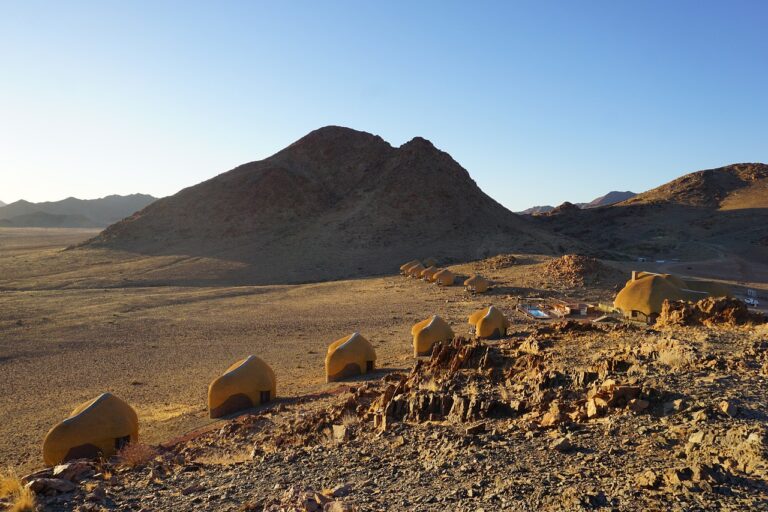
- Le Mirage near Sossusvlei. This castle-style lodge is located 20 kilometers from the entrance to the dunes. Children of all ages are welcome here: those under five stay for free, and those aged six through twelve pay half the adult rate. The lodge is designed for a peaceful getaway and spa experiences, so it’s best suited for children ages five and up; however, the pool here is not fenced off.
- Mokuti is located at the eastern gate of Etosha. It features its own Ontouka Reptile Park, where crocodiles are fed every Saturday at 3:00 p.m., a children’s pool next to the adult pool, two lighted tennis courts, hiking trails through a private nature reserve, and four on-site watering holes. The eight family rooms feature a separate bedroom and living room that can accommodate three children aged three to twelve. Children under six stay free of charge if they sleep in their parents’ room on existing beds.
- Strand Hotel in Swakopmund. This city hotel is located on the old pier, just a couple of minutes’ walk from the waterfront and cafes.
Throughout the country, children under twelve usually receive a discount of about half the regular price; restaurants offer children’s portions; and supermarkets in Windhoek and Swakopmund sell infant formula and baby food.
There are also age restrictions for certain activities, but these can often be worked around. For example, children as young as six are allowed on hot-air balloon rides in Sossusvlei, provided the child can climb into the basket on their own, remain standing for about an hour during the flight, and sit down during landing. For younger children, the company provides a babysitter free of charge at its base, but you must request this when making your reservation.

What to Pack in Your Bag
If your itinerary includes flights on small aircraft, you’ll have to leave your hard-shell suitcase behind, because small planes only allow soft-sided bags measuring approximately 25×30×62 cm. Different carriers have weight limits ranging from 15 to 20 kg per person, including carry-on luggage. Passengers are weighed together with their luggage, and children count as full passengers, so large families should pack especially carefully. It helps that almost all lodges do laundry the same day, so you’ll need about a third as many clothes as you might think at home.
It’s best to pack clothes in layers. During the day, light, breathable clothing in neutral colors is ideal—preferably with long sleeves, which provide protection from both the sun and mosquitoes. In the morning and evening, you’ll need a fleece sweater or a warm jacket. Be sure to wear closed-toe shoes, because the thorns, hot sand, and scorching clay in Dedvle are not suitable for flip-flops.
There are a few little things that people often forget, and then regret later.
- Power outlet adapter.In Namibia, they use Type D and M outlets with three round prongs and a voltage of 220 V, and European plugs don’t fit into them, so it’s best to bring a couple of adapters.
- A headlamp and a power bank.It gets dark in the lodges in the evening, and there aren’t always enough outlets.
- Motion sickness pills.Keep them in your pocket, not in your luggage: small planes don’t have restrooms, and it’s best to have a light breakfast before your flight, because motion sickness is worse on an empty stomach.
- Powders to restore fluid balance and a cooling spray for bruises.These are most often useful in a child’s first-aid kit.
- Wet wipes.It’s not always possible to wash your hands while on the go.
- A separate pair of binoculars for each child.If there’s only one pair of binoculars for the whole family, the safari turns into a waiting game.

Which dune in Namibia should you choose for a child?
The most common disappointment of the trip has to do with Big Daddy Dune. Parents read that climbing it is a must-do in Sossusvlei, so they include it in their itinerary, but once there, they find that the 325-meter climb up loose sand takes one to two hours, and with every step up, you slide halfway back down. On top of that, it’s another twenty-minute walk from the parking lot to the base. After 9 a.m., the sand gets scorching hot, and the climb becomes a grueling ordeal, so Big Daddy is suitable for teenagers and adults in good shape, but not for a seven-year-old child.
There are much easier options for a first visit to the dunes. Adults can climb Dune 45—with its clearly visible crest—in about half an hour, while children take about forty-five minutes; the descent takes a couple of minutes, and the view from the top is almost the same as from Big Daddy.
The Elim Dune, located five kilometers from the Sesriye Gate, is even lower, making it a convenient place to begin exploring the desert. A trail about one kilometer long leads from the parking lot all the way to Dedvlei with its famous dried-up trees, and you don’t need to climb the dune to get there. The last few kilometers through deep sand are covered by shuttle, and a child’s ticket costs half as much as an adult’s: 100 Namibian dollars (about €5) versus 200.

If you still want to climb the big dune with the whole family, it’s best to get in shape beforehand. Before your trip, it helps to take walks on a sandy beach, take the stairs instead of the elevator, and get used to being on your feet for two hours straight. Going down is always more fun than going up: it takes 10–15 minutes to run down from the crest at Dedvley, the sand roars beneath your feet, and this is the moment kids remember most often afterward.
In addition to climbing the dunes, your child will have to spend a lot of time in the car. For example, the route from Windhoek to Sesriem is about 350 km, followed by about 350 km on a gravel road to Swakopmund, then 325–375 km to Twyfelfontein, depending on whether you stop to see the sea lions at Cape Cross; from there, it’s about 300 km to Etosha and 420–530 km back to the capital. Each leg of the trip takes four to six hours, and it’s much easier for children when a driver-guide is behind the wheel who knows where to stop, allowing parents to sit next to their child and look out the window instead of at the GPS.
If you’re still deciding where to go, check outour team’s general overview of Namibiafrom our team, or write to us—we’ll put together tours tailored to your specific preferences, so you won’t have to worry about organizing your family vacation in Namibia.