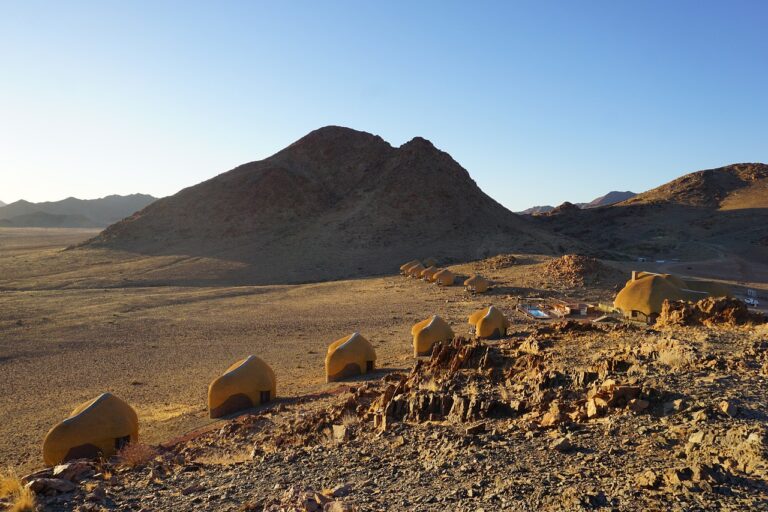


Namibia is impressive for what it lacks.
Here, you can drive for an hour on a gravel road without seeing a single car coming the other way. The country covers an area of 824,292 km²—more than Germany and Poland combined. And about three million people live across this vast expanse. Fewer than four people per square kilometer.
Based on this metric, Namibia ranks among the three least densely populated countries in the world—along with Mongolia and Australia.
There aren’t many tourists here either. In 2025, the country welcomed just over 1.2 million visitors. The main source of visitors is neighboring South Africa: in 2024, South Africans accounted for nearly 40 percent of all arrivals. From overseas, Germans make up the largest group. China made it into the top ten long-haul markets for the first time—with a share of less than one percent.
In the article “A Trip to Namibia,” we’ll explore whether you need a visa to visit Namibia, how to fly there, the best months to visit, how safe it is, and exactly what you’ll see. And while we’re at it—why this vast emptiness isn’t a geographical coincidence, but a conscious decision the country has made.

Visa for Namibia
As of April 2025, Namibia has changed its entry requirements. Thirty-three countries have lost their visa-free entry privileges—the United States, Canada, the United Kingdom, Germany, France, Japan, Australia, as well as Belarus, Kazakhstan, Ukraine, and Uzbekistan. Now, citizens of these countries must pay a fee of 1,600 Namibian dollars (about €80).
Visa-free entry agreements are in place with Russia, Brazil, Cuba, Kenya, Singapore, and South Africa’s southern neighbors. At passport control at Hosea Kutako Airport, citizens of these countries simply receive a 90-day stamp in their passports. Free of charge.
Documents you’ll need to bring: a passport valid for at least six months with at least three blank pages, a return ticket, and an immigration card filled out in English. If you’re flying through Johannesburg, keep in mind that South Africa requires two additional blank pages, so it’s safer to have five.
No vaccinations are required. A yellow fever certificate is required only for travelers arriving from an endemic country.
These countries include:African countries: Angola, Benin, Burkina Faso, Burundi, The Gambia, Ghana, Guinea, Guinea-Bissau, Gabon, the Democratic Republic of the Congo, Cameroon, Kenya, Congo, Côte d’Ivoire, Liberia, Mali, Mauritania, Nigeria, Niger, Rwanda, Senegal, Sierra Leone, Sudan, Togo, Uganda, Central African Republic, Chad, Equatorial Guinea, South Sudan, Ethiopia.
Countries in South and Central America and the Caribbean: Argentina, Bolivia, Brazil, Venezuela, Colombia, Peru, Panama, Paraguay, Suriname, Guyana, French Guiana, Ecuador, Trinidad and Tobago.
A certificate may also be requested from those who have a stamp or visa from these countries in their passport.
Namibia’s visa policy has changed three times over the past two years: the introduction of an e-visa, an increase in fees, and a new list of countries. There’s no guarantee it won’t change again. It’s best to double-check the requirements before your flight.

How to Fly to Namibia
There are no direct flights from most countries, including CIS countries, and none are planned. What’s more, there are almost no direct intercontinental flights to Windhoek at all: only from Europe, and even then, only from three cities. Frankfurt and Munich have year-round service, while Zurich has seasonal service from June through October.
Therefore, there are two possible routes.
The first and shortest route is via Addis Ababa: Ethiopian Airlines flies to Windhoek daily, with just one layover.
The second option is via Johannesburg, which can be reached in various ways. It’s longer, but more flexible: there are up to seven flights a day between Johannesburg and Windhoek, plus three from Cape Town. It’s easy to adjust the connection to fit any schedule.
Josea Kutako Airport is located about forty-five minutes’ drive from the capital.
The Namibian dollar is pegged to the South African rand at a 1:1 ratio, and the rand is widely accepted here. However, the reverse isn’t true: Namibian banknotes aren’t legal tender in South Africa. If you’re flying through Johannesburg, spend your local cash before your flight—otherwise, you’ll end up bringing home a bunch of pretty paper.

When is the best time to visit Namibia?
The peak season runs from May through October—Namibia’s winter. There’s almost no rain; the vegetation withers, and water remains only at permanent watering holes—so all the animals flock to them. That’s exactly why safaris in Etosha during these months are almost guaranteed to be successful: you don’t have to search for the animals—they come to a predictable spot on their own.
In June and July, there are often frosts in the desert at night, so bringing warm clothes for morning outings isn’t a bad idea. In September and October, on the other hand, it’s already really hot.
The rainy season, which runs from November through April, is generally considered a poor time to visit, and this is partly true for safaris: the animals are scattered throughout the area, and the lush vegetation obstructs the view. But February is calving season in Etosha, and you’ll see newborn antelopes. And photographers call April the best month of the year: after the rains, the sky is washed to a pristine blue, and the ground is still green.
The Namib Coast receives less than 20 millimeters of rain per year, while the northeastern Zambezi region receives more than 600. Moreover, ocean fog brings more water to the coastal desert than rain does.

What to See on a Trip to Namibia
Sossusvlei and Dead Vlei
The Namib has remained arid for between fifty-five and eighty million years and is considered the oldest desert on Earth. The sand took a long and winding journey to get here: the Orange River carried it from deep within the continent to the Atlantic Ocean, and the wind blew it back onto land.
The “Big Daddy” dune rises 325 meters, and over time, iron oxide has colored the sand from pink to burnt orange.
The climb takes between 45 minutes and an hour. The descent takes about ten minutes, because you’re practically running down the loose slope. At the bottom lies Dedvley: a white clay plain dotted with the skeletons of camel acacia trees.
About nine hundred years ago, the dunes blocked the course of the Tsauhab River. The trees survived for another couple of centuries, but then died—and have stood dead for six or seven centuries now. In such dry air, there’s simply nothing to help them rot.
Etosha
Twenty-two thousand square kilometers surrounding the salt basin, which is visible from space. More than a hundred species of mammals and over three hundred and forty species of birds.
In September 2025, a massive fire broke out in Etosha: about one-third of the park was destroyed by the blaze. The park remains open, and the camps are welcoming guests.
What’s more, experienced guides say that after fires, sightings are often better than usual: the animals are drawn to the young grass that sprouts from the ashes and is rich in nutrients.

Coastline
Swakopmund was founded by German colonists in 1892, and the city still looks as if a piece of Bavaria had been mistakenly planted between the Atlantic Ocean and the desert.
Further north lies Skeleton Coast—so named for the shipwrecks and whale bones lying on the sand. According to legend, the San people called this place the land that God created in his wrath. And at Cape Cross, there is a huge colony of Cape fur seals: the number is usually estimated at around 100,000, but during peak season, estimates reach as high as 200,000. You can hear them before you see them, and the smell reaches you even before the sound when traveling to Namibia.
About fifty kilometers from Swakopmund, the Welwitschia plain begins, and it’s worth taking a detour just to see it. Welwitschia looks like a tangle of ribbons wrapped around a low wooden stump—and it’s perhaps the most tenacious plant on the planet.
Over the course of its entire life, it produces exactly two leaves—and grows them for centuries, until the wind tears them to shreds. Some specimens live for more than 1,500 years. In Afrikaans, it is called “the two leaves that cannot die.” It is depicted on the country’s coat of arms, and zebras and oryx graze on its leaves for moisture.
Twiefelfontein
Namibia’s first UNESCO site, designated in 2007. With about 2,500 rock carvings, it is one of the largest concentrations of petroglyphs in Africa. People have used this valley for about 6,000 years, and the oldest engravings date back several millennia. Hunter-gatherers used it as a site for shamanic rituals.
Namibrand Nature Reserve
In 2012, the Namibrand Nature Reserve was designated an International Dark Sky Reserve in the highest, “Gold” category—the first in Africa and only the second in the world. The nearest villages are a hundred kilometers away, and the nearest city is even farther.
Here you can see the Magellanic Clouds and the Southern Cross—sights that people in the Northern Hemisphere simply have no chance to see.
And during the day, another mystery reveals itself under this sky. Scattered across the plains are hundreds of thousands of “witch’s circles”—bare, circular patches ranging from two to twelve meters in diameter, arranged with almost geometric regularity. They appear, last an average of forty years, and then become overgrown; satellite images taken four years apart have confirmed this. Scientists are still debating what creates them.

How safe is Namibia?
The answer surprises almost everyone: the danger in Namibia isn’t what you think it is.
Attacks on tourists in Namibia are extremely rare. Petty thefts do occur in Windhoek and Swakopmund, and almost always follow the same pattern: a bag was left in plain sight in a car, and the window was smashed. This can be prevented by simply making it a habit not to leave anything inside the car.
But what’s really dangerous are the roads. About26,000kilometers of the road network are gravel, and another13,000are unpaved. Less than one-fifth of the country’s roads are paved.
Most incidents involving foreigners aren’t criminal in nature—they’re car rollovers. The gravel is deceptively slippery; at speeds above eighty, a car can easily lose control. Kudu and warthogs come out onto the road at dawn and dusk, so driving at night here is a bad idea—and any car rental agency will tell you that.
And here’s one detail that often trips up independent travelers: Google Maps doesn’t understand Namibia. It’ll show a distance of 300 kilometers and estimate a travel time of three hours. On gravel roads, it’s actually five.

Gas stations inside Etosha have been operating intermittently for several years now: the supplier either fails to deliver or is involved in litigation. It’s recommended to enter the park with a full tank of gas. From the Anderson Gate, you can fill up in Outjo or at the Etosha Trading Post gas station right in front of the gate; from the von Lindequist Gate, you can fill up in Tsumeb. For those traveling on their own, this is an additional cause for concern. For those traveling with a tour operator, it’s no cause for worry.
Malaria here is a matter of geography. The southern part of the classic route—Sossusvlei and Swakopmund—is malaria-free. In Etosha, the risk is seasonal, from December through April, while in Caprivi and Kavango, it’s present year-round. It’s best to consult an infectious disease specialist before your trip to determine whether preventive treatment is necessary. Tap water in cities is safe to drink.
In Namibia, the main risk isn’t crime, but distance. Medical evacuation from a remote nature reserve takes time, which is why an organized itinerary here is less about convenience and more about peace of mind.

The emptiness in Namibia is no accident
Article 95 of Namibia’s Constitution, adopted in 1990, requires the state to protect the country’s ecosystems and natural diversity and to use living resources in a way that ensures they are sufficient for both current and future generations of Namibians.
The CIA’s *World Factbook* lists Namibia as the first country in the world to enshrine nature conservation in its constitution.
The country then took a step that few had dared to take: it granted the communities themselves the right to manage their own wilderness. Since 1998, eighty-six community-managed nature reserves have been established. They cover about twenty percent of the country’s territory, and together with national parks and privately owned lands, about forty-five percent of the country is under some form of protection.
This is also home to one of Africa’s largest nature reserves—the Namib-Naukluft Reserve, covering an area of nearly fifty thousand square kilometers. And Namibia became the first country in the world to place its entire coastline—more than 1,500 kilometers—under protection.
The results of this strategy are clearly evident in the animal population. In 1995, there were about 7,500 elephants—now there are more than 22,000. Moreover, a significant portion of them live not in parks but on community lands, alongside people who benefit from the elephants’ survival. In the late 1990s, there were about 700 black rhinos—today, Namibia has the world’s second-largest population after South Africa. As for cheetahs, they’ve practically taken up residence on farms: nine out of ten live outside of nature reserves.
So the emptiness of Namibia isn’t because there’s nothing here. It’s because the country had the good sense not to clutter the place up.