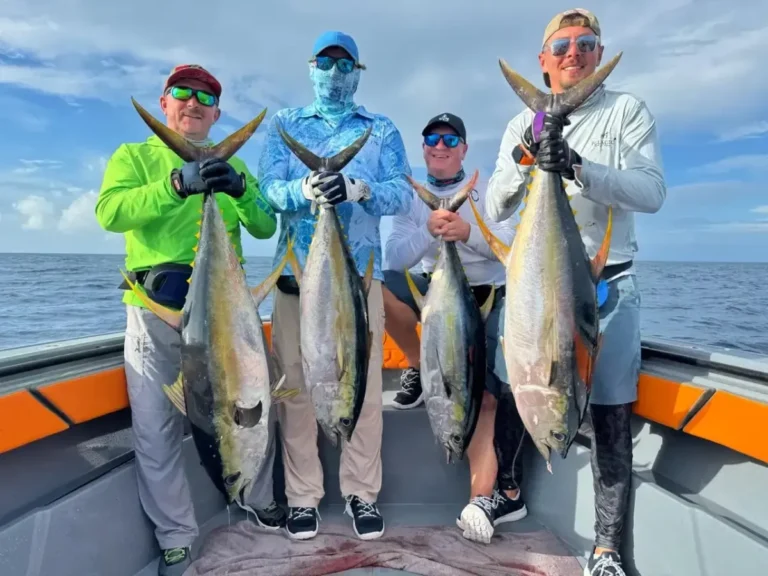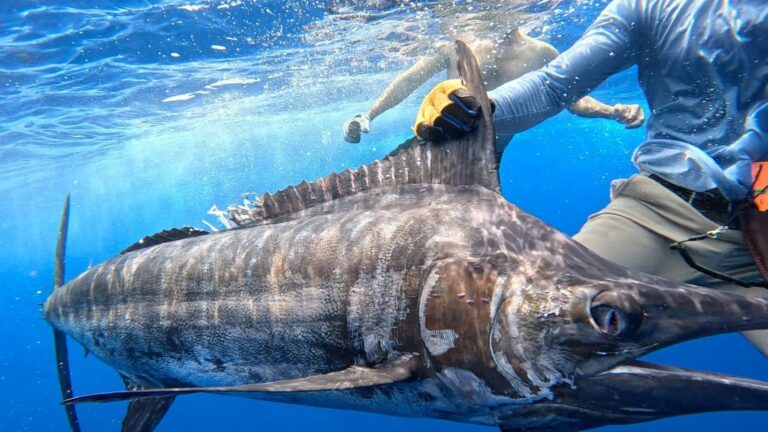


We’ve written a detailed guide for you on fishing for dogtooth tuna in the Seychelles.
First and foremost, deep-sea vertical jigging is used to catch dogtooth tuna—one of the most modern and effective methods, which works exceptionally well in the Seychelles. It allows anglers to precisely control the lure at depth and provoke aggressive strikes from the predator.
All the other tackle is selected specifically for this style of fishing.
A one-piece jigging rod rated for approximately 8 PE is considered the best choice. These rods are designed specifically for catching large fish and can withstand prolonged, powerful fights.
Several factors are important here:
• high structural strength;
• the ability to absorb powerful jolts;
• Comfort during prolonged exertion.
When it comes to reels, in most cases, top-of-the-line non-inertia reels, such as the Shimano Stella 18000 and 20000, are the preferred choice.
They are not chosen at random, as they feature a powerful and stable braking system, high reliability under extreme loads, and a capacity of at least 300 meters of durable line with a strength rating of 6–8 PE.
Although some anglers use spinning reels, these have their own characteristics and nuances that require experience.

The Cord and Its Specifications
The most common option is a Class 6 PE line. However, depending on fishing conditions, heavier-duty options—such as 8 PE—are also frequently used.
The choice depends on the fishing depth, the strength and speed of the drift, and the weight of the lures used—the more challenging the conditions, the higher the strength requirements for the entire system.
Experience shows that you often have to change your rigs while fishing, and that lures of different weights are used. It’s also important to adapt quickly to the conditions. That’s why it’s best to have at least two sets of tackle so you can adjust to the situation on the fly.
To ensure a successful fishing trip in the Seychelles—and not just when targeting dogtooth tuna—it is essential to consider the key requirements for a reel: maximum drag capacity and maximum operational stability.
We recommend that the braking load be at least 20 kg.
Brands and Approaches to Choosing Fishing Gear
When it comes to reels, we mostly use Shimano. When it comes to rods, we use Patriot Design, Ripple Fisher, and Black Hole.
In reality, however, the choice isn’t based on the brand but on performance. When it comes to heavy-duty fishing, it’s not logos that matter, but durability, balance, and reliability. That’s why we don’t distinguish between tackle “for beginners” and “for professionals.” Both beginners and experienced anglers use gear sets of equal strength.
The reason is simple—the reliability requirements are equally high; fish don’t cut you any slack based on experience, and flimsy tackle won’t hold up no matter how skilled the angler is.

The cost of a kit for catching dogtooth tuna
Good gear for catching dogtooth tuna is an investment in results.
Here’s a general guideline:
• A good reel—starting at 1,000 USD;
• fishing rod — 500–700 USD;
• Fishing lines and other accessories — starting at 300 USD.
All in all, a complete, reliable set will cost around 2,000 USD or more. It all depends on the manufacturer, the specifics of the gear, and so on.
Tackle and Rigs for Fishing Dogtooth Tuna
The classic setup uses two key connections: the first knot connects the main line to the shock leader, and the second connects the shock leader to the lure.
To connect braided line to a shock leader, we most often use the FG knot. That said, we also frequently use our own knots, which simply don’t have names.
When attaching the shock leader to the lure, you can choose from a variety of options, including the classic clinch knot and its variations, as well as custom solutions.
It is worth mentioning the so-called “Buzhuk rig”—a proprietary technique that is widely used and has proven to be extremely reliable when fishing for large fish.
A shock leader is one of the key components of the entire rig. Its role is not limited to a single function.
The main responsibilities of a shock leader:
• shock absorption when a fish strikes;
• smoothing out jerks while playing the fish;
• partial protection against abrasion from coral.
Its role is particularly important during the final stage—when the fish is being “parked” and brought on board. At this point, the tuna may make a powerful surge, and it is the shock leader that reduces the risk of the line breaking, as well as the risk of injury to the angler.
That said, it’s important to understand that even the strongest material doesn’t provide absolute protection. Contact with corals often results in snags, and that’s just part of the reality of fishing in tropical reefs.
In the vast majority of cases, we use nylon (monofilament). It has greater elasticity and good shock absorption.
Fluorocarbon is used extremely rarely. Its stiffness and low stretch make it less suitable for power fishing for dogtooth tuna, where the “spring” action of the rig is particularly important.

Length and Strength of the Shock Leader
There is no single standard here—much depends on personal preference and experience. We most often use lines with a breaking strength of 170–200 lb and a length of about 3–3.5 meters (sometimes longer).
This configuration provides good shock absorption, comfort when fishing from the boat, and additional control over the fish.
That said, there’s a downside to a long, soft shock leader—it slightly “dampens” the sharpness of the hookset. Sometimes you have to set the hook several times to get a solid hookset.
Durable Tackle for Fishing Dogtooth Tuna
Even the highest-quality tackle doesn’t offer a 100% guarantee. Fish are lost all the time, and there can be several reasons for this.
The most common of these are mistakes made while playing the fish, slack line at a critical moment, and improper technique for handling the fish.
But there are also factors beyond a person’s control:
• the fish taking the line into the coral and the shock leader breaking;
• shark attacks that could snatch the trophy;
• extremely sudden dives.
In reality, fishing gear fails less often than it seems. If you use high-quality equipment, most problems are due either to technique or to unpredictable ocean conditions.

Lures and Bait for Catching Dogtooth Tuna
Any recommendations in this section are based on our practical experience, not strict rules.
Vertical jigs are a staple lure that
There are thousands of options on the market, but in practice, medium-sized jigs work best.
Based on our observations, jigs that are too narrow and too long produce the worst results. On the other hand, lures that are too wide aren’t a one-size-fits-all solution either.
The best option:
• length: 15–16 cm, sometimes 12;
• width: about 2.5–3 cm;
• Shape: an elongated “leaf” of medium thickness.
As for weight, it’s chosen primarily based on the depth and drift speed. The weights we use most often are: 150, 200, and 250 grams.
Poppers and stickbaits are used for surface fishing, even though the dogtooth tuna is considered a deep-water fish.

How to Choose the Right Color of Lure for Dogtooth Tuna
Our main recommendation is that the color should have a silvery tint.
The most practical options:
• pure silver;
• silvery-blue;
• silvery-pink;
• pearlescent combinations.
Silver mimics the natural sheen of prey fish and is most visible in the water column. At the same time, there are periods of active feeding when dogtooth tuna will attack virtually any lure, whether in natural colors (silver, blue, green) or bright, flashy shades (pink, red, fluorescent green).
Fishing for dogtooth tuna with live bait
We use this method very rarely.
The reasons are as follows:
• a high likelihood of shark attacks;
• the complexity of the process;
• limited control over the situation;
• A high level of experience is required.
In addition, this type of fishing requires mobility—quick movements and a constant search for fish. Using live bait does not facilitate this.

How to Choose Bait for Catching Dogtooth Tuna
The main criteria to consider are depth, current speed, and drift speed. The weight and shape of the jig are selected based on these parameters.
In all other respects, the angler’s experience and “instinct” play a major role. Most often, anglers use lures that have already proven effective and in which they have confidence. Therefore, the right shape, appropriate weight, and basic color combinations yield significantly better results than endlessly trying out different options.
Tips for Catching Dogtooth Tuna
When comparing different fishing methods, fishing with live bait seems to be the most “natural” option. Live fish always seem like more attractive prey, and in certain situations, this approach really works.
However, in practice, jigging remains the primary method. Our
It has the advantage not only in terms of consistent results, but also in terms of control over the process. The angler controls the depth, retrieval speed, and behavior of the lure, which is especially important when searching for active fish.
Trolling also yields results, and sometimes it’s this method that lands truly large specimens. But it’s difficult to specifically target dogtooth tuna using this method. Unlike jigging, there’s less control and more element of chance involved.
Ultimately, it is the vertical jig that remains the fundamental technique around which the entire fishing experience is built.
The question of the correct way to work a jig is one of the most difficult. There is no one-size-fits-all answer. Over time, every angler develops their own style. Some reel in the lure faster, some slower, and some constantly change the rhythm.
However, there is one important observation to keep in mind when fishing for dogtooth tuna: a fast retrieve often yields the best results. An aggressive, fast retrieve is more likely to provoke the predator into attacking.

Operating depths for catching dogtooth tuna
It all depends on the specific location. Tuna can be found in relatively shallow areas—around 20 meters—as well as at greater depths—60–80 meters.
Thus, the operating range is most often between 20 and 80 meters. But every dive into the ocean requires adaptation—there is no one-size-fits-all depth that works every time.
The Effects of Currents and Drift
The basic principle here is extremely simple: the stronger the current, the heavier the jig should be.
Changing the line’s thickness could theoretically affect the drift, but in practice, this method is not used. Sacrificing the line’s strength for the sake of control is too great a risk when fishing for such a powerful fish.
Sometimes it’s not just the weight that matters, but also the shape of the lure. More streamlined jigs hold their vertical position better, but in most cases, the problem is solved simply by increasing the weight.
Depth and Lure Weight Selection
The logic here is simple—at depths of 20–40 meters, lighter lures are used (100–150 grams, sometimes 200 grams); as the depth increases, the weight increases (200–400 grams).
However, even at shallow depths, a heavy jig may be necessary if the boat is drifting rapidly due to wind or current. In such conditions, it is important to maintain a vertical presentation of the lure—without this, the jig loses its effectiveness.

How to Avoid Breaking Your Tackle When Fishing for Dogtooth Tuna
Most problems with fishing gear arise not because of its quality, but because of the angler’s mistakes. Even the most reliable equipment requires proper care.
The technique used to reel in the fish is crucial. The angler must constantly monitor the position of the rod, avoiding an excessive angle of tension. Keep an eye on the drag and gauge the line’s strength. Tilting the rod too far toward you is one of the most common causes of breakage.
These skills cannot be acquired through theory alone—they come only with practice.
Selecting Fishing Gear and Working with Customers on Fishing Trips
Experienced anglers usually come aboard with their own gear, which is fully tailored to their fishing style. As for tourists who simply want to try their hand at ocean fishing, there’s no need to bring anything—we have everything you need on board.
The following are included in the equipment:
• Shimano reels
• Testline braided lines
• Fishing rods ranging from Patriot Design to Black Hole
The approach here is as practical as possible: the tackle should be forgiving of mistakes—especially during the learning phase—while still having enough strength to handle trophy-sized fish.
A mandatory briefing is held before every fishing trip. Safety is the focus of this briefing. Guests are briefed on the rules of conduct on board, the location of safety equipment, how to communicate with shore, and the basics of using fishing gear. Regardless of the language spoken, this stage is given the utmost attention.
It’s worth noting that alcohol is strictly prohibited on board—this is an important part of overall safety.

What challenges do beginners face?
The main challenges are the physical exertion involved in playing the fish, the unfamiliar conditions of the open ocean, and rapid fatigue. However, fatigue is more often due to a lack of technique than to physical fitness. Incorrect movements and unnecessary strain lead to a rapid depletion of energy.
With experience comes an understanding of how to distribute the load and use your gear more effectively.
Interestingly, most beginners don’t find the process difficult. On the contrary, for them it’s a deeply emotional experience.
Mistakes Anglers Make When Fishing for Dogtooth Tuna
Even with high-quality tackle and the right lures, the outcome of your fishing trip in the Seychelles depends largely on the angler’s own actions.
The most common mistake is not setting the hook firmly enough. A dogtooth tuna’s strike is often sudden and aggressive, and if you don’t set the hook firmly and decisively at that moment, the hook simply won’t penetrate the fish’s mouth. As a result, the fish will get away within the first few seconds.
Another equally important point is keeping the line taut at all times. Even a brief slack in the line can cause you to lose contact with the fish. Dogs are known for their ability to change direction instantly, and any pause in the tension gives them a chance to break free.
The third common mistake has to do with the position of the rod. Many anglers instinctively try to “pull” the fish in, pulling the rod sharply toward themselves. This creates a critical angle of load, at which the rod blank becomes overloaded and may simply snap. Proper technique involves controlling the angle and distributing the load, rather than using brute force to “pull” the fish.

Mistakes When Handling Fishing Gear
A separate category of problems has nothing to do with technique, but rather with the preparation of the gear. Here, it’s most often the human factor that comes into play—carelessness or plain laziness.
In practice, it looks like this: the angler fails to check the condition of the shock leader after contact with a fish or coral, continues to use dull hooks, or ignores deformation of the swivels. Sometimes they use knots whose reliability is not entirely certain, or tackle that is not designed to withstand such loads.
It’s especially critical to spare no expense on the small details. Leader lines that are too thin, weak hooks, or worn-out tackle components are practically guaranteed to result in losing your catch.
When fishing for dogtooth tuna, there are no minor details—the entire system must be as reliable as possible.
What Anglers Most Often Underestimate
Even when using heavy-duty tackle, many anglers are psychologically unprepared to fish at full strength. They get the feeling that the tackle “won’t hold up,” and as a result, they consciously ease up on the fish.
This has the opposite effect. The dogtooth tuna is able to swim deeper, reach the reef, or simply put critical distance between itself and the angler. Under these conditions, the chances of successfully landing the fish drop sharply.
It’s important to understand that modern, high-quality fishing tackle is designed to withstand heavy loads. And if it’s chosen correctly, you should use it to its full potential—not “go easy on it” at the most crucial moment.

Tips for Successful Dogtooth Tuna Fishing in the Seychelles
The first thing to consider is choosing the right crew and boat. Fishing in the Seychelles depends directly on the captain’s experience, knowledge of the fishing spots, and ability to adapt to ocean conditions. That’s why fishing with a professional crew, such as Boombastic, significantly increases your chances of success.
The second important point is the tackle. Dogtooth tuna leaves no room for compromise, and any weak links in the system will sooner or later become apparent. That is precisely why the highest-quality and most reliable tackle sets are always preferred. If possible, it’s best to use your own gear, since even when well-maintained, rented equipment is under constant strain and loses some of its reliability over time.
It is equally important to monitor the condition of all your gear. Before each fishing trip, you must carefully check your knots, the condition of your shock leader, the sharpness and strength of your hooks, and the reliability of all your tackle. When fishing in the ocean, even a minor defect can result in losing a fish.
Another key factor is discipline during the actual fishing. Dogtooth tuna require precise and confident actions: a powerful hookset, constant control of line tension, and proper rod handling. Any mistake, even a brief one, can cost you the catch.
Finally, it’s important to understand that this type of fishing requires both physical and mental preparedness. It’s not a matter of passively waiting for a bite, but rather active work where success comes through effort, concentration, and experience.

The Most Memorable Dogtooth Tuna Catch by Boombastic Guests
Around March 2025, one of our guests headed out into the ocean with the lightest possible tackle—almost “unconventional” by the standards of this type of fishing.
The rod had a test rating of up to 200 grams, a thin PE-3 line, a jig weighing about 150 grams, and, essentially, a very light hook—the kind you’d typically find used for freshwater crucian carp rather than for hunting large ocean predators. But it was with this very setup that he managed to catch a dogtooth tuna.
According to the team’s estimates, the trophy clearly weighed over 50 kilograms—and possibly as much as 70—although no one actually weighed it; it was one of those situations where the process itself was more important than the numbers.
The fight with the fish turned out to be a long and intense one. Practically our entire team took part in reeling it in. Our guest would periodically pass the rod to someone else, then take it back into his own hands, move around the boat, and react to every movement of the fish—and the whole scene felt more like a lively, almost chaotic performance on the water.
It’s important to note, however, that even though the process appeared spontaneous, the team was in complete control of the situation and guided the fish step by step toward the finish. At some point, no one was quite sure what exactly was on the hook, given how powerfully and unpredictably the fish was behaving deep underwater.
In the end, we managed to haul in the dogtooth tuna and successfully “stow” it alongside the boat. We haven’t encountered any other situations quite like this to date.