

It’s commonly believed that to catch serious fish in the Seychelles, you have to go far out to atolls like Cosmo Ledo or Farkuar, which take several days to reach by boat or charter flight. In this view of the world, Mahé remains the island of the airport and the capital, where fishing is, at best, a pastime on a day off between beach hotels and dinner.
Fishing on Mahé. In reality, Mahé sits on a shallow granite slab the size of a small European country. Its drop-offs, banks, and deeps begin almost immediately beyond the marina, and in a single day here you can catch more than twenty species of predators, ranging from bottom-dwelling groups to marlins.
Below, we’ll break down which species inhabit the waters around the main islands, at what depths to look for them, what gear to bring, and which months to visit so your fishing trip ends with a trophy catch rather than just a stroll along Bo-Valon Beach.
Platon Maé: Why the Trophies Are Next to the Pier
Mahe, Praslin, La Digue, and several dozen other granite islands rise from the Seychelles Bank, an underwater plateau covering an area of approximately 31,000 km². Almost the entire bank lies within the 100-sazhen isobath—that is, at a depth of less than 180 meters—and slopes down toward the open ocean at its edges. Geologically, it is a fragment of a continent that broke away from India about 66 million years ago; therefore, rather than a sandy desert, the terrain here features underwater cliffs, plateaus, slopes, and deep waters.
For an angler, this means one simple thing: the prime fishing spots are accessible in half an hour, not three hours. Around the surrounding islands, there are spots to cast toward the rocks; on the slopes and in the pits, anglers fish with vertical jigs, while closer to the edge of the plateau, they target pelagic predators. There are so many promising spots that the main challenge isn’t finding fish at all, but choosing the right approach for a specific day and wind conditions.
This is Maé’s main advantage over the more distant islands. In the morning, the boat sets out for any destination almost immediately; in the evening, the angler returns to shore—to a villa with air conditioning, cell service, and dinner—rather than to the deck of a catamaran at the mercy of the ocean.

Groupers: Heavyweights from the Seabed
More than ten species of grouper inhabit the waters around Seychelles, and almost all of them stay in areas where the seabed topography is more complex: near underwater rocks, on slopes, and in the gaps between shoals. Just off the coast of Mahe, there are actually about six different species, ranging from small, spotted ones to well-known specimens that, after taking the bait, dart into the rocks and test the strength of the main line, the leader, and the angler’s back.
Fishing on Maé. The most striking of the local groupers is the moon-tailed or yellowtail snapper (Variola louti), with a bright red body and a yellow border on its crescent-shaped tail. It is often confused with the coral trout, which is also found here and also bites on jigs.
With groupers, the first few seconds are crucial. The fish takes the bait near the bottom and immediately tries to hide in cover, so the angler must bring it to a sudden stop within the first few meters of the retrieve. This is exactly where powerful PE 8–10 lines and sturdy leaders come in handy: with lighter tackle, the fish often get snagged on rocks rather than ending up on the deck.
Where to look:
- Slopes and ridges in the 35–120-meter range, where the stepped plateau descends.
- Underwater rocks and isolated boulders that are clearly visible on the fish finder.
- Pits between shoals where fish gather in strong currents.

Fishing on Maé: The Giant Carangid and Its Relatives
Giant Caranx (Caranx ignobilis ), which anglers simply call the GT, is considered the symbol of Seychelles fishing. Its fame is well-deserved: this fish attacks a surface popper with such force that the sound of the strike can be heard across the entire deck, and after taking the bait, it charges headlong toward the nearest reef.
On the outer atolls, where fishing pressure is minimal, GTs typically weigh 30–50 kg; they move farther out and grow larger. Off Mahe, the average size is more modest, but caranks are present here, and it’s actually possible to catch four different species of this fish in a single fishing trip. In addition to GT, the waters around the main islands are home to blue trevally (with blue fins), golden trevally, yellow-spotted trevally, and big-eyed (big-eyed trevally).
There are two methods for catching trevally: casting poppers and stickbaits near rocks and reef edges, or vertical jigging over drop-offs. Everything depends on the fish’s activity on a given day. If things are quiet around the rocks, it’s wiser not to waste hours on fruitless casts, but to head down the ladder, where the trevally hang out with groupers and jobfish.

Jobfish and "bourgeois": the most sought-after fish on the plateau
If the schools put on a spectacular, high-energy display—a “carangid” spectacle—then the jobfish and snappers will be the best catch, gastronomically speaking. It is these fish that the Seychellois value most at the table, and it is on them that the local handline fishery depends.
Green jobfish (green jobfish,Aprion virescens), known as “Zob Gri” in Creole, is a fast-swimming pelagic predator with an elongated body and a powerful tail. It doesn’t tend to stay in one spot, but there are so many of them in the Seychelles that a double or even a triple strike comes as no surprise. Along with it, other jobfish that inhabit deeper waters are targeted with jigs, so up to three species are caught just off the coast of Mahe.
Red Emperor snapper (Emperor snapper,Lutjanus sebae) is called “Burzwa,” meaning “bourgeois,” by Seychellois fishermen. This is not a nickname, but its official Creole name, under which the fish is listed in local documents.
The “bourgeois” is easily recognizable by the bright red and white stripes on young fish and the deep pink-red coloration of adults. It is one of the most beautiful fish in the Indian Ocean, and anglers appreciate it just as much for its appearance as for its taste. In addition to the “bourgeois,” several other species of snapper are caught off Mahe, usually at the same reefs where they gather in schools.

Dogtuz and Other Tuna Species
Dogtuz (kilozuby tuna,Gymnosarda unicolor) is the predator that draws many anglers to the Indian Ocean. It gets its name from a row of large, conical teeth, which are atypical for tuna. According to FishBase, this species can reach 130 kg or more, but what matters most is not its weight but its temperament: the dogtooth tuna strikes near the drop-off and immediately dives down toward the rocks, where it will fray the line if the angler gives it even a little slack.
There are two ways to catch dogtuz. The first is fast vertical jigging with lures weighing 200–400 g along the edge of the drop-off, because this fish simply ignores slowly moving lures. The second is slow trolling with large wobblers along the edge of the drop-off. Both methods require powerful tackle and an experienced captain who can keep the boat over the right spot despite wind and current.
In addition to dogtooth tuna, two or three other species of tuna are caught behind the train off Maé. Yellowfin tuna (yellowfin tuna) rise to the surface to feed on baitfish and are easily caught by casting and jigging. Striped tuna (jumper) and bonito stay near flocks of seabirds, and this is a spot that beginners often overlook.
Birds over the water are a sign of fish, but off the coast of Ma’e, it’s usually small skipjack and bonito circling beneath them. If you’re after a trophy catch, it’s better to head out to deeper water and search for fish with a fish finder than to spend half the day casting lures into shallow waters.

Wahoo, corvina, and barracuda
These three predators are rarely the main target of a fishing trip, but they almost always take notice of the catch when the boat is traveling between spots or setting trolling lures along the edge of the plateau.
Whoever happens to be in the way:
- Wahu(vahu), also known in the Seychelles as the kingfish, is one of the fastest predators in the ocean. It attacks trolling lures at high speed and, after striking, makes a sudden dash that literally makes the reel screech. It’s best caught during the transitional months, when current lines bend along the drop-offs.
- The corifena(dorado, mahi-mahi) stays near floating debris, seaweed, and any objects on the surface. It’s beautiful, a strong jumper, and takes to light bait well.
- Barracudacan be found both near reefs and in open water; it attacks fast-moving lures and keeps the angler on their toes even with medium-sized lures.
When trolling off Mahe, these species can be caught on any given day, so it’s a good idea to keep gear for them on board, even if your main plan is to jig. A wahoo caught on the way to a jigging spot usually turns out to be the fastest fish of the day.

Marlin and the Sailboat: A Big Game on the Main Islands
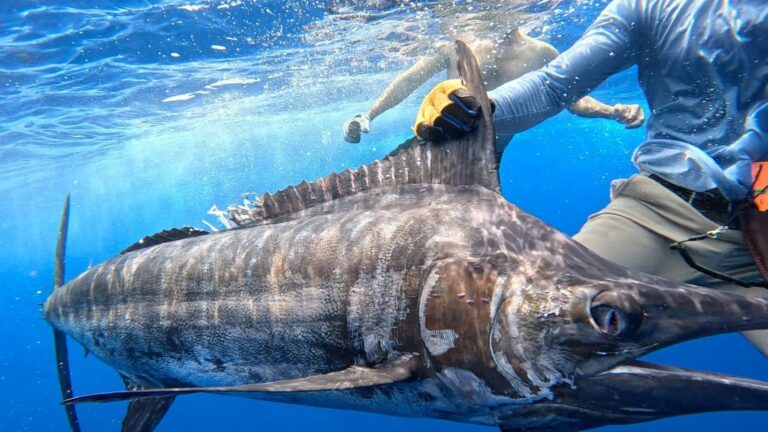
Off the coast of Mahe, you can also organize a classic big-game fishing expedition. Blue marlin, black marlin, and Indo-Pacific sailfish (sailfish) have migrated to the edge of the Seychelles Bank, and they can be caught here not only from large trolling yachts but also from a well-equipped open boat equipped with outriggers.
The sailfish season in the Seychelles lasts roughly from December through March, peaking in January and February, when the northwest monsoon brings warm waters rich in forage fish to areas south and southwest of Mahe. Marlin are caught during the same period, but trips to target them are not dependent on weather or sea conditions.
At one of the tournaments in Mahé, the crew of an open 37-foot motorboat took first place with two marlins, beating the team on yachts ranging from a quarter to 65 feet in length.
This result clearly illustrates the local situation. In the Seychelles, the size of the yacht determines comfort, while the catch depends on the captain’s expertise, experience, and time spent on the water.

The Wind Decides: Maé's Seasons and Monsoons
The weather in the Seychelles is dictated by the winds, and they determine where and how you’ll be able to fish on any given day.
How the year is structured:
- The northwest monsoonlasts from about November through March. During this time, it’s warmer and rains more often, but the sea is usually calmer. This is prime time for sailfish, marlin, and pelagic predators; the western coasts of the inner islands are well sheltered during this period.
- The Southeast Trade Windsblow from about May through September. The weather is dry and cooler, but windy. The eastern coast of Mahé experiences swells during this time, while the western coast remains sheltered.
- Transitional months—April and October–November—offer stable, reliable conditions. One wind has already died down, while the other has not yet picked up strength, and more often than not, this allows access to any destination.
Even during the season, a single windy day can throw a wrench in your plans. With winds of 10 knots and waves of one and a half meters, the fishing area narrows dramatically, and you end up with the boat reaching places you can walk to, while the fish are in spots that are hard to fish. On days like these, the captain’s experience, daily monitoring of the forecast, and willingness to change course are what make the difference.
The timing of the monsoon shift is also unpredictable. In recent years, the southeast monsoon has been arriving in the Indian Ocean as early as the beginning of May—earlier than usual—and we’ve had to adjust our fishing plans on the fly. Under such conditions, an experienced captain near Maé steers the boats under the cover of the islands, ensuring no fishing days are lost.

Tackle and Lures That Work in Maé
The main fishing method on the main island is vertical jigging. Effective depths range from 35 to 120 meters, and there are no typical spots here: you have to scan large areas with a fish finder rather than simply heading to a familiar shoal. It takes more time to find the fish, but this type of fishing pays off.
The best day of a recent fishing trip ended with 72 fish on board a single boat. For the three anglers, that was more than enough to keep them going until evening.
What to bring:
- Jigs weighing 150–300 g.The silver color consistently performs better than the others for Maé; this has been proven across various species.
- Lures with glittering particles.Colored octopus lures with glow-in-the-dark inserts appeal to everyone, from groupers to tuna. Their downside is that the silicone tears easily and slips off. A more reliable option is lurex secured with mounting thread and epoxy resin, featuring UV-reflective and light-storing elements. Anglers who know how to tie fly fishing flies also make these lures themselves.
- Two classes of fishing gear.Heavy-duty PE 8–10 nets for groups, dogtuz fishing, and fishing near rocks, and lightweight PE 3–5 nets for areas where the fish are wary and heavy gear only gets in the way.
- Heavy-duty holdersup to 300 pounds for bottom fishing.
- Poppers and stickbaitsfor casting at rock-dwelling karankas.
For this kind of fishing, you need more than just a boat—you need a properly equipped boat, such as a Boombastic. The open deck provides space for three anglers with jig rods, and the powerful motors allow you to move quickly between spots, while the outriggers and trolling gear transform the same boat into a big-game platform if a marlin appears on the horizon. Today, you can find almost everything you need for saltwater fishing at the local tackle shop on Mahe, but the prices there are quite Seychelles-style, so it’s best to bring your basic gear with you.
Contact us in any way that’s convenient for you, and we’ll take care of everything to organize and guide you through your best fishing trip in the Seychelles.