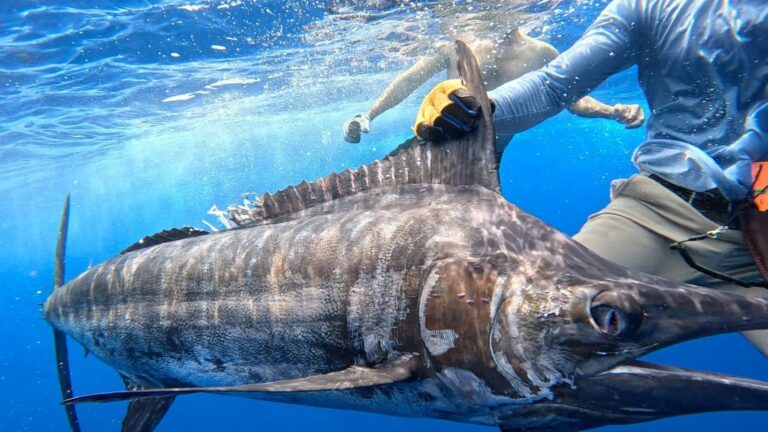


We’ve written a detailed guide for you on fishing for marlin and sailfish in the Seychelles.
There are trophies that anglers are willing to fly a thousand kilometers from home to catch. Marlin and sailfish fall into this very category. It’s not just about catching big fish; it’s a battle lasting many hours against a coveted trophy, as it pulls, circles, leaps out of the water, and at some point, you no longer know who’s catching whom.
In this article, we’ll tell you where to find marlin and sailfish in the Seychelles, during which months their peak season begins, what tackle and fishing techniques work best, and why you should go on this fishing trip with the Boombastic Tours team.
What are marlins and sailfish?
Three species of marlin—blue, black, and striped—are found in the Seychelles year-round. The striped marlin is the rarest of the three. It’s easy to tell them apart: the black marlin has stiff pectoral fins that do not lie flat against its body, while those of the blue marlin lie flat; the striped marlin has a dark blue or black back, silvery sides with a blue sheen, and a white belly.
The most distinctive feature of the striped marlin is the 12–20 distinct bluish vertical stripes running along the sides of its body.
Note: Marlin (Latin: Makaira) is a genus of ray-finned fish in the family Istiophoridae. They are found in the tropical and subtropical zones of all oceans. They inhabit coastal waters or the open ocean. They are pelagic fish. They feed on squid and large fish. Marlin are known to be capable of swimming very fast, reaching speeds of up to 110 km/h.

When it comes to the weight of marlin species, in the Seychelles this fish is most commonly caught weighing around 200 kilograms: Specimens weighing 100–150 kilograms are the most active; those over 150 kilograms are caught less frequently; and giant marlins weighing more than 200 kilograms are considered rare trophies.
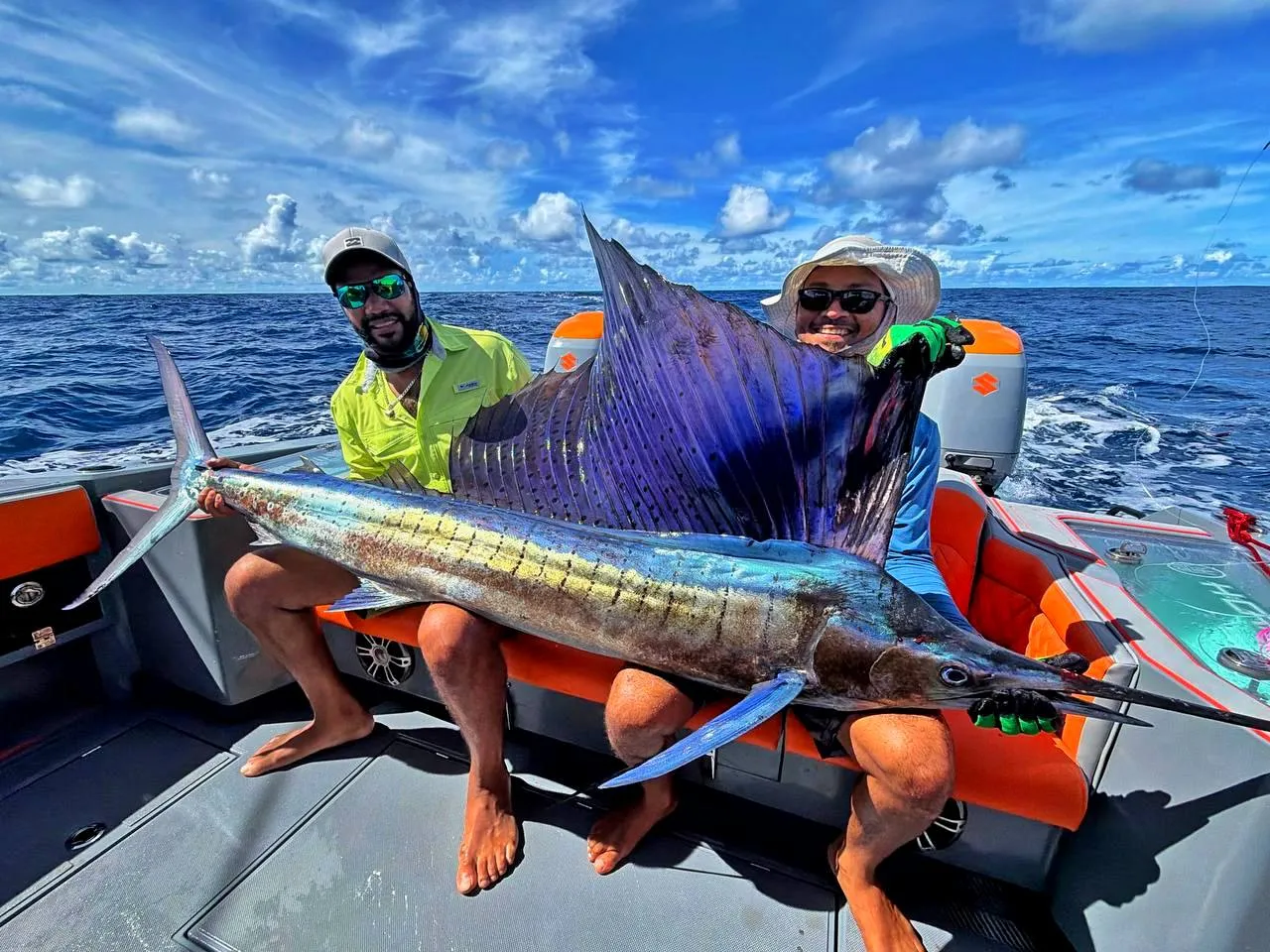
The sailfish is a source of particular pride for the islands; it even appears on their coat of arms. It’s easy to spot thanks to its huge dorsal fin, which looks like a sail. But as soon as you hook it, the fish immediately leaps out of the water, twists in midair, and darts off to the side, as if testing your resolve.
Note: The sailfish (Latin: Istiophorus platypterus) is a species of marine ray-finned fish in the marlin family, the sole member of the genus Istiophorus, and the fastest-swimming fish in the world. It inhabits the tropical, subtropical, and temperate waters of all oceans.
Marlin and sailfish, like tuna (tuna), wahoo (Latin: Acanthocybium solandri), and many other species of fish, are pelagic fish—that is, fish that inhabit the water column, far from the seafloor and coastal areas, in the so-called pelagic zone of oceans, seas, or large lakes.
The word “pelagic” itself comes from the Greek πέλαγος, meaning “open sea.” Unlike bottom-dwelling fish (which live on the seafloor) and reef fish (associated with coastal ecosystems), pelagic species are adapted to life in open water.

When to Go Hunting for a Trophy
Fishing around Mahe Island is divided into zones based on distance from the shore. The nearest group of islands is a calm option for a family outing and a chance to learn local fishing techniques. Further out lies the Drop Off—the edge of an underwater plateau about 40 miles from Mahe, where the seafloor drops sharply.
It is right here that the plateau gives way to a drop-off, and a large predator approaches the drop-off—this is the classic habitat of the marlin.
For those willing to venture even further, the Outer Islands (remote atolls) await—85 miles or more away. There are fewer tourists, more untouched fish, and a much higher chance of landing a truly massive catch. For these multi-day trips, it’s more convenient to live right on the water—for example, aboard a Lagoon 62 or Bali 58 catamaran—while doing the actual fishing from the more maneuverable Boombastic boats.
How to Catch Marlin and Sailfish: Fishing in the Seychelles
The main technique is trolling. The boat moves slowly, with lures trailing behind it on the surface. This technique is particularly effective in rough weather. The goal of this technique is to mimic the movement of prey and trigger the fish’s predatory instinct.
The second most effective method is fishing with live bait; it often comes in handy when the fish are finicky and won’t bite on artificial lures.
For trolling for billfish* heavy-duty rods rated for 100–150 lb line and multiplier reels with plenty of line capacity are typically used—a marlin can pull more than a hundred meters of line off the reel in a single run.
*Billfish—often translated into Russian as “spearfish”—is a term that refers to a group of large, predatory marine fish. They are easily recognized by their elongated, pointed upper jaw, sometimes called a “beak,” “rostrum,” or “bill.” They use this feature to hunt: they strike their prey with it in a flash to stun it.
The term “billfish” refers to members of two families:
- Istiophoridae — this family includes sailfish, marlins, and spearfish (for example, the Atlantic blue marlin, the black marlin, and the longfin spearfish).
- Xiphiidae is the only extant family represented by the swordfish (Xiphias gladius). Its bill is flat and sword-like, whereas in other billfish it is more rounded and spear-like.
Occasionally, something unusual happens, and a marlin is caught using much lighter tackle. But that’s more the exception than the rule. Our team once landed a black marlin that way, and that’s a story worth telling on its own.
On our Marlin Special Tours, we focus exclusively on catching marlin, without switching to other species. It is precisely this approach that allows our team and guests to achieve a success rate of nearly 90% on trips targeting this trophy fish.
Two Cases from Our Experience
One story took place in early April. Two boats—the Boombastic 1 and the Boombastic 2—set out to sea together with a group of 12 guests. Within the first couple of hours, the Boombastic 1 brought three marlins on board in a row—one after another. By evening, the day’s tally stood at 16 marlin strikes across both boats (9 of which were recorded as catches, while 7 fights ended in the marlin’s favor). This was an unprecedented result in the company’s history.
The second story is about jigging and a black marlin measuring 244 centimeters. It happened during a friendly tournament: the fish was landed from a depth of 46 meters using tackle rated up to 8 PE and a 6 PE line. The guest landed the marlin single-handedly—an extremely rare occurrence for this fishing technique. A 238-centimeter sailfish also made it onto the leaderboard for that same tournament.
Days like these don’t happen every time. But they really show what these waters are capable of—and what the team working in them is capable of.
Bycatch During Marlin Fishing
Marlin and sailfish rarely appear alone. Yellowfin and dogtooth tuna, wahoo, and corifena are often caught on the same tackle. So even if the marlin decides not to show up that day, you certainly won’t go home empty-handed.
Do you need a license to fish in the Seychelles?
Tourists do not need a separate license for recreational fishing—the boat operator handles the permit. However, the following are prohibited everywhere and at all times: fish spears, explosives, and any chemicals used to stun fish. You may cook and eat your catch, but you may not sell it.
Many operators in the region practice “catch and release” for large billfish: they photograph marlin and sailfish and then release them, preserving the population for future anglers. This is a long-standing tradition among the captains of the archipelago, and we share it.

How much does this kind of fishing cost?
Prices for deep-sea fishing in Seychelles waters vary quite widely and depend primarily on the type and size of the boat, as well as the distance to the fishing spot and the boat’s equipment.
A short trip within the nearshore zone will cost less than a full day of marlin fishing at the Drop Off, let alone a multi-day expedition to the Outer Islands with accommodations on a catamaran. We always calculate the exact cost for your specific trip on a case-by-case basis—it depends on the dates, group size, the boat you choose, and other details.
Contact us, and we’ll find the best fishing tour in the Seychelles for you.
Why Do People Choose Boombastic Tours for Marlin Fishing?
Our captains constantly monitor conditions at sea, and what sets their work apart is that they decide to go out in search of marlin or other species of fish only when it will actually be effective. Fishing in the Seychelles.
Boombastic Tours doesn’t make empty promises to its guests or leave things to chance; instead, it develops a well-thought-out fishing strategy for every trip, drawing on our captains’ many years of experience.
Boombastic boats have a cruising speed of 30–32 knots and can reach a top speed of 55 knots—which means the trip to distant destinations like Drop Off and the Outer Islands doesn’t waste any daylight.
Marlin and sailfish—these are the catches that truly make it worth flying to this corner of the Indian Ocean. Everything else—the season, knowledge of the fishing spots, and an experienced crew on board—determines whether this fishing trip will be just good or whether it will become one of your fondest memories.
The BoombasticTours team organizes fishing tours for all skill levels—from a first taste of big-game fishing to serious fishing in the Outer Islands. Email us—and we’ll try to help you set your personal record.