

Many people imagine fishing in the Maldives as just a couple of trips out from a resort island. In the morning, the hotel’s boat heads out for some trolling, returns around lunchtime, and the rest of the vacation is spent by the pool. For those who came specifically for the fishing, that’s not enough.
Now let’s take a look at how Boombastic Tours typically organizes a fishing safari in the Maldives: how it all works and what you can catch north of Malé.
The Maldives stretch from north to south for nearly a thousand kilometers. It’s a double chain of 26 atolls and more than a thousand islands, with fish distributed along its entire length. From a single resort island, a boat typically operates within a 30–45-minute radius, but on a safari, the yacht moves to a new location every evening, and in the morning, the tenders head out to the reefs where no one has cast a line before you.
In this article, we’ll describe what a typical week is like on a fishing yacht north of Malé: where the anglers stay, what kind of boats they use to reach the reefs, how a typical day unfolds from dawn until night fishing at the stern, what’s served for dinner, and what gear to bring along.

Why Go Fishing from a Yacht in the Maldives?
The Maldivian atolls have formed on coral shoals and stretch in a long chain across the equator. Reefs, straits, and drop-offs are everywhere here, but the fish aren’t concentrated in a few well-known spots—they’re scattered over hundreds of kilometers. To find a large snapper or a school of tuna, the boat has to cover a lot of ground and try new spots every day.
You can’t do that from a resort island. The boat leaves in the morning and has to return by evening, so anglers spend the week fishing the same reefs around the hotel. A yacht solves this problem on its own. At night, it sails to the next atoll; in the morning, the tenders depart from it to go fishing, and over the course of a week, you’ll see dozens of reefs instead of just five or six.
There’s also a practical reason. Hotel boats mostly use trolling, whereas on a safari you can tailor the fishing experience to exactly what anglers fly to the Maldives for with their spinning rods: popping, stickbaits, and vertical jigging.

A Yacht as a Floating Hotel
For the duration of a week-long safari, the yacht becomes your home. A good fishing yacht in the Maldives is designed so that, after eight hours on the water, everyone has their own space and some quiet time.
Each angler has a private cabin with two beds, air conditioning, a fan, a closet, and a private bathroom with a shower. There are plenty of outlets, which is important because you’ll need to charge your phones, cameras, fishfinder batteries, and flashlights. The saloon features a large communal table, sofas along the walls, TVs, and a bar counter. Everyone gathers here in the evening to discuss who caught what and which lures worked best.
On the upper deck, there are lounge chairs for relaxing and sunbathing, and at the stern, there’s a large area where you can fish directly from the yacht in the evening and at night. There are also separate relaxation areas in the bow.
There is a chef on board. He usually cooks Asian-style, but is happy to tone down the spices if guests ask. Lunch includes fresh soup, beef and chicken dishes, vegetable salads, and fruit, and fresh fish from the day’s catch is served almost every day. It’s best to order fruit and ice cream in advance; when it’s hot, ice cream quickly becomes the most popular dessert on board.
This format is also suitable for those traveling with family or friends who don’t fish. While some are out on the boats, others relax on the upper deck, snorkel near the reef, or stroll along the beach of an uninhabited island.
Two boats and a crew

Fishing takes place on a safari from separate boats that travel alongside the yacht. In our example, there are two of them. The first is 31 feet long with a 300-horsepower engine; the second, the flagship, is 44 feet long with a 600-horsepower engine. Each can accommodate up to seven anglers and is crewed by a captain and two assistants.
Everyone on this team has their own role. The captain locates the fish, navigates the boat to the spot, and advises where and when to cast. The assistants support the anglers while they’re playing their catch, replace broken lures, help haul the fish alongside, and handle dozens of small tasks that anglers, caught up in the excitement, have neither the time nor the free hands to do.
They fish from the boats using spinning rods and jigs, without trolling. This is a deliberate choice of fishing style. With a spinning rod, you can see the bite and feel it in your hands—and for those who travel to the Maldives with their own gear, that’s the whole point of the trip.
A Morning at the Audition
A day on a safari starts early. Around 6:00 a.m., the boats leave the yacht for the reefs. Morning is the most productive time in the Maldives. It’s still cool, a light breeze is blowing, and the fish are active. The best fishing lasts until about noon.
The main techniques during these hours are popping and fishing with stickbaits along the reef edge and on the shoals. In the early days, the trevally caught are usually small but abundant. The farther the yacht travels from Malé, the larger the fish become. Near densely populated atolls, competition for the fish is higher, while on remote reefs, the catches are noticeably larger.
On those same morning trips to the reefs, you’ll catch groupers, snappers, green jobfish (known locally as aprions), spiny-tailed trevally, and barracuda. Sometimes bonito come to the surface, chasing fry. Catching them isn’t easy. The fish are fast, their runs are short, and it’s not uncommon to get just one strike for every ten casts.
We’ve covered in detail which lures to use for giant trevally and how to work them in our article “Lures for GT in the Maldives.”

A Day on a Deserted Island: A Fishing Safari in the Maldives
By noon, the sun is high in the sky, the fish head deeper into the water, and the fishing slows down. The boats return to the yacht for lunch, and it’s time to relax.
In the afternoon, it’s nice to take a trip to a nearby uninhabited island, go snorkeling near the reef, or simply relax in the shade. There aren’t many uninhabited islands without hotels left in the Maldives, and a stroll along an empty white-sand beach has also become part of the trip. For those who can’t sit still for long without a fishing rod, a light spinning rod with small wobblers and jigs works well from the shore.
Evening Jigging and Tuna Cauldrons
Toward evening, you can head out onto the water again. This is a short trip using light tackle or a jig.
Vertical jigging in the Maldives works at depths ranging from 30 to 250 meters. It’s a distinct technique with its own gear and lures, and for those who’ve never fished this way before, it’s best to start with casting and only then move on to deep jigging.
On evening trips, the boat sometimes comes across schools of yellowfin tuna when the school is feeding near the surface and the water around them is churning. Such trips are rarely planned. More often, they’re spotted by birds, and then the captain drops everything and turns the boat toward the school. We’ve covered how to find large tuna and what to use to catch them in the article “Fishing in the Maldives: How to Catch a Huge Yellowfin Tuna Here.”

A Night at the Stern
When it gets dark, the fishing moves to the yacht. A bright light is turned on at the stern, and after a while, life begins to gather within its beam. First comes the plankton, followed by fry, and then the predators. Squid, sargan, small barracudas, and carangids.
Squid are caught using a silver shrimp lure, while sarganas and small barracudas are caught right there using a light spinning rod. Sometimes an entire school of tuna approaches the stern, feeding on plankton in the light of the lanterns. In such cases, anglers use small jigs, and the fishing session can last until morning. Sometimes the Maldivian crew joins the anglers at the stern; for the locals, night fishing from a boat is a familiar practice.
At night, Maldivian fishermen traditionally fish with hand lines from a “doni,” a wooden boat that has been used for fishing here for centuries. You can try this method from the yacht as well, if you ask the crew to show you how.
What's for dinner, and what's off the menu
On a safari, there’s almost always fresh fish to eat, but you need to choose what to take wisely. Reef predators can accumulate ciguatoxin. According to Health Canada, the most common cases of poisoning occur after eating barracuda, groupers, and snappers, and the risk is higher for fish weighing more than three kilograms. The toxin is not destroyed by cooking, freezing, or smoking.
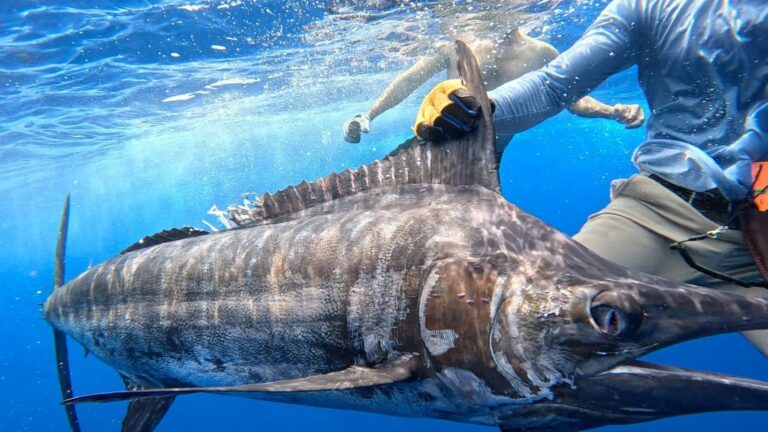
That’s why smaller groupers and tuna are usually brought back to the kitchen. The chef prepares lunches and dinners from the smaller groupers, while fresh yellowfin tuna is used for sashimi and steaks. Large barracudas and giant snappers are photographed alongside the boat and then released.
Four sets of fishing gear
A week-long safari involves different types of fishing, so you’ll need more gear than you would for a typical trip. It’s most convenient to pack four sets.
Main casting rod.An 8–9-foot popping rod with a test rating of up to 150 g. The reel should hold at least 300 m of PE 6 line, have a drag rating of 25 kg, and a gear ratio of 5.4 or higher. In current product lines, the Shimano Stella SW 10000 HG and 14000 XG or the Daiwa Saltiga 10000-H and 14000-XH meet these requirements. Lures weighing 100–150 g, poppers, and stickbaits for garfish near the reef edge.
Auxiliary casting.A 7.1–8.6-foot saltwater rod with a test rating of up to 120 g, paired with an 8000-size reel, such as the Shimano Stella SW, Twin Power SW, or Daiwa Saltiga 8000-H. PE line 3.5–4 and a 100 lb shock leader. This setup is used with sinking saltwater wobblers up to 120 mm and weighing 30–60 g, cicada lures, casting jigs, and small poppers. It’s useful for bonito, tuna, and smaller reef predators.
Light spinning tackle.Small wobblers up to 100 mm, jigs imitating worms and crabs, and squid lures. This setup is used for fishing from the beach of an uninhabited island, from a boat near a reef, and in the evening from the stern of a yacht.
Vertical jigging.A jigging rod for a non-inertia reel, 5.5–6.5 feet long with a test of 150–180 g. Jigs 100–150 mm long and weighing 80–150 g, plus an inchiku. You’ll need at least ten lures to cover both fast and slow retrieves.
You can go on a safari north of Malé almost year-round, but the weather changes with the monsoons. From May through November, the southwestern Hulhangu monsoon brings rain and wind, and trips out to the open water during this time depend on the weather. From January through March, during the Iruvai (Iruvai) dry season, the sea is usually calmer.
If you’re choosing between the two options, a fishing safari offers something a resort can’t: new reefs every day, morning casting, evening jigging, and night fishing from the stern—all without having to leave your cabin for more than a couple of steps. It’s easier to find the right yacht, boats with experienced captains, a season-appropriate itinerary, and gear suited to the fish you’re targeting when you work with those who organize these trips every year.
Contact us in any way that’s convenient for you, and the Boombastic Tours team will take care of all the arrangements and support for your best fishing safari in the Maldives and other locations.