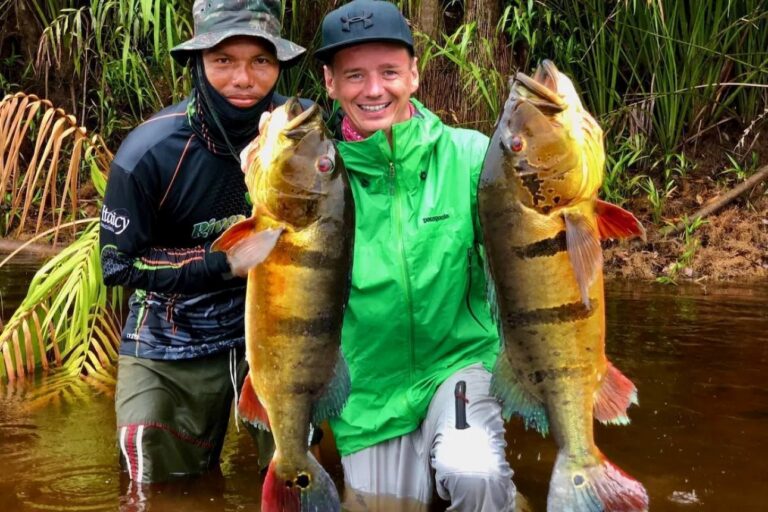


For decades, Brazilian anglers have debated whether there are two species or just one of giant perch in the Amazon’s rivers. The spotted “paca” and the golden-striped “asu” look so different that they could easily be mistaken for different fish. Scientists have settled the debate: they are one and the same fish, just in different seasons.
When it comes to peacock bass in Brazil, things are generally more complicated than they seem. It’s not just one fish, but an entire genus comprising about fifteen species, and only one of them qualifies as a world-class trophy.
We’ve figured out who’s who among the tukunares, how this predator lives, and in which Brazilian rivers to look for truly large specimens.
Why “peacock” and why “tucunaré”?
The peacock bass belongs to the genus Cichla in the cichlid family—it is not related to the bass we catch at home. English-speaking anglers call it “peacock bass,” while Spanish-speaking anglers call it “pavón,” meaning “peacock.” The reason is a dark spot within a light ring at the base of its tail. It resembles an “eye” on a peacock’s tail.
It is not known for certain why this fish has this eye. One theory is that it confuses predators and piranhas—which readily bite off fins—so that they attack the tail instead of the head.
The Brazilian name “tucunaré” (Portuguese: tucunaré) comes from the Tupi language and means “friend of the tree.” The name says it all: the fish likes to stay near submerged trees and snags.
Another important point: the peacock bass cannot tolerate cold temperatures, and water temperatures below 15 °C can be fatal to it; therefore, in the wild, cold temperatures limit its range to warm waters.

How many species of tukunare are there?
In 2006, ichthyologists conducted a review of the genus and identified 15 species. Most of them were described at that time—prior to that, many of these fish had simply not been distinguished from one another. In 2020, a sixteenth species was added to the list, discovered in Guyana and Venezuela.
For an angler, five or six species are important. But when it comes to trophy fishing, just one will do.
Tukunare-asu — the main trophy
The Tucunaré-asu (Cichla temensis) is the largest and strongest member of the genus. It can grow up to one meter in length and weigh about 13 kg. It is found in the Rio Negro and Orinoco basins, as well as in several blackwater rivers of the central Amazon.
It is specifically for the asu that anglers from all over the world fly to Manaus, and then travel several more hours by seaplane or boat to reach the spot.
Borboleta, Popoka, and the rest
Other species are noticeably smaller, but each has its own range and characteristics.
In the state of Amazonas, recreational and sport fishermen are not allowed to keep any tukunare—it’s catch-and-release only. Three species—asu, vasoleri, and pinima—are also off-limits to commercial fishing. We covered this in more detail in our article on fishing regulations in Brazil.

Paka or Asu: One Fish, Two Looks
Let’s return to the debate we started with. Brazilian anglers called the spotted perch “paca” and the striped perch “asu.” Many were convinced that these were different species.
In 2012, researchers compared the body shape, genetics, and reproductive organ condition of fish with different colorations. They found no differences among them. However, they did find a clear correlation: the closer a fish is to spawning, the fewer spots it has.
How the color changes:
- Outside the spawning season, it is a dark fish densely covered with light specks: this is a “paka”;
- Before spawning, the spots gradually disappear;
- During spawning season—a golden-olive body, three distinct black stripes, and a bright belly: this is an “asu”;
- Before spawning, males develop a fatty hump on their foreheads.
Both males and females change color: you can’t tell their sex by color—except perhaps by the male’s hump. This is useful information for anglers: the coloration indicates what stage the fish is in. A striped asu in its spawning colors is most likely guarding its nest—and attacks the bait not out of hunger, but out of aggression.

Behavior: How the Peacock Bass Lives and Hunts in Brazil
The peacock bass is a diurnal predator. It hunts by sight and hardly feeds at all in the dark. On the Rio Maria, one of the best rivers for peacock bass, large fish are most active on warm days from about 9:00 a.m. to 3:00 p.m.
What does the peacock bass eat:
- small fish—tetras, pencilfish, and other characins;
- juvenile local fish during their migration—during this period, they make up nearly half of the asu’s diet;
- young arowanas and other cichlids;
- smaller tukunares;
- its own young, if there isn’t enough other food.
Perch are found along the shorelines of lagoons, in sections of the riverbed with sandy or rocky banks, near snags, and in submerged forests. Juveniles travel in schools, while larger individuals often hunt alone.
Spawning and Protection of Offspring
The asu spawns during the receding waters and low-water season—a time when the fish gather in lagoons and channels. The pair builds a nest at a depth of 1–1.5 meters, and the female lays between 2,000 and 10,000 eggs.
In two or three days, the fry are already swimming on their own, but their parents do not abandon them for about two more months—until the young fish grow to about 6 cm.
During this time, the asu aggressively defends its territory and attacks anything that comes near the nest. This partly explains the popularity of surface lures when fishing for tukunar: the splash of water when a fish strikes a popper is exactly what people come here for.

How long does it take for a trophy to grow?
From 2019 to 2025, a project to tag tukunare-asu was carried out on the Rio Maria. It was led by representatives of the International Game Fish Association (IGFA) in collaboration with local communities, guides, and the Brazilian environmental agency. Over the course of six years, more than 3,000 fish were tagged. The results proved to be quite revealing.
Here’s what the researchers found:
- Asu gains 3–4 grams a day—that’s 1–1.5 kg a year;
- Up to a length of 76 cm, the fish grows about 10 cm per year; after that, it grows only 4 cm;
- Perch measuring 88–90 cm in length are already 10–12 years old.
Most fish are strongly tied to their specific stretch of river. But there are exceptions: one fish swam 117 kilometers upstream—a record-breaking migration for all species of tukunare. And one tagged pair migrated together 28 km downstream and built a new nest there.
And here’s another telling detail: the same fish was caught and released four times over the course of 31 days.
It turns out that a trophy fish that takes 12 minutes to land has been growing for ten years. Therefore, the “catch-and-release” principle in fishing for asu isn’t just a whim of environmentalists, but a condition necessary for the continued existence of this type of fishing.

Records: The World's Largest Peacock Bass
The history of the peacock bass records is the history of a single pond.
In December 1994, Gerald Lawson caught an asu on the Rio Negro, setting a record that stood for 16 years. It wasn’t until February 2010 that Bill Gassman broke it with a 28-pound (about 120) fish. Bill caught it on a surface lure in a tributary of the Rio Negro. But this record didn’t last long either: in November of that same year, Brazilian Andrea Zaccarini landed a 13.19-kilogram asu near Santa Isabel do Rio Negro.
In 2017, a 14-kg fish was caught at Rio-Maria, but the IGFA did not recognize it as a world record.
The length record is tracked separately: in September 2023, a 94-centimeter-long asu was caught and released at Rio-Maria. All significant records from the past thirty years have been set in the Rio Negro basin. This in itself is a good benchmark for those deciding where to go.

Where are the largest tukunares found?
Rio Negro and Barcelus
The main fishing hub for the asu is the town of Barcelus on the Rio Negro, 405 km from Manaus. The sport fishing season here runs from September through February.
Further upstream is Santa Isabel do Rio Negro: the area is more remote, there’s less pressure from anglers, and that means a better chance of catching a big fish. It was right here that the record-breaking asu was caught in 2010.
Rio-Marie — “River of Giants”
The Rio Marie is a tributary of the Rio Negro, approximately 800 km long. It flows through indigenous lands covering an area of about 2 million hectares. Fishing here is managed by 15 local communities, and there is only one practice: catch-and-release.
What is Rio-Marie famous for:
- Survival rate of released fish—over 99.5%;
- According to the IGFA, more asu weighing over 9 kg are caught here using fly fishing than in the next five bodies of water worldwide combined;
- The number of anglers per season is limited: in 2017, there were only 107.
Revenue from fishing goes to the communities—for infrastructure and salaries. So every perch that is released literally feeds the local residents.
Tapajos, Xingu, Araguaia: An Alternative
If you’re more interested in the number of bites and the excitement of the fishing than in catching a record-breaking fish, you should check out other rivers:
- The Tapajos and its tributary, the Arapions, have crystal-clear water—you can see the fish striking with your own eyes. The fish are smaller than those in the Rio Negro.
- Shingu—rocks, rapids, and technical fishing near São Félix do Shingu and Altamira.
- Tokantins and Araguaia—the blue and yellow tukunare.
The best time to visit is during the dry season, when the water recedes from the flooded forest and the fish gather in the channels and lagoons. On the Rio Negro, the peak season runs from October through December. During the high-water season, from April through August, the fish are scattered throughout the forest, making them much harder to find.

Peacock bass in Brazil outside the Amazon region
There’s another side to the peacock perch. Wherever people have released it—or let it slip away—it turns from a trophy into a problem.
In 1984, one species of tukunare—the borboleto—was introduced to Florida to combat the invasive tilapia. It succeeded in its mission: today, it is a popular fish in the canals of Miami.
Elsewhere, the outcome was even more disheartening. In Brazil’s Rosana Reservoir, introduced bass reduced the density of native fish by 95% and the number of native species by 80% within two to three years. In Lake Gatún in Panama, a tukunare escaped from a sport-fishing pond, and seven of the lake’s eleven native fish species disappeared. Forty-five years later, the lake’s fish community has still not recovered.
At home, the peacock bass is protected by the law. When visiting, he acts as if he himself were the law.
Peacock bass in Brazil comprise an entire genus of predators, but only one species—the tucunaré-azu—is considered a world-class trophy fish. It takes ten years to reach maturity, changes color before spawning, and in Brazil lives primarily in the rivers of the Rio Negro basin, which are often accessible only by seaplane.
The choice of river depends on your goal: a record-breaking catch, the number of bites, or fly fishing. And the season determines whether the fish will even be there. That’s exactly why it’s best to choose the route, dates, and lodge with a team that knows these waters and understands where and when the fish will be waiting for guests.
Contact us in any way that’s convenient for you, and the Boombastic Tours team will take care of everything to organize and guide you on your best fishing trip in Brazil.