

Brazil is often portrayed as a country where all an angler has to do is fly to Manaus, hop on a boat, and cast a line. In reality, fishing in Brazil involves a federal license, state-specific laws, separate closed-season schedules for each river basin, and quotas that change when you cross state lines.
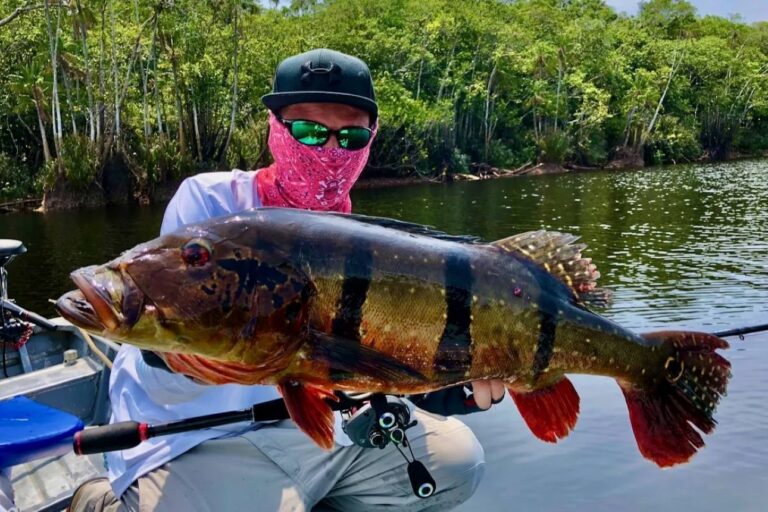
Sometimes this leads to paradoxes; for example, the peacock bass is protected by law in the state of Amazonas, but in neighboring Mato Grosso do Sul, it is considered a introduced species, and no quotas are required for it.
In this article, we’ll tell you about the fishing regulations in Brazil for 2026, so your trip ends with a photo of your catch—not a citation.
Fishing License in Brazil: Who Needs One and How Much Does It Cost?
Recreational and sport fishing in Brazil requires a federal license—the Licença de Pesca Amadora. It is issued by the Ministry of Fisheries and Aquaculture and is valid for one year throughout the country.
As a rule, you don’t need to pay separately for a regional license, but some states require their own—for example, Mato Grosso do Sul, where the southern part of the Pantanal is located. And if state regulations are stricter than federal ones, you must comply with them.
There are two categories of fishing:
- “from the shore” (desembarcada) — costs 20 reais per year;
- “from a boat” (embarcada) — 60 reais per year; also includes kayaking and free-diving.
For a trip to the Amazon or the Pantanal, you’ll need a Class 2 license: almost all fishing there is done from a boat.
You can pay for the license via PIX, by credit card, or with a boleto payment slip. A temporary 30-day license is issued immediately after you submit your application. The permanent license is issued within three days if you pay via PIX or credit card, and within seven days if you pay via boleto, after the receipt is sent.
Who needs a license:
- anyone holding a fishing rod, including those on board a boat;
- foreigners—under the same conditions as Brazilians, provided they have a Brazilian CPF tax ID number (see below for more information);
- For those who fish with a guide: the guide’s license applies only to the guide himself.
A companion who goes out in a boat just to enjoy the scenery and doesn’t touch the fishing gear doesn’t need a license. But if, in the middle of the day, he decides to “give it a try with just one cast,” that’s considered fishing—with all that entails.
Men over 65 and women over 60 are exempt from the license fee, but they still need to apply for it through the system. It’s a good idea to check gov.br for rules regarding minors and other eligible groups before your trip. However, you can fish without a license only using the simplest gear, such as a hand line—any reel or boat requires a license.

CPF (Cadastro de Pessoas Físicas) — Brazilian Individual Taxpayer Identification Number
Until recently, the main problem for foreign anglers was the CPF. This is a Brazilian tax ID number, similar to our TIN. Without it, you couldn’t apply for a license, and if you lived outside Brazil, there was only one way to get it: make an appointment and go to the consulate in person. A license costing 60 reais turned into a quest that required a trip to the embassy.
Starting in late 2025, the rules have been simplified. Tourists traveling to Brazil to go fishing no longer need a CPF—the license is issued based on their passport.
However, it is important to understand that a foreign national cannot submit the application themselves. A Brazilian citizen or a fishing tour operator must do so on their behalf through the gov.br government portal, which offers a separate option labeled “application for a foreign national without a CPF.”
You’ll need your passport number, personal information, and answers to a short questionnaire about fishing.
What to do before your trip:
- Select the license category—for the Amazon and the Pantanal, it is “from a boat”;
- Provide your passport information in advance to the host party: the lodge, guide, or tour operator;
- Get your license before heading out on the water and save a copy on your phone—cell service isn’t available everywhere in the Amazon, and the inspector needs to see the actual document, not just a promise to show it.
If you already have a CPF, you can apply for a license on your own, under the same conditions as Brazilians.

How much fish can you keep for yourself?
Federal quota for recreational fishing:
- in rivers and lakes—10 kg plus one fish;
- at sea—15 kg plus one fish.
That said, minimum sizes have been established for many species, and fishing for some species is prohibited entirely. Under no circumstances may an angler sell their catch to another angler.
There is a separate rule regarding transportation. Fish may not be stored or transported in a form that makes it impossible to identify the species: without the head, fins, scales, or skin, or in the form of steaks or fillets. Under federal regulations, the only exception is for fish at least one meter long: the head may be removed as long as both parts remain identifiable. In some states, even this is prohibited.
Simply put, having a neatly filleted fish in a cooler bag is already a violation, even if the fish was caught completely legally.
The federal quota is a cap. States have the right to set their quotas lower, and many actively exercise this right. In Amazonas, the premier state for peacock bass fishing, the quota for tukunaré is zero.
Amazonas: Peacock Bass
The state of Amazonas is the premier destination for fishing for the tukunare, or peacock bass—the fish that draws anglers from all over the world to Brazil. According to estimates by the state’s tourism department, sport fishing attracts more than 30,000 tourists per season and generates approximately 500 million reais.
That is precisely why the state protects its most prized trophy with some of the strictest rules in the country.
What restrictions are in place in Amazonas:
- Amateur and sport fishermen are prohibited from keeping any tukunare throughout the state—only “catch-and-release” is allowed;
- Three species—tukunare-asu (Cichla temensis), vasoleri, and pinima—are off-limits to commercial fishing, transport, and processing; the only exception is for local residents who fish for their own subsistence;
- Recreational and sport fishing with live bait is prohibited;
- In bodies of water designated by the authorities as having particularly abundant fish populations, with large fish, it is strictly prohibited to catch tukunare—under any circumstances.
The law was passed in December 2023 and tightened at the end of 2024. In 2024, the state also officially recognized sport fishing as a sport based on the “catch-and-release” principle.
For sport fishermen, this is actually good news. A trophy-sized asu takes about ten years to grow, and every perch that is released is a fish that will continue to grow and eventually take the bait of the next angler. For example, researchers on the Rio Maria caught and released the same tagged fish four times in a single month.
The following species are also subject to a spawning ban in the Amazon:
- Tambaki—from October 1 through March 31;
- Arowana, black arowana, kaparari, surubim, matrinshan, pirapitanga, mapa, sardine, and pacu—from November 15 through March 15.
The spawning ban on the tukunare does not prevent you from catching it on a “catch-and-release” basis.

When to Go Fishing in the Amazon
The best time for fishing in the Amazon is the dry season, when the water recedes and the fish congregate in the channels and lakes. On the Rio Negro, this is generally from September through February, with the peak season running from October through December. We’ll cover the fishing seasons on the various rivers in detail in a separate article.
Pará, Mato Grosso, and Mato Grosso do Sul: Each state has its own rules
As soon as you cross a state line, you enter a different jurisdiction with its own rules, so it’s important to be familiar with the fishing regulations in at least three popular fishing regions.
Pair: Shingu and Tapajos
Here, the spawning season closure lasts from November 15 through March 15 statewide. During this period, recreational anglers may catch up to 5 kg plus one fish, but fishing for some species is completely prohibited. Only a fishing rod, line, and hook are permitted—no nets or traps.
Mato Grosso: the northern Pantanal and the Araguaia River
As of January 1, 2024, a law known in Brazil as the “Zero Transport” law has been in effect here. The transport, storage, and sale of 12 species of fish are prohibited for five years.
- Tukunare;
- dorado;
- Pintado (Surubim);
- kachara, jhau, piraiba, pirara;
- pirarucu (arapaima), trairan, matrinshan, kaparari, piraputanga.
You can fish for these species on a “catch-and-release” basis—except during the spawning season, when all fishing is prohibited. For the 2026/27 season, this period runs from October 1 through January 31.
You may also eat your catch, but only on the spot: up to 2 kg or one fish of a non-prohibited species, provided that the hotel, floating hotel, or camp is located no more than 500 meters from the river.
Mato Grosso do Sul: the southern Pantanal
There is an exception to the general rule here: in addition to the federal license, you need a state license. It is issued by the environmental agency Imasul, and you can apply for it on the website or through the MS Digital app.
Basic Rules:
- A spawning ban is in effect from November 5 through the end of February—during this time, all recreational fishing is prohibited;
- You may take one specimen of a local species and up to five piranhas with you;
- Dorado—the Pantanal’s premier trophy fish—may not be taken as a catch until at least March 31, 2027, but it may be caught and released;
- Fishing is prohibited within 200 meters of waterfalls, rapids, and headwaters, and within 1,500 meters of hydroelectric dams.
And now, the promised paradox. The tukunare in Mato Grosso do Sul is not a native species, but an introduced one. Therefore, it—along with tilapia and African catfish—can be caught without any quotas. In Amazonas, you could get a fine for catching that same perch, but here, no one even weighs it.

Piracema: When Fishing Is Prohibited. Fishing Rules in Brazil
Piracema is the spawning migration season, when fish swim upstream. During this time, a fishing ban is in effect in Brazil. There is no single “closed season” for the entire country; instead, the dates of the ban vary by state, river basin, and even fish species.
Restricted periods for the 2026 season:
- Amazonas —November 15–March 15 for certain species; for tambaqui, October 1–March 31; the ban does not apply to tucunaré under the “catch-and-release” policy.
- Couple — November 15 – March 15.
- Mato Grosso — October 1 – January 31.
- Mato Grosso do Sul — November 5 – February 28.
- São Paulo — November 1 – February 28.
- Piauí — November 15 – March 16.
That’s why dates are always determined based on a specific route and a specific river, rather than “for Brazil as a whole.”
Arapaima: Protected and Hunted at the Same Time
The arapaima, or pirarucu, is one of the largest freshwater fish in the world: it grows up to three meters in length and weighs nearly 200 kg. And this is perhaps the most striking example of how differently the law regarding the same fish is interpreted in Brazil.
In the Amazon, the arapaima is protected. In the states of Amazonas, Pará, Acre, and Amapá, a spawning ban is in effect from December 1 through May 31, and recreational fishing is permitted only in regulated areas subject to strict controls—typically in areas where the resource is managed by local communities.
In areas where the arapaima does not occur naturally, the opposite is true. In March 2026, the federal environmental agency IBAMA designated it an invasive species in the river basins of the northeast, southeast, south, and parts of central Brazil, as well as in the upper Madeira River in the state of Rondônia. There, any fish caught—including those caught while sport fishing—must be killed. Releasing them is prohibited.
Therefore, if your trip includes fishing for arapaima, the fishing location determines not only your catch but also what you’re allowed to do with it.

How to Properly Release a Trophy
Since Brazil’s most prized catches are increasingly being released under the “catch-and-release” principle, it’s important to do so in a way that ensures the fish actually survives—not just to check a box.
Basic Rules:
- Don’t drag out the fight: a long struggle exhausts the fish and reduces its chances of survival;
- Keep the fish in the water, and lift it out briefly for a photo—ideally for less than a minute;
- Handle the fish with wet hands, avoiding contact with the gills and eyes, and use a rubber-coated landing net—this helps preserve the protective mucus on the skin;
- Hold large fish horizontally: with one hand on the lower jaw and the other supporting the belly; do not lift the fish vertically by one jaw or the gill covers—the fish will be injured by its own weight;
- Use round “circle” hooks for live bait, which catch on the corner of the fish’s mouth, and use single hooks without barbs for artificial lures, or press the barbs down on treble hooks;
- If the fish has swallowed the bait deeply, cut the leader near its mouth instead of pulling the hook out;
- Release the fish where you caught it, and hold it alongside the boat with its head against the current until it swims away on its own.
These skills quickly become second nature—especially when you have an experienced guide from Boombastic Tours by your side.
Fines: The Cost of Not Knowing the Rules
Brazilian authorities take these violations seriously. In a single operation during the “piracema” season in Mato Grosso do Sul, fines totaled more than 190,000 reais.
Federal sanctions:
- Fishing without a license—a fine of 300 to 10,000 reais, plus 20 reais for each kilogram of catch;
- Fishing during the closed season or in a prohibited area—a fine of 700 to 100,000 reais, plus 20 reais per kilogram;
- Confiscation of fishing gear, boats, and catch.
In addition, fishing during the closed season, catching protected species, or catching fish smaller than the minimum size limit constitutes an environmental crime, for which the law provides for up to three years of imprisonment.
A top-of-the-line reel, left behind as a memento by the Brazilian environmental police, isn’t the kind of souvenir worth flying across the ocean for.
Fishing regulations in Brazil are strict, but they are designed to benefit anglers. Thanks to the “catch-and-release” policy, the peacock bass in the Amazon River is protected by law, which means there will continue to be trophy catches.
The most important thing is to prepare in advance: obtain a license before heading out on the water (without a CPF, the host now handles this using your passport), choose the correct category, and check the closed-season calendar and regulations for the specific state.
That’s exactly why it’s best to leave the itinerary, dates, and paperwork to a team that stays on top of changes in the law and knows where and when the fish are biting. That way, you can focus all your energy on reeling in your catch, rather than on talking to an inspector.
Contact us in any way that’s convenient for you,and the Boombastic Tours team will take care of everything to organize and guide you on your best fishing trip in Brazil.