

It’s customary to go fishing in Norway in the summer, when it’s warm, light, and all the lodges are open. But that’s only half the story.
The thing is, the Norwegian coast doesn’t have just one season—it has several—and each one brings its own fish, its own light, and its own list of restrictions. The best catch of the year could very well be landed in a month when the sun over Tromsø is still just trying to peek out from behind the mountains.
All in all, there are plenty of paradoxes here. For example, while the whole world heads to Norway to catch cod (Gadus morhua), it’s forbidden to catch halibut (Hippoglossus hippoglossus)—even if it bites the jig on its own. The brightest northern lights don’t occur during the pitch-black polar night, but rather around the equinoxes, when darkness lasts for a normal human day. And the quietest weeks on the water are in the fall, which guidebooks, for some reason, tend to overlook.
In this article, we’ve put together a fishing calendar for Norway, providing a detailed breakdown of which fish can be found where during each season, which lodges are open to guests at that time, how many hours of daylight there will be, and what fishing regulations are in effect in Norway in 2027.
Two Fishing Calendars for Norway
Fishing trips in Northern Norway are planned according to two different schedules.
The fish sets the tone. Pollock migrate to the coast to spawn from January through April. Halibut head to spawning grounds at depths of 300–700 meters in the winter and move to shallower feeding grounds in the summer. Pollock (Pollachius virens) is best caught in the spring and fall, especially at high tide, when it follows small fish almost to the very shore.
The second calendar is based on the sun. Almost all of the fishing spots mentioned in this article are located above the Arctic Circle, where the entire spectrum of light found on Earth—from the polar night to the midnight sun—occurs over the course of a year. Light doesn’t affect the bite, but it does affect everything else: how many hours you’ll spend on the water, whether you’ll see the aurora, and whether the evening after a fishing trip will feel like an evening at all.
There is also a third factor that people tend to think of last—the operating seasons of the resorts. Most of them welcome guests from April through October, and only a few are able to offer their guests access to the sea in the winter.

From late February through mid-April
This section is for those heading out to catch trophy cod. We’ve covered the cod itself, its migration routes, and the gear needed in detail in the article“Cod Fishing in Norway: 2027 Season.” Right now, however, we’re more concerned with something else: where to stay during these weeks and what to use to get out to sea, since only a few fishing bases are operating in the winter.
In Signe, the Mefjord Brugge base offers year-round fishing trips aboard the 45-foot yacht Sargo, where the winter waves feel much gentler than in an open boat. The base considers March through October the best months for fishing, and from January 4 through the end of March, it also offers a winter package that doesn’t include fishing: a marine safari, aurora hunting, and snowshoeing.
Just south of Tromsø, anglers head out from the Amberfish base: It’s not far from here to the Malangsgrunnen shoal by speedboat, and during storms, fishing operations move into the fjord and the Kvalsoon Strait, where wolffish (Anarhichas lupus) and cod are found.
At Mikelvik and Aurora on the island of Ringvassøy, capelin are caught in March and April. The Big Fish Adventure opens in March on Sørøya. In the spring, capelin (Mallotus villosus) come close to shore, followed by cod, and then whales, so you can observe the food chain right from the deck.
Two things you should know in advance:
- Hansnes Base. You can live here year-round, but boats aren’t available until April 1. So you can’t catch any winter smelt here—except maybe the last of them in April.
- Halibut. From December 2 through April 20, inclusive, fishing for this species is prohibited throughout Norway’s exclusive economic zone. Any fish caught accidentally must be released, no matter how much you might want to take pictures with it.
The weather during these weeks is as follows. The average temperature in Tromsø in January is around −3 °C; the sea does not freeze, but strong winds blow 30–40% of the time along the Finnmark coast in January. That’s why cabin boats and outposts that offer an alternative for fishing in sheltered fjords are highly valued in winter.
The sky is on your side. The aurora is visible from late August through late March, with peak activity occurring in March–April and September–October, around the equinoxes. According to Visit Norway, the best time for viewing is from 11:00 p.m. to 2:00 a.m. By mid-March, days above the Arctic Circle last more than eleven and a half hours, so there’s plenty of daylight for fishing, and the nights are still dark enough to see the sky.
The key thing to know about winter: it’s only really possible to catch skrei and see the aurora in a single trip from late February through late March. Later in the season, the nights are too bright for the aurora, and earlier in the season, the days are too dark for fishing.

May and June
Summer fishing grounds “wake up from hibernation” as early as April, and starting April 21, you can fish for halibut again:
- Riseøyhamn on Andøya and Efjord Shokhus near Narvik open on April 1;
- Polarsirkelen at the Arctic Circle on April 15;
- Kasneshamn vs. Senya on April 20;
- And by May, the high season begins at Arney Brugge near Budø.
Spring is a great time for fish that are harder to catch in the summer. In Andfjord near Rysøyhamn, catfish—a powerful bottom-dwelling fish that pierces sea urchin shells with its jaws—can be found until June. Ling (Molva molva) and tusk (Brosme brosme) spawn from April through June at depths ranging from 100 to 400 meters and deeper. This is the time for those who enjoy heavy tackle and the long haul up from the bottom. Ling can grow up to two meters long and weigh 40 kilograms, and from a depth of 300 meters, you can feel it with every turn of the reel.
In the second half of May, the midnight sun rises over Tromsø and Senja, and fishing is no longer bound by the clock. At the same time, off Andønes, at the northern tip of the same island where Risøyhamn is located, the sperm whale season begins: they stay near the Bleiksdjupet underwater canyon from May through September.
And here’s one more detail to keep in mind when planning. According to tour operators’ schedules for 2027, the high season at summer resorts begins on different dates: at Polarsirkelen on May 1, at Kasneshamn on May 15, and at Efjord Shohus on June 1. The weeks leading up to these dates offer almost all the summer activities, though the water is colder and the docks are less crowded.

July and August
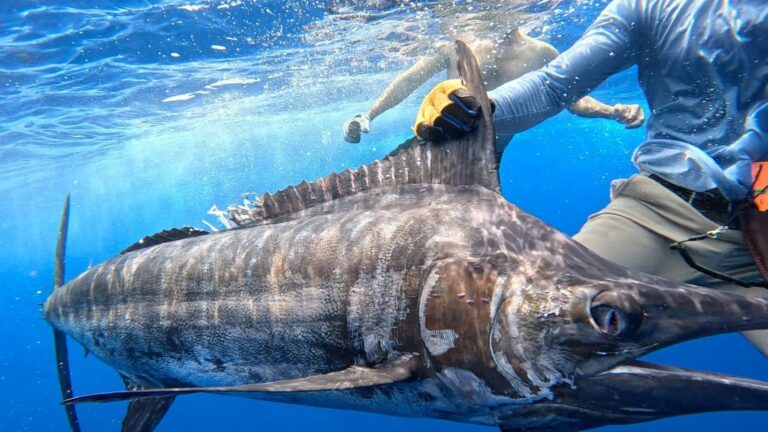
It’s peak season, and for good reason. In the summer, halibut migrate from their winter spawning grounds to shallower feeding grounds, and the chances of catching a large fish increase. Anglers head to Bolg in Meloe, south of Bodo—where halibut are traditionally plentiful—to Arney Brygge, a half-hour boat ride from Bodo, where the base record stands at 180 kg, to Mikkelvik near Tromsø, and to Big Fish Adventure on Sørøya. At Efjord Shohus, there’s a spot with a current where halibut congregate, just a five-minute boat ride from the cabins. From Polarsirkelen, anglers head out to the lighthouse for halibut and large cod, and to the west of the base, large saithe are regularly caught in July and August.
There are two restrictions on halibut. You may keep fish measuring 84 cm or longer, but halibut longer than two meters must always be released, regardless of the gear used or the location. So the biggest catch of the summer remains only in a photograph. Norway seabass (Sebastes norvegicus) north of Stada can only be caught with a jig and only from June 1 through August 31; it is off-limits the rest of the time.
The midnight sun shines in Tromsø and on Senja until around July 23, and on Sørøya until July 27. Near the Arctic Circle, on Bolga and Polarsirkelen, the season is shorter: from around June 5 to July 5.
The average temperature in Tromsø in July is around +12 °C, and even in August, the water rarely warms up above 10–11 °C. That’s why, even in the summer, people here head out to sea wearing waterproof coveralls—and that’s not just to be on the safe side.
The Lowdown on Summer: July and August are the best months for halibut and the busiest weeks at the resorts. If you have a specific resort and week in mind, it’s best to book in advance.

September and October
Fall in Norway is unfairly considered the off-season. The saithe are back in top form, there are almost no tourists, and the guides at Big Fish Adventure call October their favorite month for halibut. And Mefjord Brugge offers an autumn package for September and October that includes a Northern Lights tour, with fishing added as a separate option.
The summer bases are closing one by one. Polarsirkelen is open until September 30, Hansnes rents out boats until October 1, Røysøyhamn and Efjord Shokhus welcome guests until October 15, and Kasneshamn and Arney Brygge remain open until the end of October.
Large schools of saithe are found in Andfjord near Rysøyhamn during the summer and fall.
From the end of August, darkness returns—and with it, the northern lights. They’re especially active in September and October, and the nights aren’t freezing yet, so you can gaze at the sky right from the pier without having to bundle up. The weather, however, is more unpredictable in the fall: October in Tromsø is the rainiest month of the year, with about 127 mm of precipitation.
From November through January
This season isn’t for fishing, but for those who want to experience the North as it truly is. From late November through mid-January, the sun doesn’t rise above the horizon in Tromsø, and in December, according to long-term observations, there are zero hours of sunshine here. The halibut fishing season is closed starting December 20, and most fishing lodges are closed until spring.
But in the winter, the whales arrive. Since the winter of 2017–2018, Norwegian spring-spawning herring (Clupea harengus) have been overwintering in the Kvenangen Fjord area near Sørøya, followed by killer whales and humpback whales. The whales stay there from around late October to late January. It’s about 160 km from Tromsø to where they are, a four-hour trip.
But no one can guarantee that they’ll be there. In December 2025, the Institute of Marine Research estimated that there were about 780,000 metric tons of herring in the wintering fjords of Troms and Finnmark, compared to approximately 2 million a year earlier. According to scientists’ estimates, a significant portion of the school likely overwintered in the open sea, although the herring stock itself is currently growing.

Most of our bases are closed at this time of year, so the easiest way to see the whales is to take a one-day safari from Tromsø. On Senja, the yacht Mefjord Brugge sails year-round.
A record for cold-water fishing enthusiasts: the largest documented saithe, weighing 22.7 kg, was caught on a fishing rod in Saltstrømmen near Bude on November 30, 1995.
How much light will your base have?
The duration of the polar night and the midnight sun depends on latitude. The dates in the table are calculated for a flat horizon. In the mountains, the sun remains hidden longer, so the dates shift by a few days in those areas.

Trøndelag: A Calendar Without the Polar Night
The island of Hitra lies nearly a thousand kilometers south of Sørøya and a good three degrees south of the Arctic Circle. There is neither a polar night nor a midnight sun here; winters are milder, and summer nights are simply bright. People come here for the fish, which are almost nonexistent further north. The lyr (Pollachius pollachius), also known as pollock, is rarely found north of Helgeland, but off Hitra, it is one of the main targets for anglers.
In winter, anglers catch haddock, whiting, and large cod at Khitra. German tour operators bring groups here in February, and for those who want to go deep-sea fishing without the polar darkness, this is a good option. The Angelamfi base was open year-round in 2025, but for 2026, dates were only available through September 30, so you’ll need to check availability for winter weeks in advance. Khitra lies north of the 62nd parallel, so the regulations for halibut and sea bass here are the same as in the north.
Fishing Regulations in Norway, Which Vary by Month
Norway’s fishing regulations for tourist anglers are revised almost every year, and 2027 is no exception.
Current as of the date of publication (October 2026):
- Halibut. Fishing is prohibited from December 20 through April 20, inclusive. The minimum size is 84 cm; fish longer than 2 m must be released year-round. In the protected area around the Skinnabanaken bank, halibut fishing is prohibited year-round.
- Sea bass. North of Stada, only jigging is allowed, and only from June 1 through August 31. The minimum size is 32 cm within 12 nautical miles of the baseline and 30 cm beyond that.
- Cod. The minimum size is 55 cm within four nautical miles of the baseline and 44 cm beyond that.
- Haddock (Melanogrammus aeglefinus). Minimum size: 40 cm. There is no minimum size for pollock, whiting, catfish, or ling.
- Haul-out of the catch. Effective January 1, 2027, every tourist aged 12 and older may export 10 kg of fish and fish products, no more than twice per calendar year. In 2026, the limit was 15 kg. Only catches from a registered tourist base may be exported; such bases must report their catches daily, and documentation must be prepared separately for each person. Trophy fish exceeding the limit may not be exported.
- Fine. If the limit is exceeded, customs officials will confiscate the entire catch and refer the case to the police. The fine is 8,000 NOK (about €727) plus 200 NOK (about €18) for each kilogram over the limit.
- Boat. If you were born in 1980 or later, you need a license to operate a boat with an engine more powerful than 25 l. s. Most of the bases mentioned in this article have boats with engines ranging from 75 to 150 l. s., so it’s best to sort this out before your trip or go out to sea with a guide.
A simple practical conclusion follows from the export limit. Since you can export your catch twice a year, it makes sense to split your fishing trips to Norway into two: one in the spring for haddock, and one in the summer or fall for halibut. That way, each trip has its own 10 kg quota and its own season, rather than having to compromise between them.
Infographic: A Year on the Norwegian Coast

In Norway, there isn’t just one “right” month for fishing—there’s a right month for whatever you’re after: skrei and haddock in March, halibut under the midnight sun in summer, saithe and tranquility in the fall, and whales during the polar night. First, choose the fish; then, the season; and only then, the base that actually heads out to sea during those weeks.
Contact us in whatever way is most convenient for you, and the Boombastic Tours team will take care of everything to organize and guide you on your best fishing trip in Norway.