Dogtooth tuna fishing gear: deep sea fishing in Seychelles with Boombastic
We have written a detailed article and guide for you on catching dogtooth tuna in the Seychelles.
First and foremost, vertical jigging is used for catching dogtooth tuna — one of the most modern and effective methods that works excellently in Seychelles conditions. It allows you to precisely control the lure at depth and provoke aggressive attacks from the predator.
The rest of the tackle is selected specifically for this style of fishing.
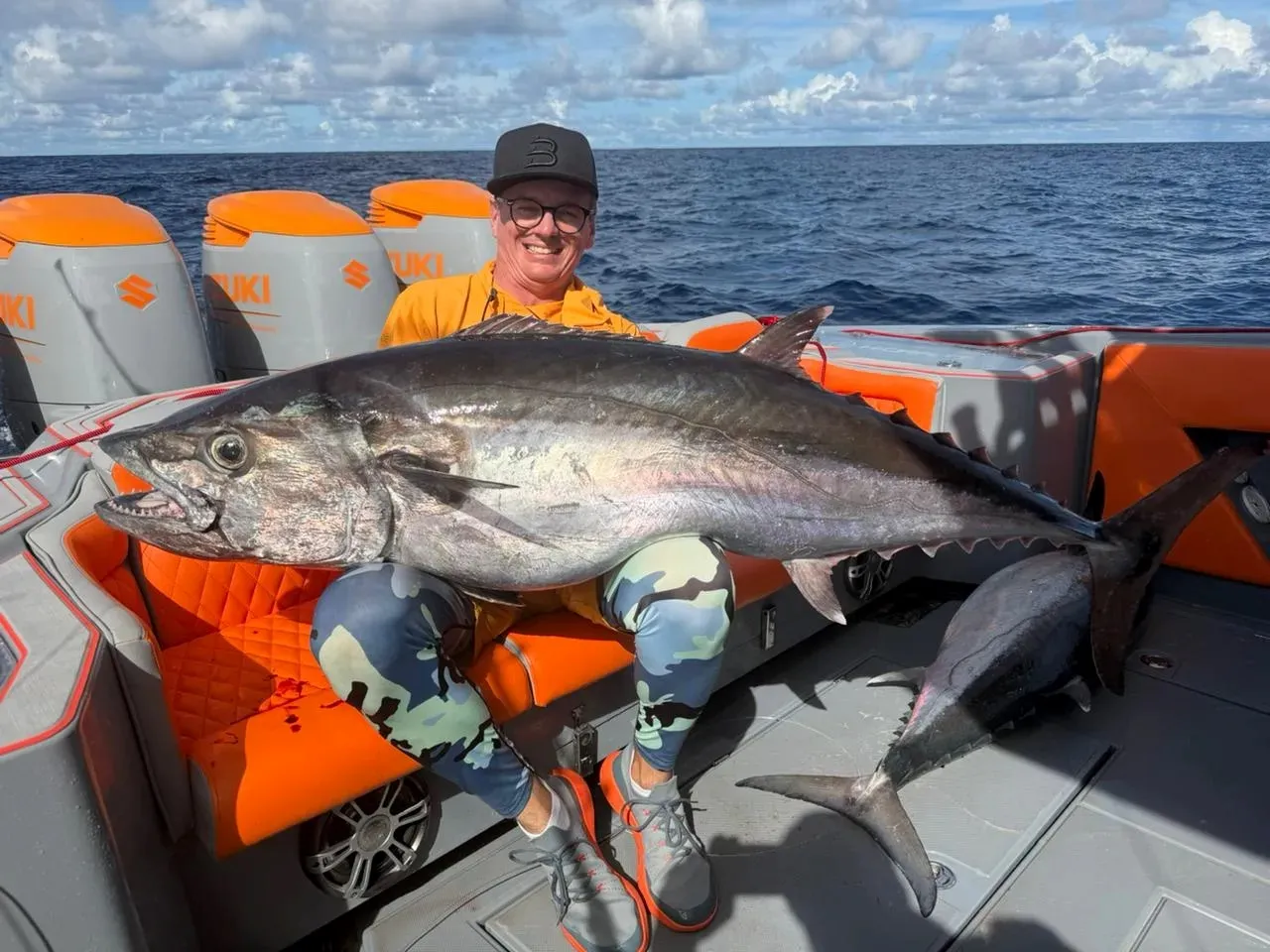
The optimal choice is a jigging rod with a solid blank, rated for around 8 PE power. Such rods are specifically designed for handling large fish and can withstand prolonged, powerful fights.
Several factors are key here:
- high build strength;
- the ability to absorb powerful jerks;
- comfort under sustained load.
When it comes to reels, preference is most often given to top-tier spinning reels such as the Shimano Stella 18000 and 20000.
They are chosen for good reason, as they feature a powerful and stable drag system, high reliability under extreme loads, and a capacity of at least 300 meters of strong 6–8 PE braided line.
Although some anglers use conventional (multiplier) reels, these have their own specific features and nuances that require experience.
Line and its characteristics
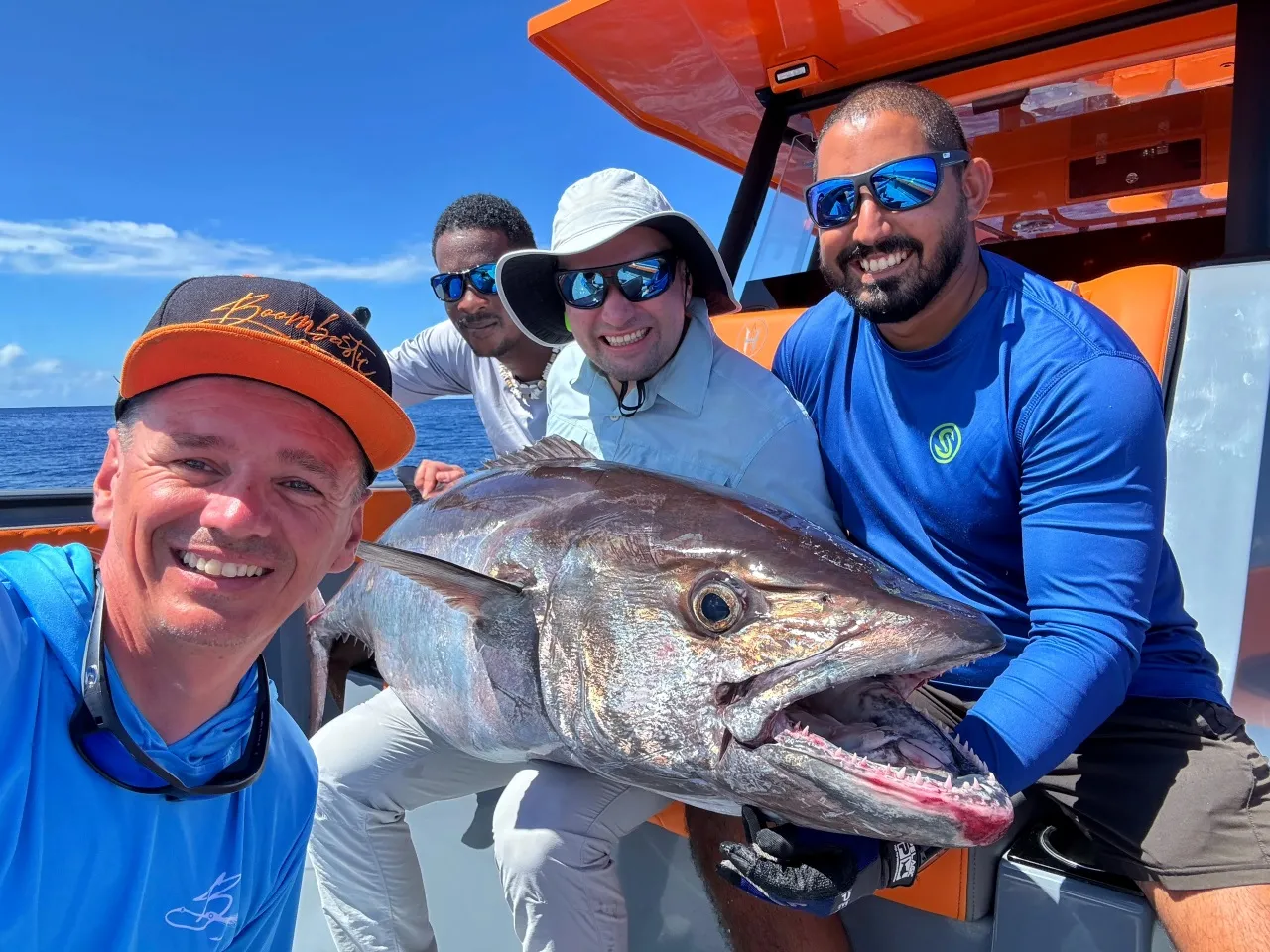
The most common choice is 6 PE braided line. However, depending on fishing conditions, more powerful options — such as 8 PE — are also often used.
The choice depends on fishing depth, current strength and drift speed, as well as the weight of the lures used — the more challenging the conditions, the higher the strength requirements for the entire setup.
Experience shows that setups have to be changed during the fishing trip, and lures of different weights are used. Quick adaptation to conditions is also critical here. Therefore, it's best to have at least two rod and reel setups to respond quickly to the situation.
For fishing in the Seychelles — not only for dogtooth tuna — to be productive, a key requirement for the reel is maximum drag pressure and maximum stability.
We recommend a drag rating of at least 20 kg.
Brands and tackle selection approach
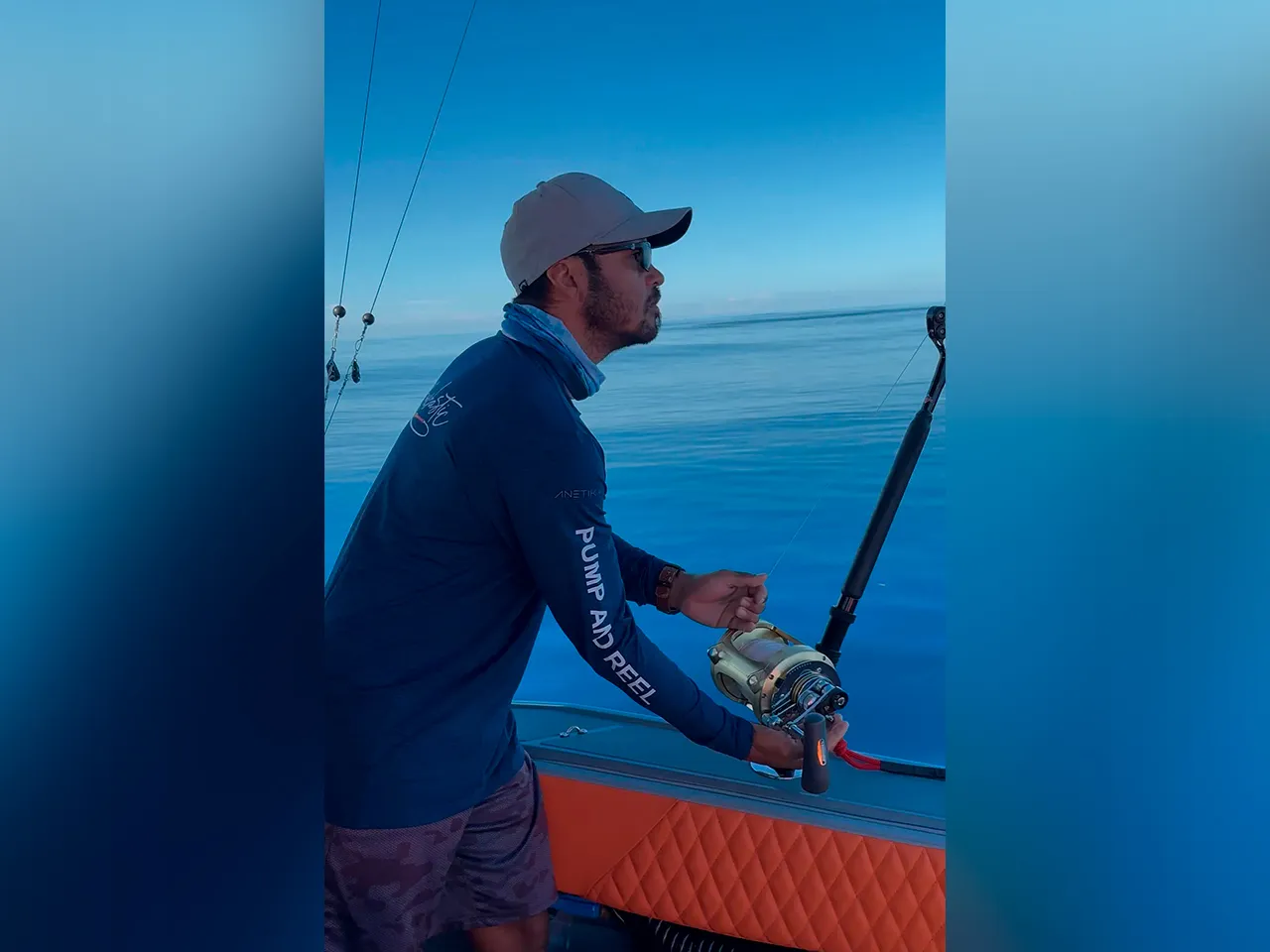
When it comes to reels, we most often use Shimano. As for rods, we use Patriot Design, Ripple Fisher, and Black Hole.
However, in reality, the choice is not built around brands but around performance characteristics. In heavy‑duty fishing, it's not logos that matter, but strength, balance, and reliability. That's why we don't divide tackle into "beginner" and "professional" categories. Our beginners and experienced anglers use equally powerful setups.
The reason is simple: the demands on reliability are equally high. The fish makes no allowances for experience, and weak tackle will not hold up regardless of the angler's skill level.
Cost of a dogtooth tuna setup
A quality dogtooth tuna setup is an investment in results.
Here's a rough estimate:
- a good reel — from 1000 USD;
- a rod — 500–700 USD;
- lines and other components — from 300 USD.
In total, a complete, reliable setup will cost approximately 2000 USD and up, depending on the manufacturer, the specifics of the tackle, and so on.
Rigging and setups for dogtooth tuna fishing
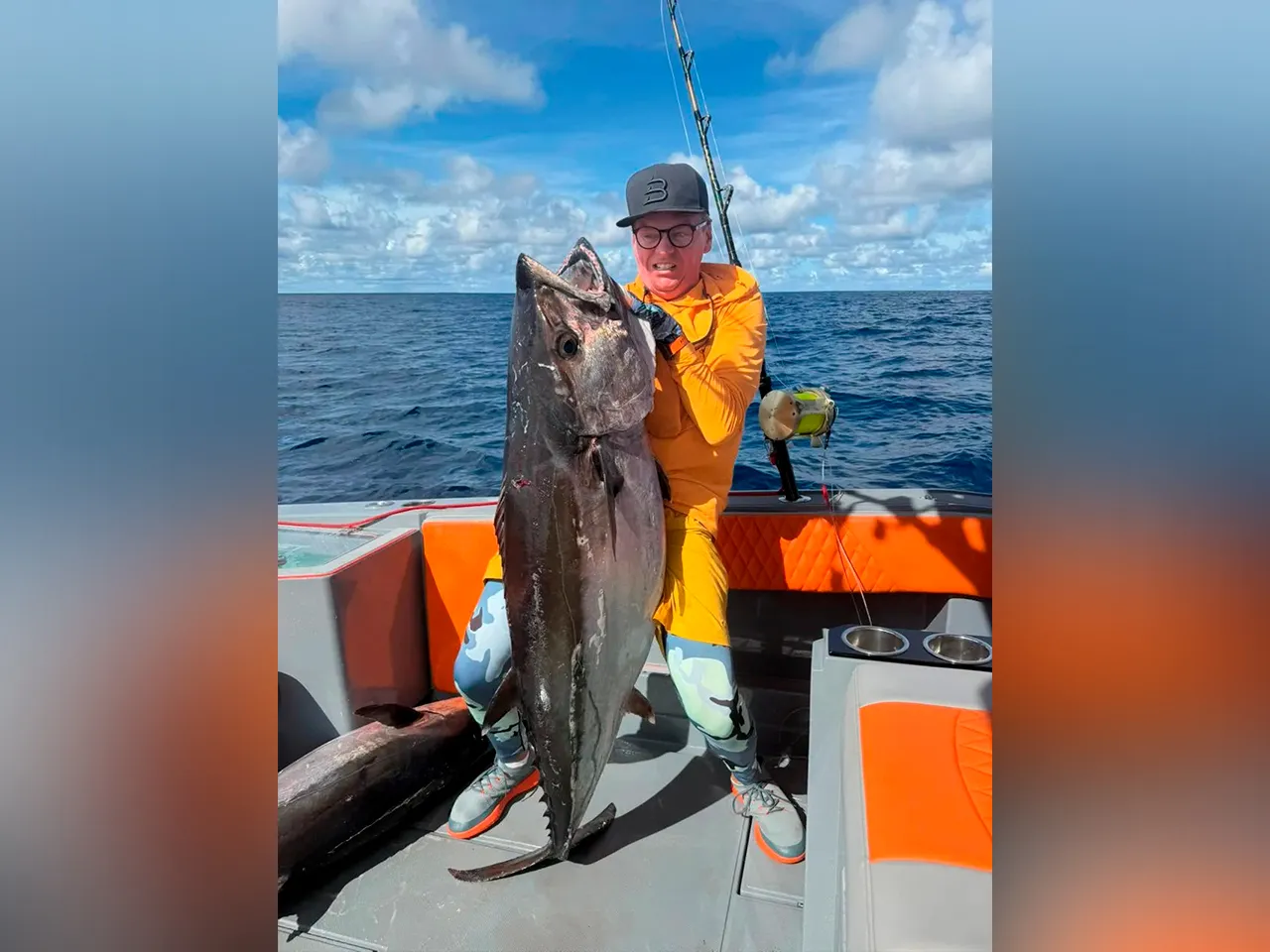
In the classic setup, two key connections are used: the first knot connects the main braided line to the shock leader, and the second connects the shock leader to the lure.
For connecting the braided line to the shock leader, we most often use the FG knot. We also frequently use custom knots that simply don't have names.
The connection between the shock leader and the lure also allows for variation — from the classic clinch knot and its modifications to individual solutions.
Special mention should be made of the so‑called "bar‑tie knot" — a custom technique that is actively used and has proven itself to be extremely reliable when working with large fish.
The shock leader is one of the key elements of the entire rig. Its role is not limited to a single function.
The main tasks of the shock leader are:
- shock absorption during the strike;
- smoothing out jerks during the fight;
- partial protection against abrasion on coral.
Its work is especially important in the final stage — during the so‑called "parking" of the fish and bringing it aboard. At this moment, the tuna can make a powerful surge, and it is the shock leader that reduces the risk of line breakage as well as injury to the angler.
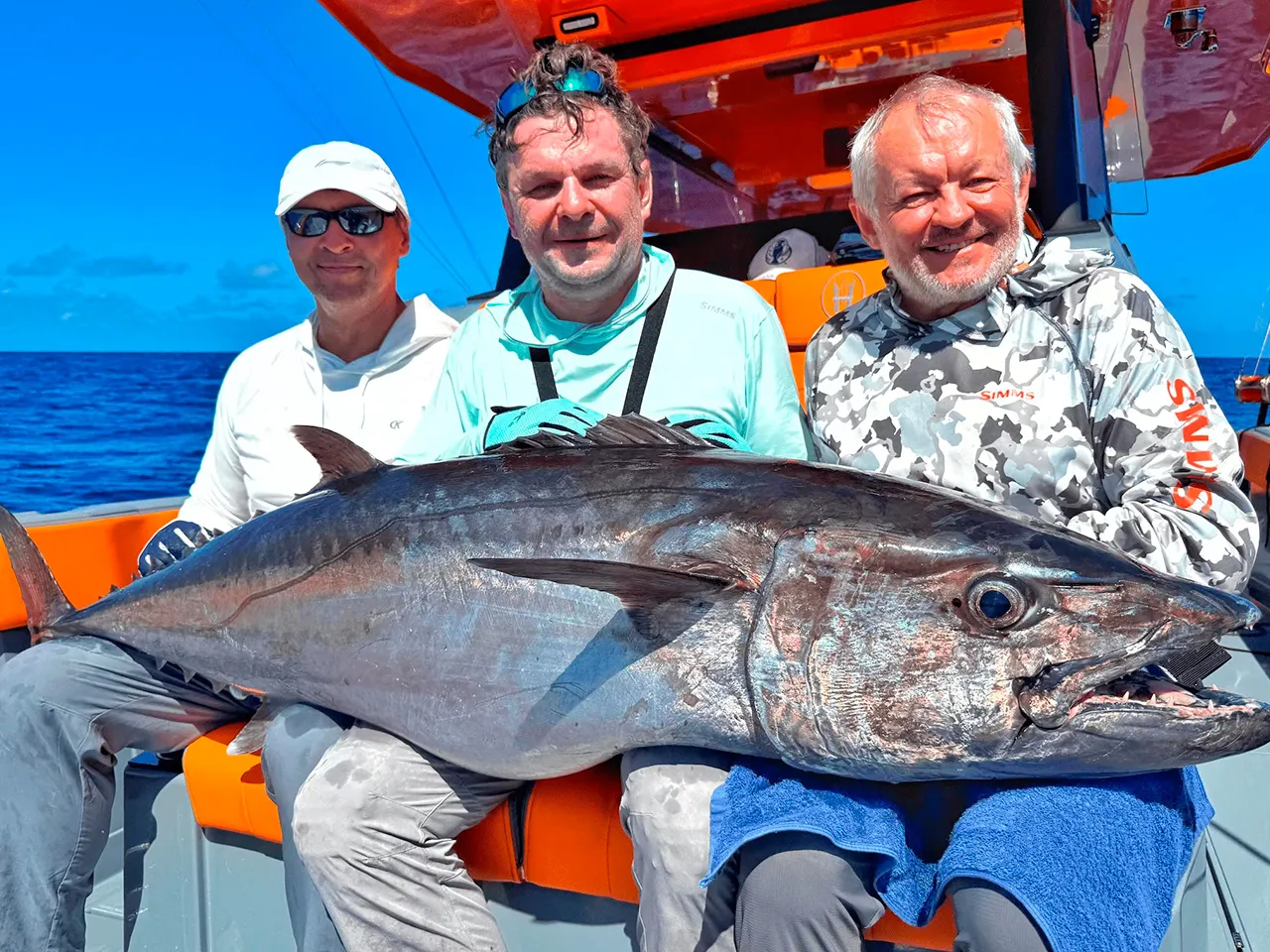
At the same time, it's important to understand that even the strongest material does not provide absolute protection. Contact with coral often results in a cut‑off, and this is part of the reality of fishing in tropical reefs.
In the vast majority of cases, we use nylon (monofilament). It has higher elasticity and good shock absorption.
Fluorocarbon is used extremely rarely. Its stiffness and low stretch make it less suitable for power fishing of dogtooth tuna, where a "spring" in the system is essential.
Shock leader length and strength
There is no universal standard here — much depends on personal preference and experience. We most often use a shock leader with a strength of 170–200 lb and a length of about 3–3.5 meters (sometimes longer).
This configuration provides good shock absorption, convenience when working alongside the boat, and additional control over the fish.
However, a long, soft shock leader also has a downside — it somewhat reduces the stiffness of the hook set. Sometimes, multiple hook sets are needed to drive the hook home effectively.
Heavy‑Duty tackle for dogtooth tuna fishing
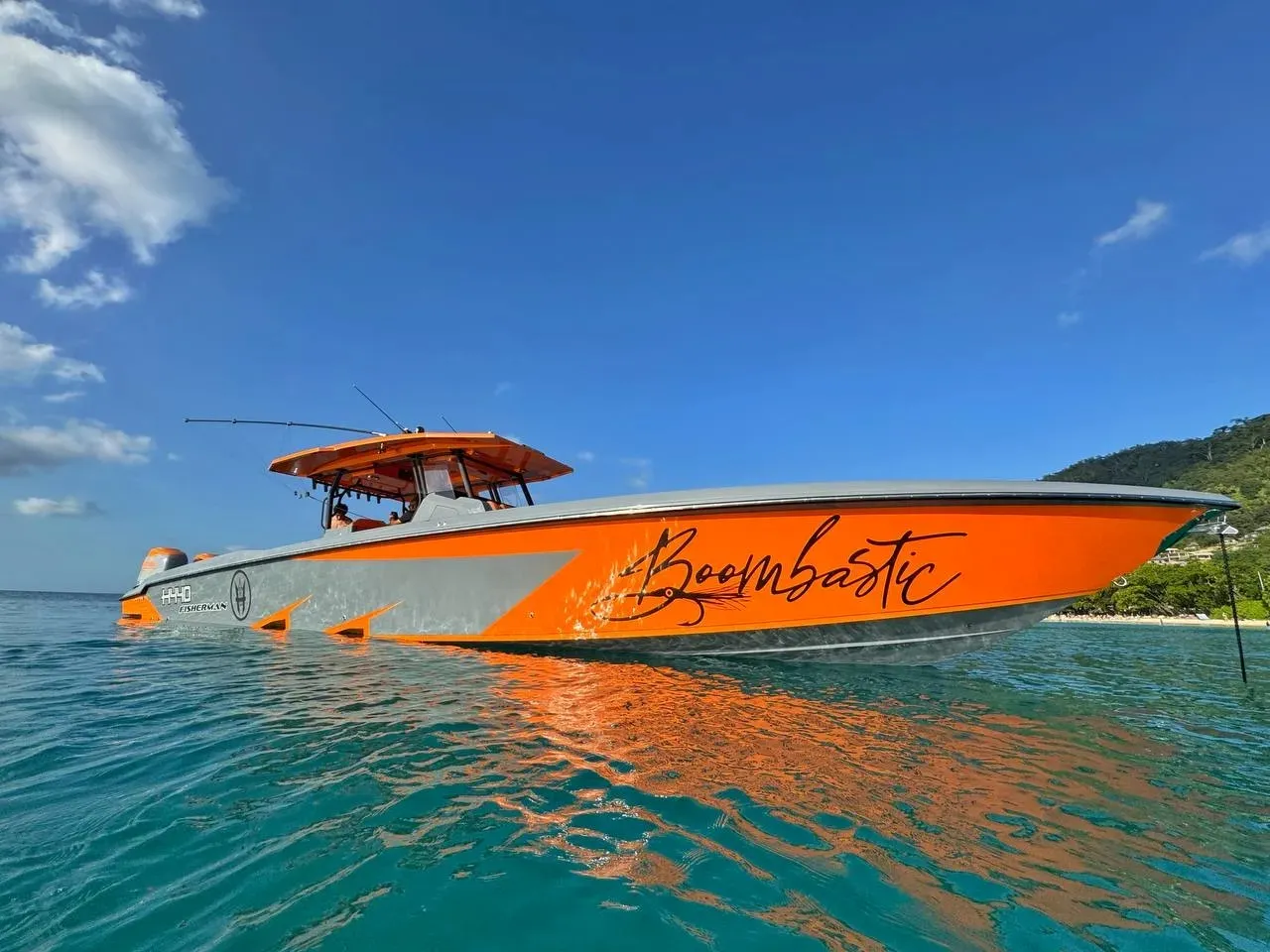
Even the highest‑quality rig does not offer a 100% guarantee. Fish are lost regularly, and there can be several reasons.
The most common are mistakes during the fight, slack line at a critical moment, and improper fish‑handling technique.
But there are also factors beyond human control:
- the fish running into the coral and cutting the shock leader;
- shark attacks that may intercept the trophy;
- extremely sharp, deep‑diving surges.
In reality, tackle failure happens less often than it seems. When quality equipment is used, most problems stem either from technique or from unpredictable ocean conditions.
Lures and baits for dogtooth tuna fishing
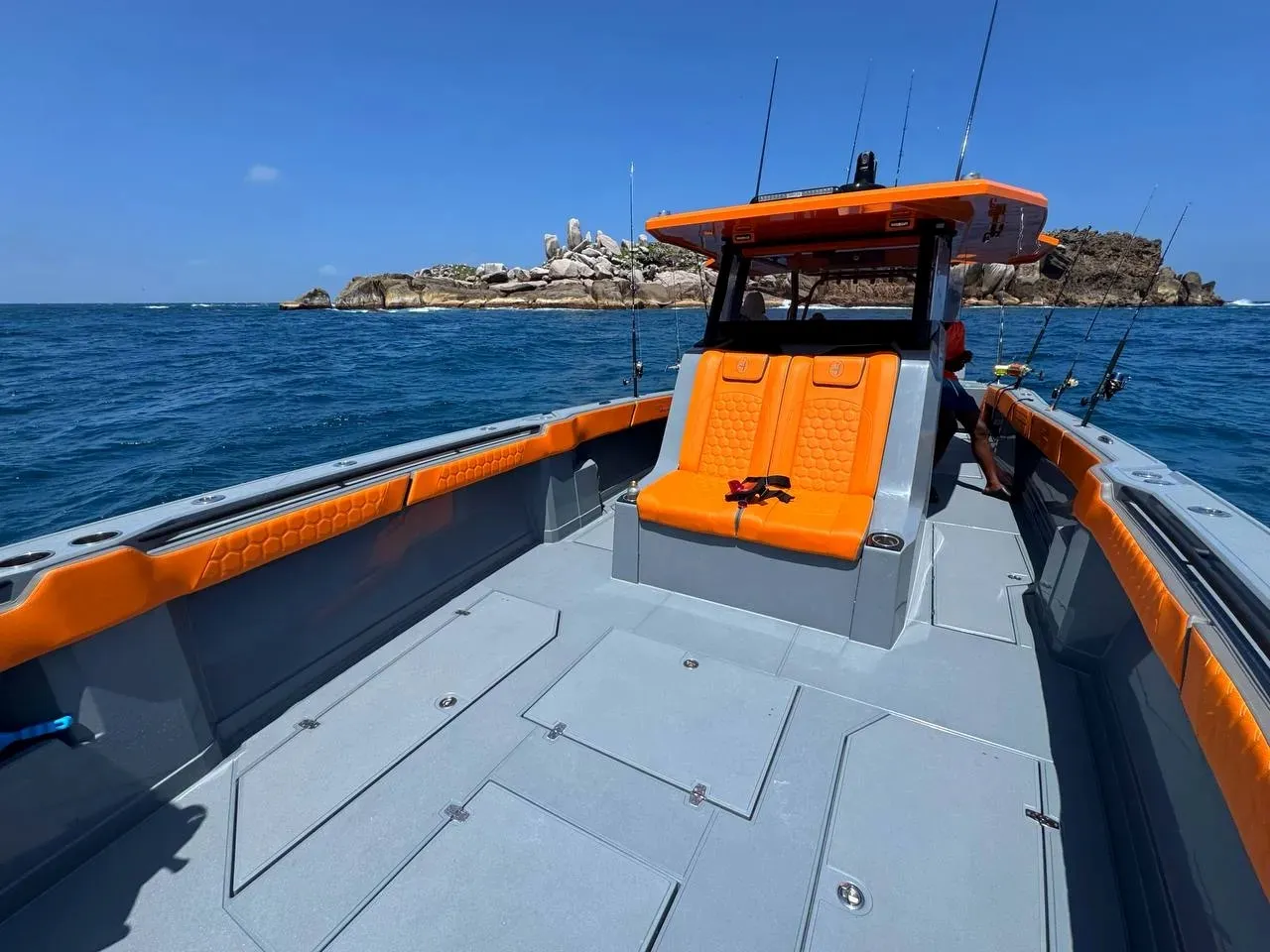
Any recommendations in this section come from our practical experience — they are not strict rules.
Vertical jigs are the go‑to lure that dogtooth tuna hit not only in the Seychelles but around the world. These are heavy metal lures that quickly reach the desired depth, mimic the movement of an injured or fleeing baitfish, and thereby provoke the predator to strike.
There are thousands of options on the market, but in practice, mid‑sized jigs perform best.
In our observation, overly narrow, long jigs produce poorer results. On the other hand, excessively wide lures are not a universal solution either.
The most optimal shape and size:
- length: 15–16 cm, sometimes 12 cm;
- width: approximately 2.5–3 cm;
- shape: an elongated, medium‑thickness "leaf".
As for weight, it is chosen primarily based on depth and drift speed. The weights we use most often are 150 g, 200 g, and 250 g.
For surface fishing, poppers and stickbaits are used, although dogtooth tuna is considered a deep‑water species.
How to choose lure color for dogtooth tuna
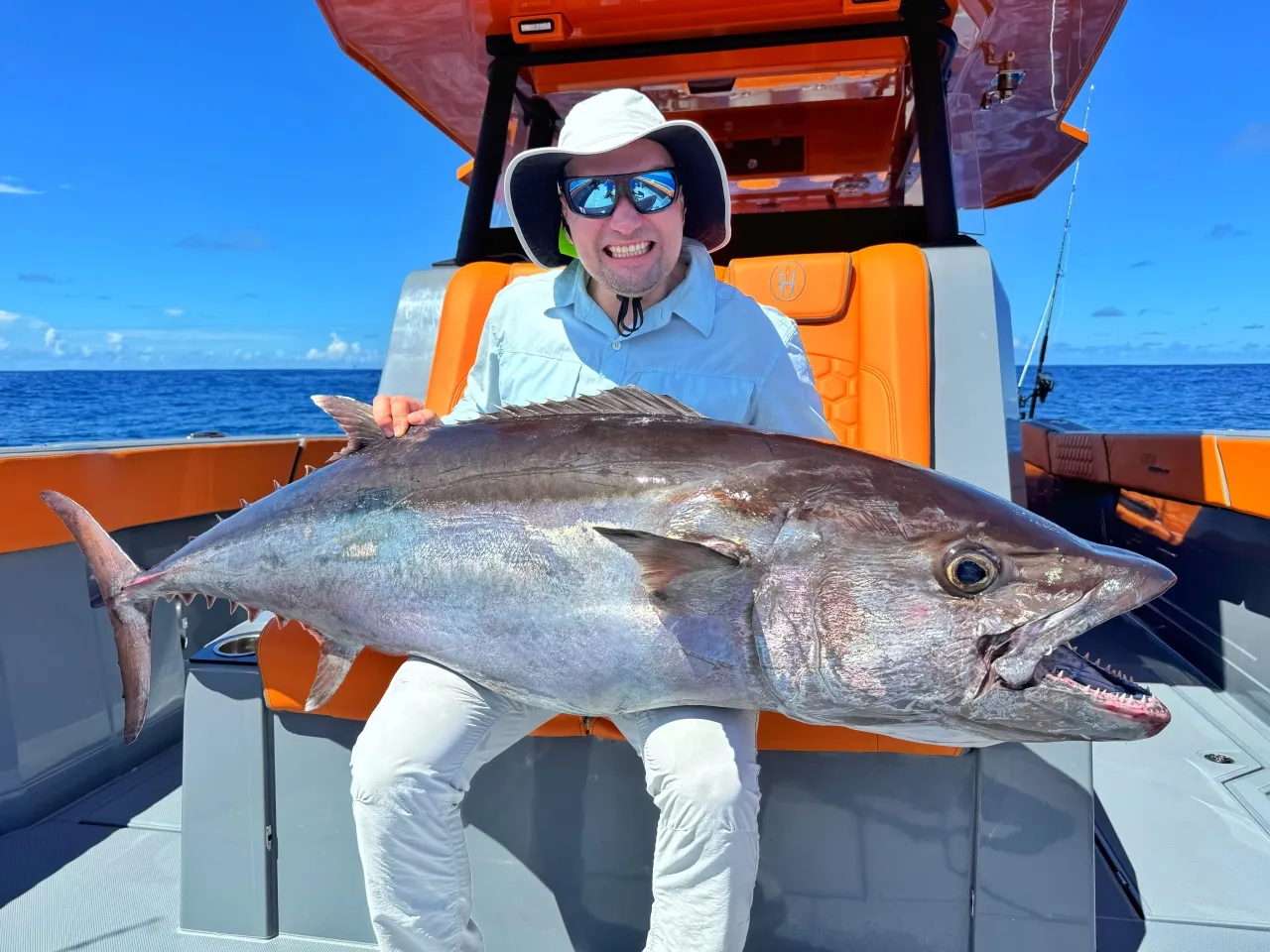
Our main recommendation is that the color should have a silver tint.
The most effective options are:
- pure silver;
- silver‑blue;
- silver‑pink;
- pearlescent combinations.
Silver mimics the natural flash of baitfish and is most visible in the water column. However, there are periods of active feeding when dogtooth tuna will strike almost any lure — both natural colors (silver, blue, green) and bright, provocative shades (pink, red, fluorescent green).
Fishing for dogtooth tuna with live bait
We very rarely use this method.
The reasons are as follows:
- high likelihood of shark attacks;
- complexity of the process;
- low situational control;
- the need for a high level of experience.
Moreover, this style of fishing demands mobility — quick moves and constant searching for fish. Using live bait does not facilitate that.
How the lure is chosen for dogtooth tuna fishing
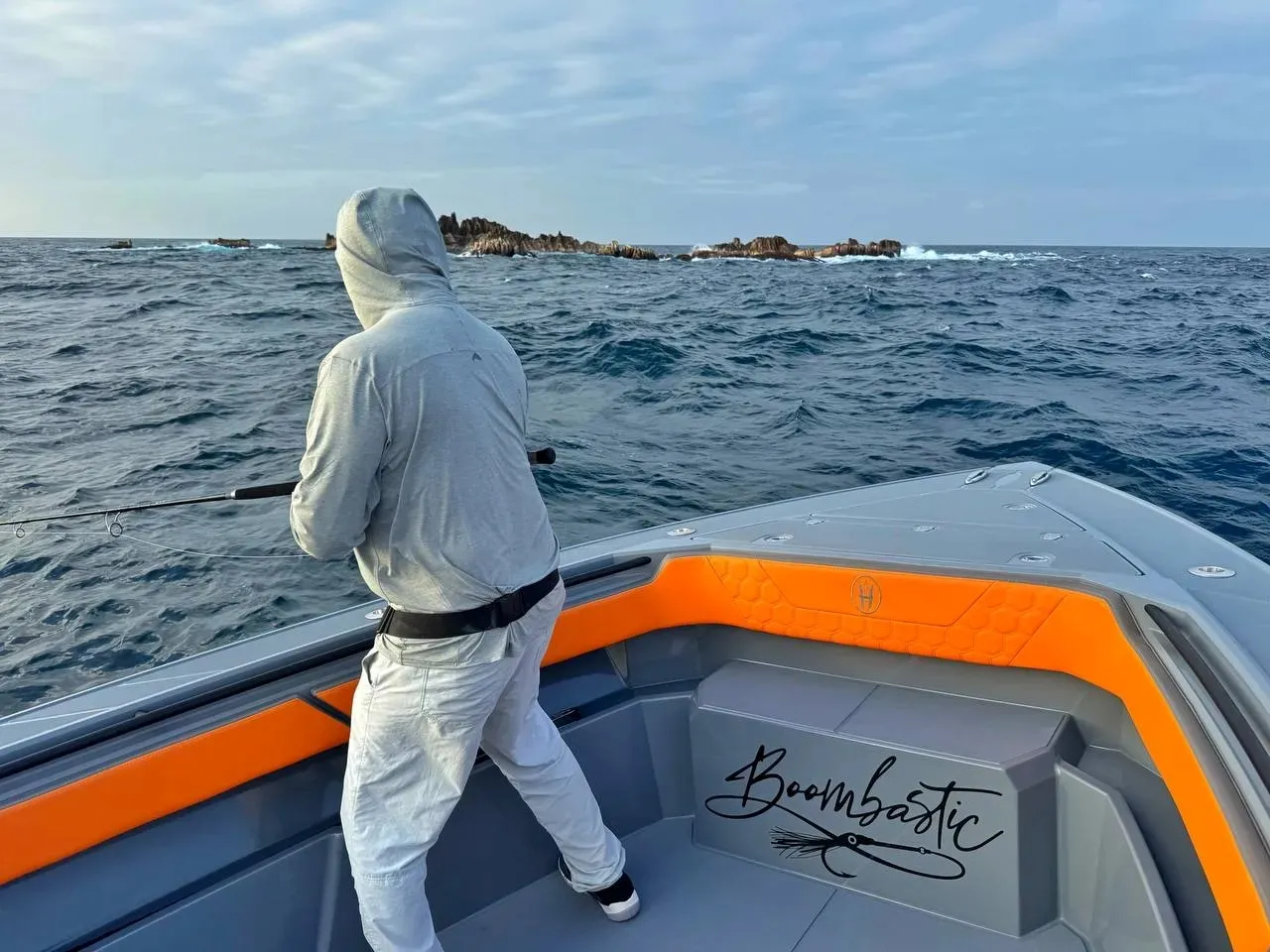
The main factors to consider are depth, current speed, and drift speed. The weight and shape of the jig are selected based on these parameters.
Beyond that, the angler's experience and "feel" play a major role. Most often, we use lures that have already proven their effectiveness and in which we have confidence. Therefore, the right shape, appropriate weight, and basic color combinations deliver significantly better results than endlessly cycling through countless options.
Dogtooth tuna fishing specifics
If you compare different fishing methods, live bait fishing might seem the most "natural" option. Live bait always appears more attractive as prey, and in certain situations it does work.
However, in real‑world practice, jigging remains the primary method. Our fishing tours in the Seychelles are no exception.
Jigging wins not only in consistency of results but also in process control. The angler controls the depth, retrieve speed, and lure action — all of which are especially important when searching for active fish.
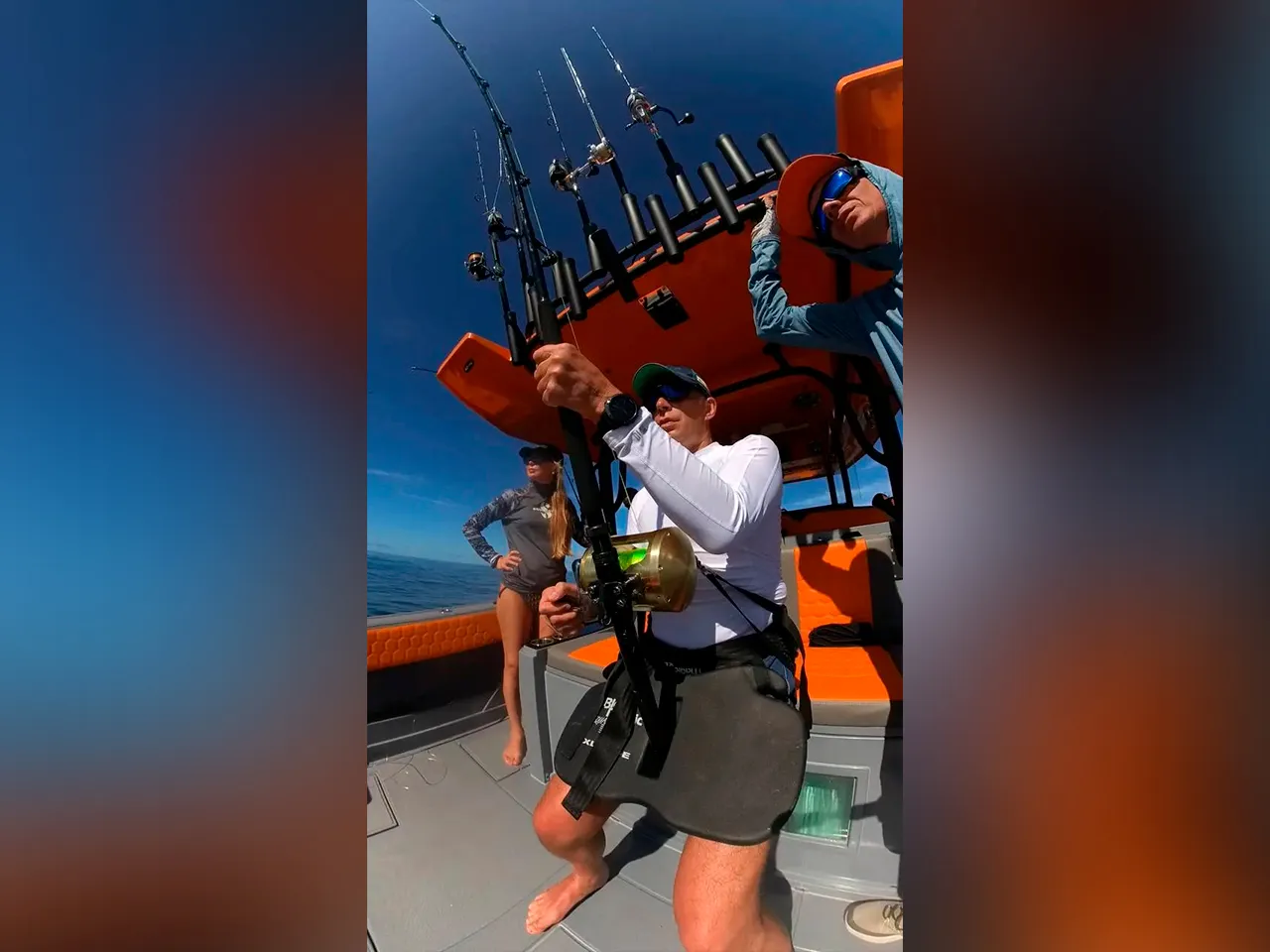
Trolling also produces results, and sometimes it's exactly how truly large specimens are caught. But targeting dogtooth tuna specifically with this method is difficult. Unlike jigging, there is less control and more randomness.
In the end, vertical jigging remains the fundamental technique around which all the fishing is built.
The question of the proper jig retrieve is one of the most challenging. There is no universal answer. Every angler eventually develops their own style. Some work the lure faster, some slower, some constantly change the rhythm.
Nevertheless, for dogtooth tuna fishing, there is an important observation: a high retrieve speed often yields better results. An aggressive, fast action of the lure better provokes the predator to strike.
Productive depths for dogtooth tuna fishing
It all depends on the specific location. Dogtooth tuna can hold in relatively shallow areas — around 20 meters — as well as at deeper horizons of 60–80 meters.
Thus, the working range is most often between 20 and 80 meters. But every trip to the ocean requires adaptation — there is no universal depth that works all the time.
The influence of current and drift
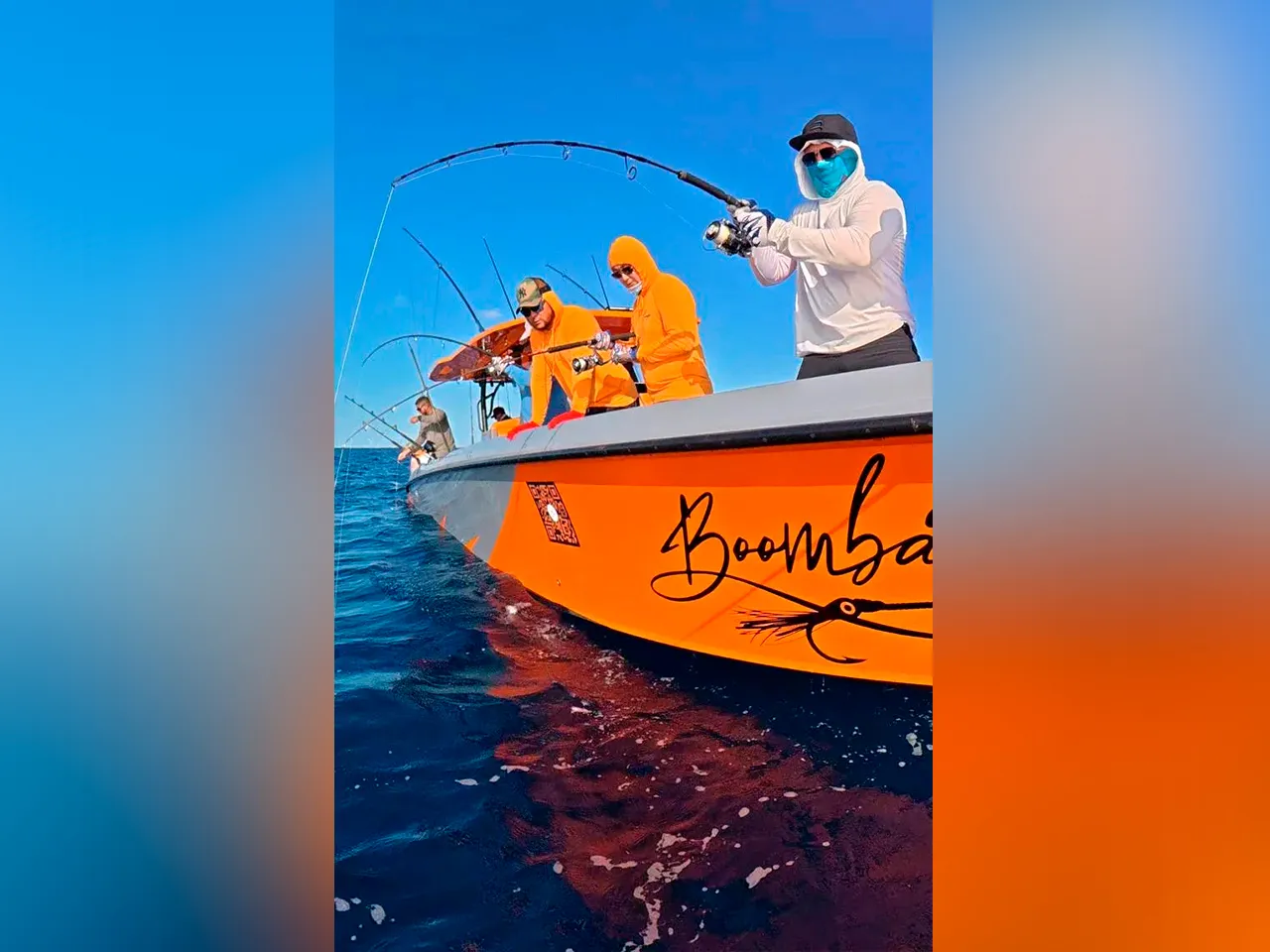
The basic principle here is very simple: the stronger the current, the heavier the jig must be.
Changing the thickness of the braided line could theoretically affect drift, but in practice, this is not used. Reducing the strength of the tackle for the sake of control carries too much risk when targeting such a powerful fish.
Sometimes, not only weight but also the shape of the lure matters. More streamlined jigs hold the vertical better, but in most cases, the problem is solved simply by increasing the mass.
Depth and lure weight selection
The logic here is simple — in depths of 20–40 meters, lighter lures are used (100–150 g, sometimes 200 g), while weight increases with depth (200–400 g).
However, even at shallow depths, a heavy jig may be required if the boat is drifting quickly due to wind or current. In such conditions, it's important to maintain a vertical presentation of the lure — without this, the jig loses its effectiveness.
How to avoid tackle breakage when fishing for dogtooth tuna
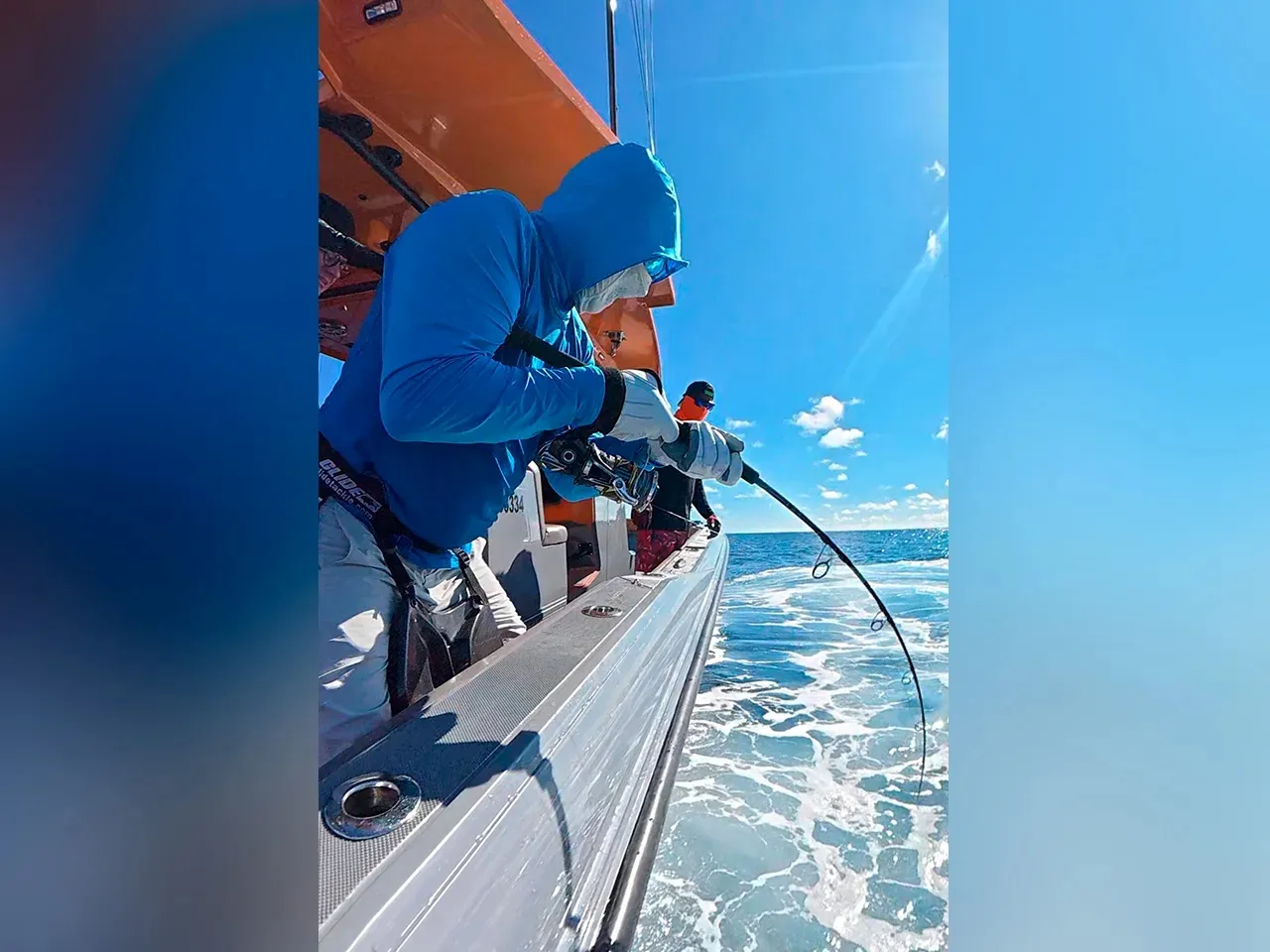
Most tackle problems arise not from poor quality, but from angler error. Even the most reliable equipment requires proper handling.
The key factor is fighting technique. The angler must constantly control the rod position, avoiding an excessive angle of load. Monitor the drag, feel the strength of the line. Excessive tilting "toward yourself" is one of the most common causes of breakage.
These skills cannot be learned theoretically — they come only with practice.
Tackle selection and working with clients on fishing trips
At Boombastic, there is no division of tackle into "beginner" and "experienced."
The reason is simple: the fishing conditions and the fish themselves dictate the equipment requirements. Therefore, we use one proven setup that withstands extreme loads, works in different conditions, and allows us to confidently handle large fish.
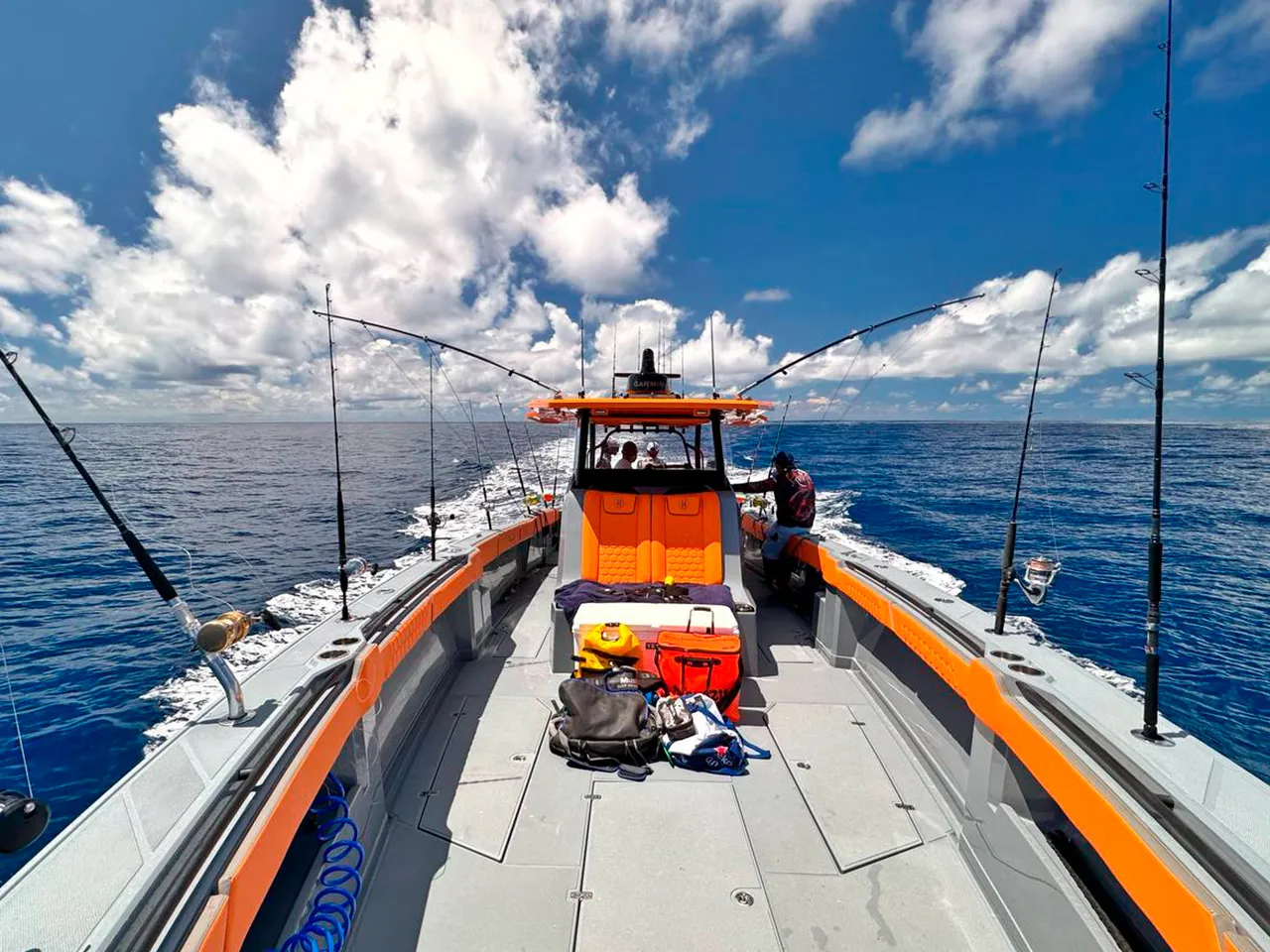
Experienced anglers usually bring their own gear — fully adapted to their fishing style. As for tourists who simply want to try ocean fishing, there's no need to bring anything; everything necessary is already on board.
The equipment used includes:
- Shimano reels
- Testline braided lines
- rods ranging from Patriot Design to Black Hole
Our approach is extremely practical: the tackle should "forgive" mistakes, especially during the learning phase, while still maintaining a strength reserve for battling trophy fish.
A mandatory briefing is conducted before every fishing trip. Its foundation is safety. Guests are explained the rules of conduct on board, the location of safety equipment, methods of communication with the shore, and the basic principles of working with the tackle. Regardless of the language spoken, maximum attention is paid to this stage.
It is also worth noting that alcohol is completely prohibited on board — this is an important part of overall safety.
What challenges beginners face
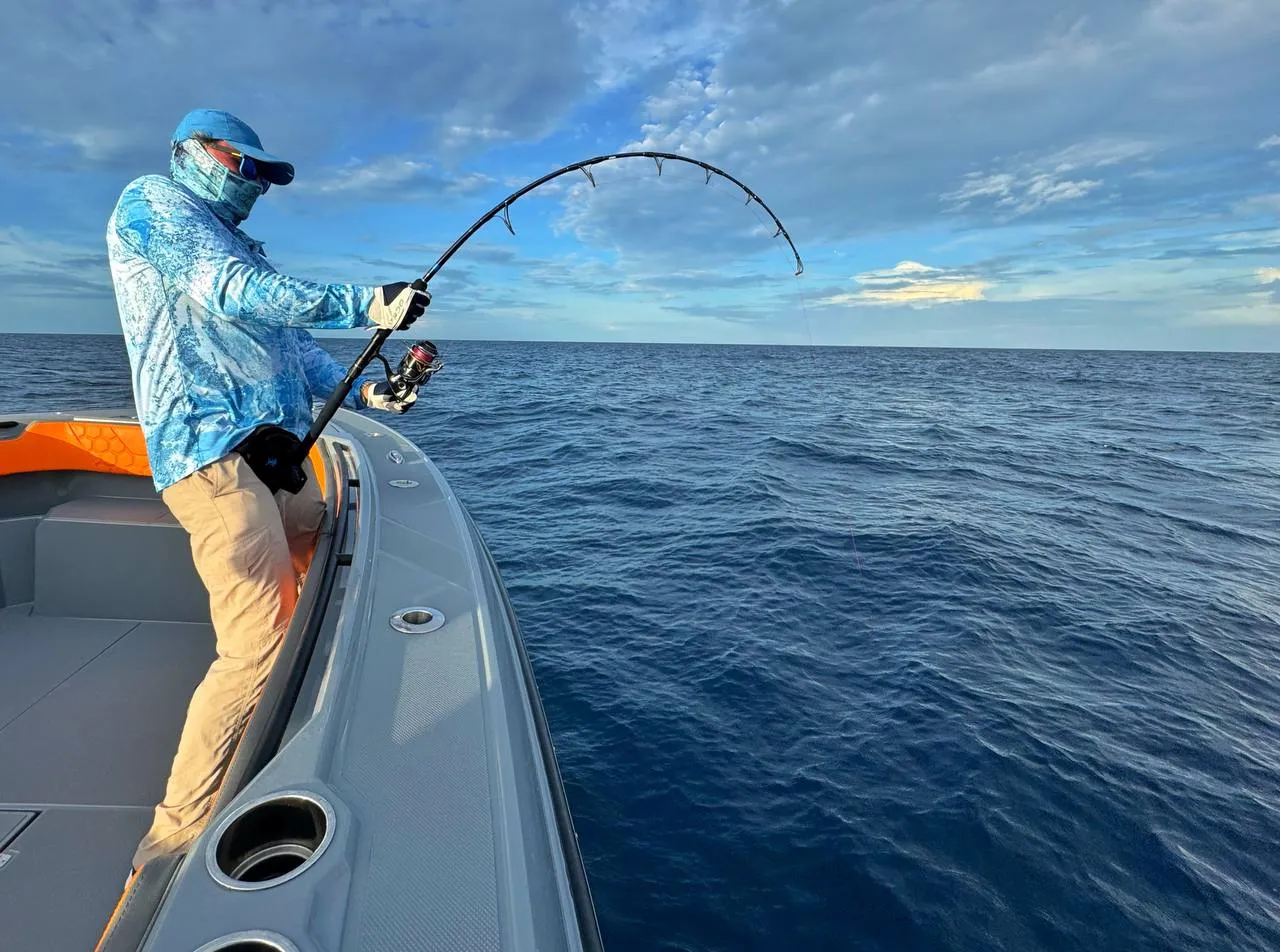
The main issues are the physical exertion during the fight, the unfamiliar conditions of the open ocean, and rapid fatigue. However, fatigue is more often related to a lack of technique rather than physical fitness. Incorrect movements and unnecessary tension lead to a quick drain of energy.
With experience comes an understanding of how to distribute the load and work the tackle more efficiently.
Interestingly, most beginners do not perceive the process as difficult. On the contrary, for them it is a powerful emotional experience.
Angler mistakes when fishing for dogtooth tuna
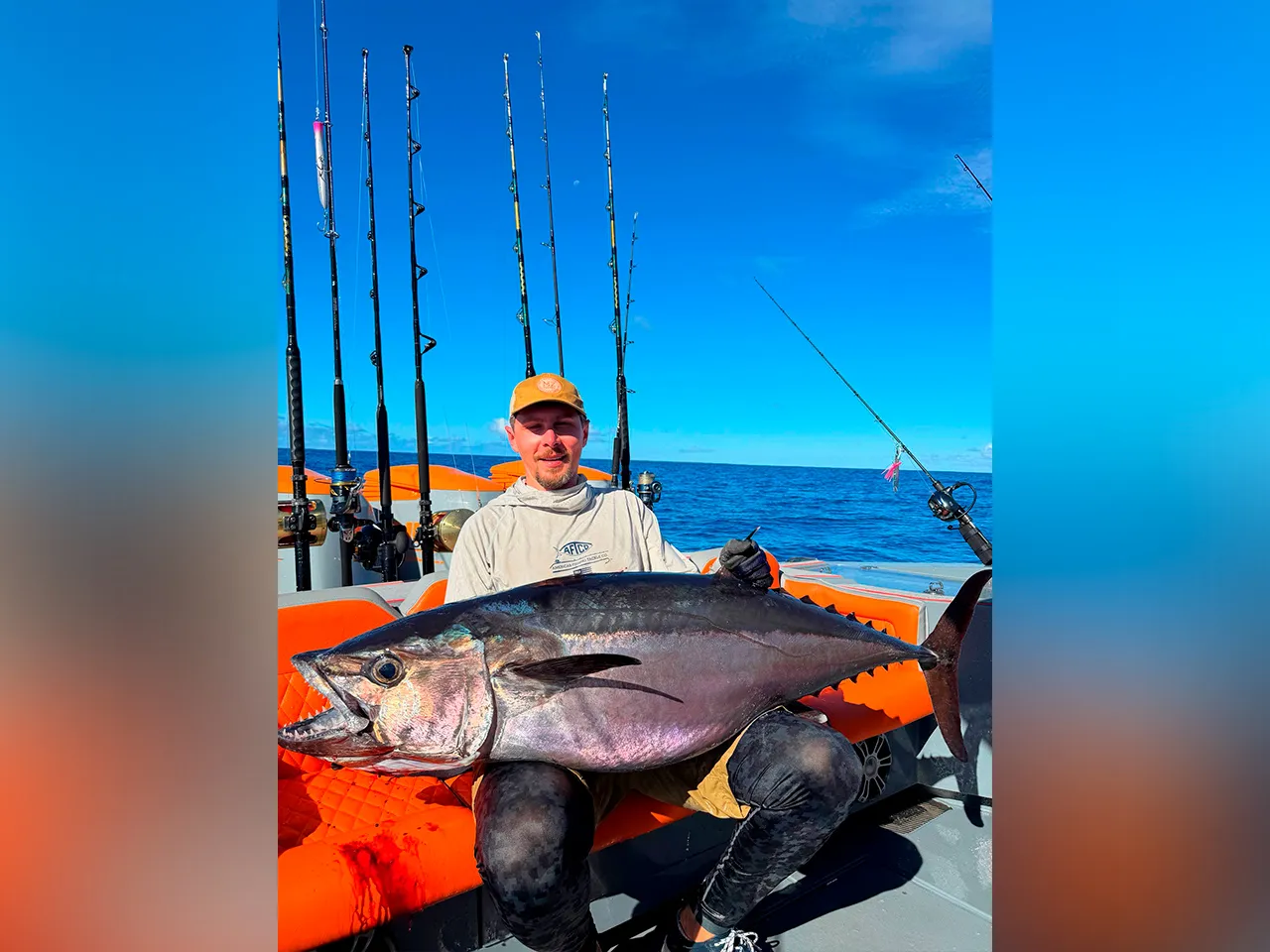
Even with quality tackle and properly selected lures, the outcome of a fishing trip in the Seychelles depends largely on the angler's actions.
The most common mistake is not setting the hook hard enough. A dogtooth tuna strike often comes sharply and aggressively, and if you don't deliver a firm, confident hook set at that moment, the hook simply won't penetrate the fish's mouth. The result is a lost fish within the first few seconds.
Equally important is maintaining constant tension on the line. Even a brief moment of slack can cause you to lose contact with the fish. Dogtooth tuna are known for their ability to change direction instantly, and any pause in tension gives them a chance to escape.
The third typical mistake relates to rod position. Many anglers instinctively try to "winch" the fish in by lifting the rod sharply toward themselves. This creates a critical load angle, overstressing the blank to the point where it may simply fail. Proper technique involves controlling the angle and distributing the load, not a brute‑force tug‑of‑war.
Mistakes in tackle preparation
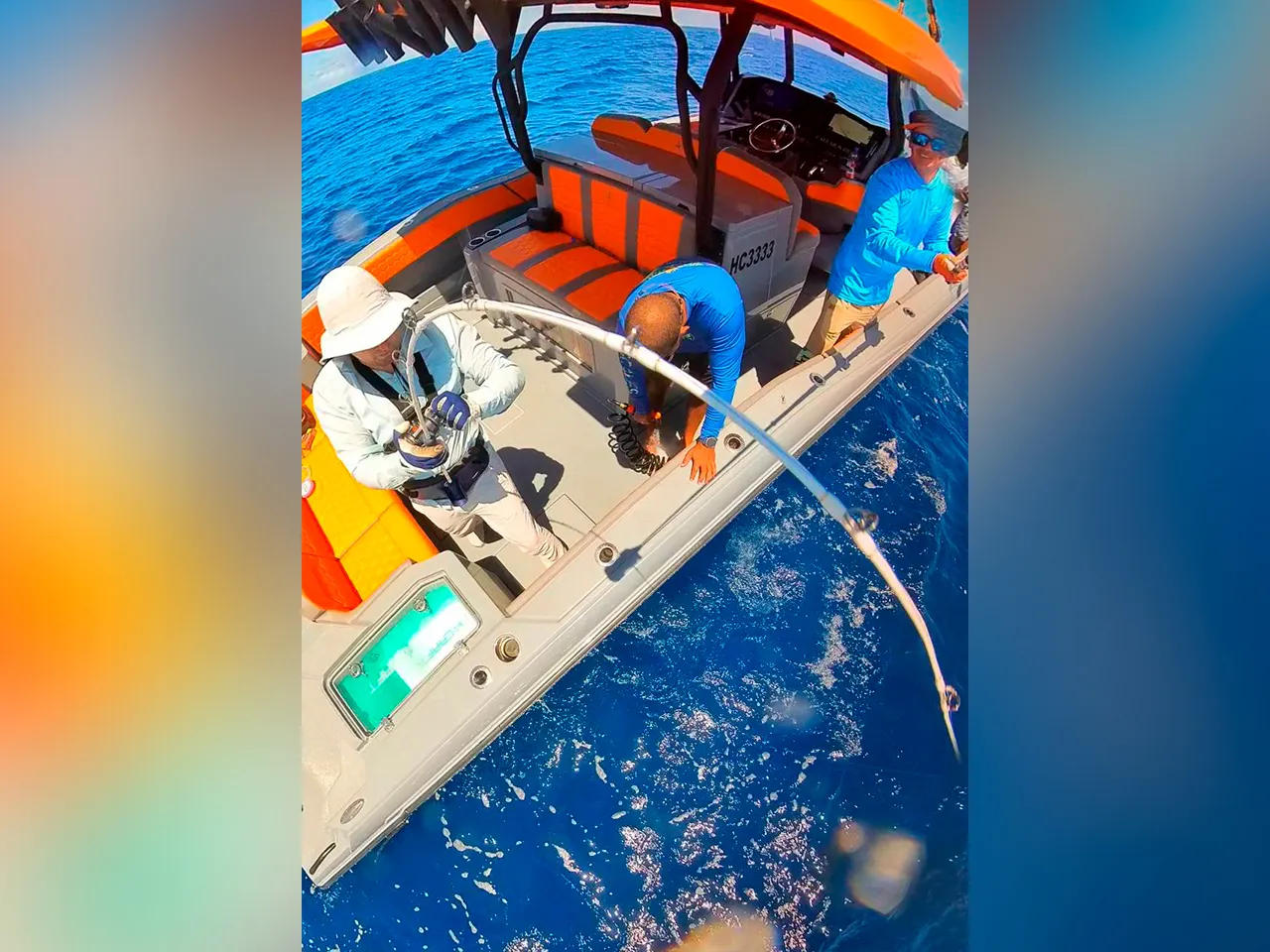
A separate category of problems is related not to technique but to tackle preparation. Here, the human factor most often comes into play — carelessness or simple laziness.
In practice, this looks like: the angler fails to check the condition of the shock leader after contact with a fish or coral, continues to use dull hooks, or ignores deformed split rings. Sometimes knots are used that the angler is not fully confident in, or components that are not rated for such loads.
Skimping on the small things is especially critical. Too‑thin assist lines, weak hooks, or worn‑out rig components will almost certainly lead to the loss of a trophy.
In dogtooth tuna fishing, there are no minor details — the entire system must be as reliable as possible.
What anglers most often underestimate
Even when using powerful tackle, many anglers are psychologically unprepared to work at full load. There is a feeling that the tackle "won't hold," and as a result, the angler consciously reduces pressure on the fish.
This leads to the opposite effect. The dogtooth tuna gets an opportunity to go deeper, reach the reef, or simply build a critical distance. Under such circumstances, the chances of successfully landing the fish drop dramatically.
It is important to understand that modern, high‑quality tackle is designed for serious loads. And if it has been chosen correctly, it must be used to its full capacity — not "saved" at the most critical moment.
Recommendations for successful dogtooth tuna fishing in the Seychelles
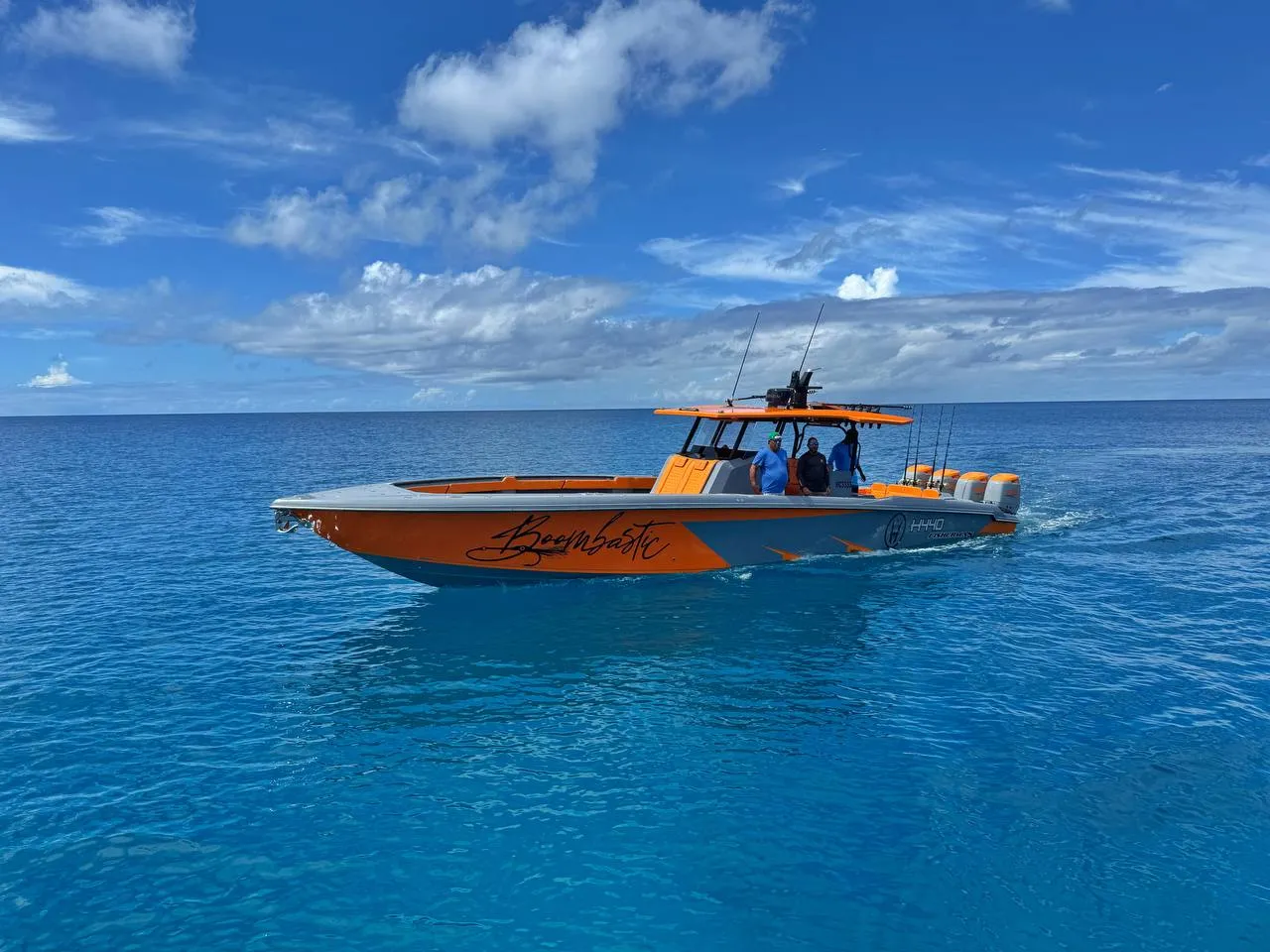
First and foremost, pay attention to the choice of team and boat. Fishing in the Seychelles depends directly on the captain's experience, knowledge of the spots, and ability to adapt to ocean conditions. That is why fishing with a professional team like Boombastic significantly increases your chances of success.
The second important factor is tackle. Dogtooth tuna leaves no room for compromise, and any weak link in the system will eventually show itself. That is why preference is always given to the highest‑quality, most reliable setups. Whenever possible, it is better to use your own gear, because even with good maintenance, rental equipment operates under constant load and loses some of its reliability over time.
Equally important is checking the condition of the entire rig before every fishing trip. Carefully inspect the knots, the condition of the shock leader, the sharpness and strength of the hooks, and the reliability of all terminal tackle components. In ocean fishing conditions, even a minor defect can result in a lost fish.
Another key factor is discipline during the fishing itself. Dogtooth tuna demands precise, confident actions: a powerful hook set, constant line tension control, and proper rod work. Any mistake, even a brief one, can cost you the trophy.
Finally, it is important to understand that this type of fishing requires physical and mental readiness. It is not a passive wait for a bite, but an active effort where results come through hard work, concentration, and experience.
The most memorable dogtooth tuna catch recorded by Boombastic guests
Around March 2025, one of our guests went out on the ocean with a setup that was extremely light — almost "non‑specialized" by the standards of this type of fishing.
The rod had a casting weight rating of up to 200 grams, a thin PE‑3 braided line, a jig of about 150 grams, and, essentially, a very light hook — the kind you'd typically find in freshwater crucian carp fishing, not in the pursuit of a large ocean predator. Yet, on this very setup, he managed to land a dogtooth tuna.
In the team's estimation, this was clearly a trophy over 50 kilograms, possibly in the 70‑kilogram range, although no precise weighing was done — it was one of those situations where the experience itself was more important than the numbers.
The fight with the fish was long and emotional. Almost our entire team took part in the landing process. The guest would periodically hand off the rod, then take it back, move around the boat, react to every move of the fish — the whole scene resembled a lively, almost chaotic performance on the water.
It's important to note that despite the apparent spontaneity of the process, the team was fully in control of the situation, step by step guiding the fish toward the final outcome. At a certain point, no one was really sure what exactly was on the end of the line — so powerful and unconventional was the fish's behavior in the depths.
In the end, the dogtooth tuna was successfully brought up and secured alongside the boat. To date, we have not encountered any other such unusual situations.