

Sossusvlei and Dead Vlei in Namibia are generally considered easy to reach by car. The red dunes, the white, cracked pan, the black tree skeletons, and the cloudless blue sky all come together in the frame on their own, and it seems that all the photographer has to do here is press the shutter button.
In reality, between you and this picture lie 66 kilometers of road from the gate, 325 meters of loose sand, and a set of traffic rules that the ministry has changed three times in the past six months. But most importantly, there’s the light: at dawn, this is one of Africa’s most recognizable landscapes, but at noon, the very same scene looks as flat as a postcard from a newsstand.
We figured out how the park gates work, when and how to climb “Big Daddy,” what has changed along the road to Dead Vlei, and why its trees haven’t rotted away in seven centuries. So that you can start your morning in Namib by watching the sunrise from the crest of a dune, rather than waiting in line at the barrier.
Why Isn't It "Death Valley"?
Half the meaning is hidden in the titles here, so let’s start with them.
Sossusvlei has a compound name. In Afrikaans, “vlei” means “swamp,” and “sossus” translates from the Nama language as “no return.” This means a marsh from which there is no escape, and it is an accurate description of the place: the seasonal Tsauchab River flows into it here, but it has no outlet. The water arrives, spreads across the flat clay basin, and seeps into the ground without ever flowing out. Major floods are rare—sometimes several years pass between them—and when they do occur, the dry crust of the pan softens and becomes sticky.
Deadvlei (Dooie Vlei / Deadvlei) is almost always translated as “Dead Valley,” but this is a mistake. “Valley” in Afrikaans is “vallei,” and “vlei” means a body of water or a marsh. Deadvlei means “dead marsh”: a place where water once stood, but has now dried up. That is why it does not look like a valley between mountains, but rather like the bed of a former lake. The flat white clay, crisscrossed by cracks forming polygons, is surrounded on all sides by enormous dunes.

Why Get Up Before Dawn?
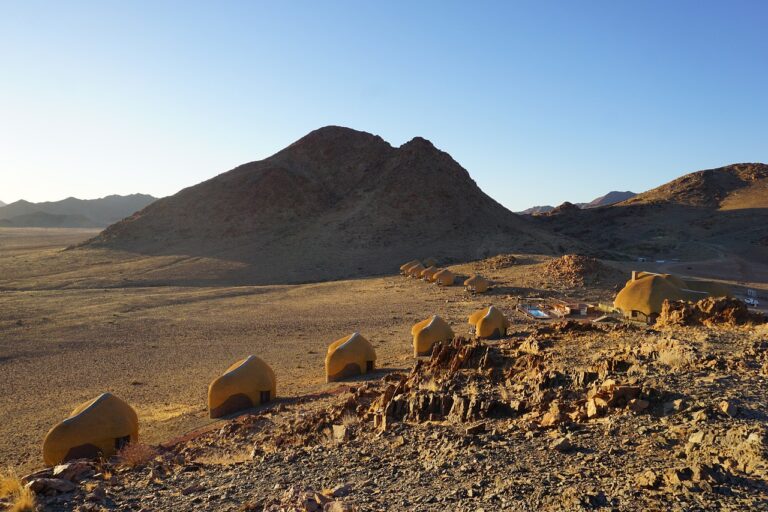
The first reason has to do with the gate system, which isn’t usually mentioned. There are two gates in Sesriem. The outer gates open exactly at sunrise and close at sunset. The inner gates lead into the desert itself and open about an hour earlier. Only guests staying overnight within the perimeter can drive through them before sunrise, and there are only four such places: two lodges and two campgrounds.
The advantage here isn’t as great as it seems. You’ll drive the first few kilometers from the inner gate in the dark, with a speed limit of sixty kilometers per hour, so you’ll reach the dunes just as dawn breaks—but not much earlier.
The main advantage of spending the night inside is that there’s no line at the outer gate. During peak season, dozens of cars gather there, and each one will head to the dunes before you do, so if you’re spending the night outside, you should arrive at the gates about an hour before they open.
The second reason has to do with the sand. As noon approaches, it gets so hot that you can no longer walk on it barefoot, and climbing the dune in the heat becomes an exhausting ordeal. At dawn, the sand is cool and slightly damp from the night, making it noticeably easier to walk on, and many people climb the dune without any shoes at all.
The third reason also has to do with the sand—only this time, it’s under the wheels. By lunchtime, it becomes so loose that even an all-wheel-drive vehicle struggles to cover the last few kilometers.
The fourth reason is the light—the very reason for all of this. In the first half-hour after sunrise, the sun is low in the sky, the shadows are long, the eastern slopes glow with a reddish hue, and the western slopes fade into a cool lilac. By noon, the sun is directly overhead, the shadows disappear, and with them goes that famous dramatic contrast. The same dunes and the same backdrop result in a lifeless photograph.
We’ve saved the fifth reason for a separate section below.

The Road to the Sossusvlei and Dead Vlei Dunes in Namibia
It’s about 350 kilometers from Windhoek to Sesriem, which is a five-hour drive. Technically, it’s possible to make a day trip to the dunes, but there’s little point in doing so: a ten-hour drive will leave you with no energy and no chance to see the sunrise—which is the whole reason people come here.
It’s about 66 kilometers from the gate to Sossusvlei. The first sixty kilometers are on paved roads, and if you stick to the speed limit, the drive takes about an hour. Along the way, you’ll pass Dune 45, which got its name simply from its kilometer marker.
Then the asphalt ends, and the sand begins. This spot is called the “2×4 parking lot”: you can’t go any further without four-wheel drive. The remaining five or six kilometers to the parking lot at Dedvley can be covered either in a modified vehicle or by shuttle.
The Shuttle: A Story That Unfolded Three Times in Six Months
In December 2025, the concessionaire that transports tourists from the 2×4 parking lot announced, together with the ministry, that private vehicles would no longer be allowed beyond the parking lot. A few days later, the ministry clarified that the concession agreement did not include such a ban, and the closure was rescinded.
In April 2026, the ban was announced again, this time on behalf of the ministry and effective May 1. The industry was outraged, and tour operators and members of parliament accused the ministry of creating a monopoly. The ban lasted exactly one day: on May 2, a new notice was issued that rescinded all previous ones. All-wheel-drive vehicles were once again permitted to drive on their own, shuttle service became optional, and the ban remained in effect only for buses and trucks.
Three official policies in less than half a year. The May policy is currently in effect, but the concessionaire is challenging it, so the rule may change again. It’s worth checking again before your trip. A round-trip shuttle costs 260 Namibian dollars (about €14) for an adult and 130 (about €7) for a child under twelve.
If you’re driving yourself, here are two tips that will come in handy. Before hitting the sand, lower your tire pressure as recommended by the rental company: this will widen the contact patch and prevent the car from getting stuck. And stay in the tracks behind the shuttle, because local drivers know exactly where the sand holds.

"Big Daddy": Climbing One of the World's Tallest Dunes
“Big Daddy” rises about 325 meters above the pan and is considered the highest point in the Sossusvlei area. It is not a Namib record, however: Dune 7 near Wolfish Bay is taller, reaching approximately 388 meters. Locals call “Big Daddy” the Crazy Dune, and standing opposite it is another giant dune named “Big Mama.”
In terms of shape, this is a star dune with three or more “rays.” Such dunes form where the wind constantly changes direction: the sand has nowhere to go, so it accumulates in one place, and the dune grows upward.
The ascent follows the ridge, and there’s one thing you should know in advance. In some places, the ridge narrows to half a meter, and the sand drops away on both sides. There’s no real danger—the trail is well-trodden—but anyone with a fear of heights should be prepared for this.
It’s tough here not because it’s steep, but because the sand slips away from under your feet: two steps forward, half a step back. An average adult in decent shape can make the climb in forty-five minutes to an hour; at a leisurely pace with breaks, it takes an hour and a half. Someone who sets out late and gets caught in the sun might take the full two hours.
There’s one detail that almost no one warns you about. After the first plateau, the trail descends again, and you lose some of the elevation you worked so hard to gain before the main ascent begins. Psychologically, this is the most unpleasant part of the route, and many people stop right there on the first plateau. You can already see Dedvley from there, so it’s a perfectly reasonable decision.
There’s also a direct route, straight up the slope. Guides call it the “leg-breaker,” and the name speaks for itself. If you do decide to take it, zigzag your way up the steepest section—that way, less sand shifts beneath your feet. And on the ridge, stick to the very top: the sand is denser there, so your feet sink in less.

The descent that was the whole reason for this whole thing
From the top, most people don’t head back along the ridge but go straight down the slope toward Dedvley. You lose 300 meters in elevation in about ten minutes, and this is the most fun part of the day. Your feet sink ankle-deep into the sand; you’re essentially falling forward in controlled leaps, and it’s hard to stop even if you want to.
For those who decide to skip the lift, it’s about a kilometer from the parking lot to Dedvley—a walk of roughly 15 minutes across the dune, following the white marker posts. It’s best to stick to the posts: the surrounding landscape is monotonous, and it’s easier to get lost here than you might think.
The transition below is almost theatrical. A second ago, there was red, loose sand underfoot, and now there’s solid white clay.

Trees that haven't rotted in seven hundred years
Once upon a time, the seasonal Tsauhab River flowed all the way here, and camel acacias grew along its banks. About nine hundred years ago, the climate became drier, the dunes blocked the riverbed, and the trees, after surviving for another couple of centuries, died.
That’s where the real fun begins. In a normal climate, a dead tree rots away over the course of several decades, but here it has become so dry that there’s nothing left to cause decay: no moisture, no fungi, and no bacteria. The trees have turned black in the sun and remain standing.
They are often referred to as “petrified,” but that is inaccurate. No mineralization has taken place; the wood has simply dried out. Before you are the very same tree trunks that have stood here, dead, for six or seven centuries.
Hence the rule you need to know before you arrive: don’t touch the trees—and definitely don’t climb them. A trunk that has stood for seven centuries can snap from a single ill-advised hug just to get the perfect photo.
The place only seems lifeless. Along the edges of the plain grow solyanka bushes and thickets of nara, a prickly desert melon, and they all thrive on the morning mists from the Atlantic.

The Fifth Reason to Wake Up Early: The Beetle That Drinks the Fog
Since 2013, the Namib Sand Sea has been listed as a UNESCO World Heritage Site. The site covers more than three million hectares, and UNESCO documents refer to it as the world’s only coastal desert where vast dune fields are shaped by fog.
It hardly ever rains here, but fog from the ocean rolls in along the coast about every third day and extends more than a hundred kilometers inland. It reaches the Sossusvlei dunes less frequently—a few dozen times a year—but thick fog can deposit up to seven and a half liters of water per square meter in a single night.
All of life here revolves around this water, and there is, as it turns out, a surprising amount of it. The sandy sea is home to about three hundred species of plants and animals, and more than half of them are found nowhere else. According to some estimates, no other desert in the world can boast such a large number of endemic species.
The most famous local resident is the black-backed beetle, known as the “fog beetle.” At dawn, it emerges onto the crest of a dune, positions itself upside down at an angle of about forty-five degrees, and exposes its back to the wind. Moisture condenses on its shell, rolls down toward its head, and drips straight into the beetle’s mouth. An hour later, the fog lifts, the sun rises, and the beetle disappears into the sand until the next morning.
Living nearby are the dune gecko, which burrows into the sand to escape the heat; the wheel spider, which curls up into a ball and rolls down a slope to escape predators; and the dune lark, the only bird found exclusively in Namibia. Oryxes, springboks, and ostriches roam the plains.
So on that very ridge you’re climbing to take in the view, there’s a spectacle unfolding at dawn. You can see it for only about an hour.

What to See Nearby
Dune 45 stands right by the road at the 45-kilometer mark, which is where it gets its name. It rises about 80 meters, and the climb up it is noticeably shorter and easier than that of “Big Daddy.” The sand in it is about five million years old: the Orange River carried it from the Kalahari to the ocean, and the wind brought it back to land.
Sossusvlei itself lies about two kilometers from Dead Vlei. The landscape there is similar, but the trees are smaller and the clay isn’t as white, which is why many people simply don’t make it there, even though it was this very place that gave the entire area its name.
Hiddenvale is tucked away a couple of kilometers from the parking lot. There are almost no signs, so it’s usually deserted. The walk takes about an hour and a half, and you’ll most likely have the place all to yourself.
The Elim Dune is located five kilometers beyond the gate. It is about 100 meters high, partially overgrown with grass, and makes for a great spot to watch the sunset on the way back from the park.
Sesriem Canyon lies a few kilometers from the gate. It is about one kilometer long and up to thirty meters deep, and was carved out by the same Tsauhab River. The name translates from Afrikaans as “six straps”: settlers would tie together six rawhide straps so that a bucket could reach the water. This single detail explains the local area better than any description.
A hot-air balloon ride at dawn requires a separate booking and a separate budget. It costs 10,720 Namibian dollars per person (about €580), and this price includes a one-hour flight, transportation, and breakfast after landing. There is only one operator in the area, so spots sell out quickly.

What to Bring
The list is short, but every item on it has been hard-won:
- water—at least one liter per person, and more if you’re leaving late;
- Closed-toe shoes and thick socks: It’s comfortable to climb barefoot, but it’s better to wear shoes when descending and walking along the path;
- a flashlight or headlamp if you’re driving after dark;
- a buff or a scarf, because the wind blows sand in your face at the crest;
- Warm clothes for the morning: it gets really cold in the desert before sunrise;
- Namibian dollars in cash. They accept cards at the gates, but the connection isn’t always reliable, so it’s best to withdraw cash in the last major city on your route.
Sossusvlei with Boombastic Tours
Everything mentioned above is decided in advance, not at the barrier. We plan the route so that you spend the night on the right side of the gate, so that dawn finds you already at the dunes, and so that the question of whether they’ll let your 2×4 vehicle into the parking lot today doesn’t even come up. The guide knows where the sand holds best on the crest of “Big Daddy,” when to turn toward Hidden Valley to be the only one there, and when the fog will drive the beetles out onto the dune.
Let us know when you’re planning your trip, and we’ll put together an itinerary for you in Namibia that includes Sossusvlei at the time of year when it looks its best.