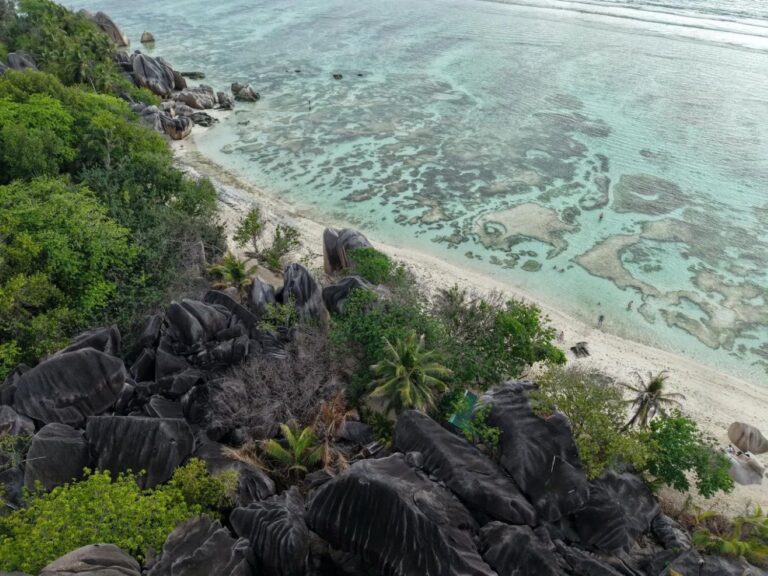


Есть инстаместа Сейшельских островов, которые узнаешь по одной фотографии, еще не зная их названия. Гранитные валуны в бирюзовой воде, пальма, склонившаяся над белым песком. Это Сейшелы, и такие кадры давно живут на заставках смартфонов по всему миру.
But there’s another side to the archipelago that tourists usually skip on their way to the famous beaches. Viewpoints overlooking the jungle, tiny picture-perfect islands, red earth where turtles roam, and real pirate graves just a fifteen-minute boat ride from the capital.
Inthe first part, we compiled a list ofseven of the archipelago’s most recognizable locations. Now let’s move on and show you some places that don’t often make it onto lists, but are just as impressive. And while we’re at it, we’ll give you some tips on how to plan a route between them so you can visit them at their best, rather than in the midday heat along with three buses.
Victoria: a capital city that people usually just drive past
Most visitors only catch a glimpse of Victoria—one of the world’s smallest capital cities—from a taxi window on the way from the airport. And that’s a shame. You can easily walk around the compact downtown area in a couple of hours, and the photos you take here are anything but postcard-perfect.
The easiest place to start is at the Clock Tower in the very heart of the city. It was erected in 1903 in memory of Queen Victoria, and locals affectionately call it “Little Big Ben.” In reality, it’s a replica of the modest clock at London’s Victoria Station, but “Big Ben” just sounds more impressive.
A few blocks from the tower stands Arul Mihu Navasakthi Vinayagar, the country’s only Hindu temple. Its colorful, intricately carved tower at the entrance easily earns it the title of the capital’s most photogenic building.
If you’re looking for greenery and shade, the National Botanical Garden—founded in 1901—is just a twenty-minute walk from downtown. Here you’ll find coco de mer palms bearing the world’s largest nut, and in a separate enclosure, Aldabra giant tortoises, some of which are over 150 years old. Admission is 250 rupees.
The best light in the city is before noon, before the sun reaches its zenith and the tour groups start arriving. It’s convenient to make a walk through the capital a separate item on the itinerary and combine it with a transfer from the hotel.

Mae: Viewing Platforms and a Waterfall in the Jungle
The Seychelles aren’t just at sea level. Once you climb a little higher, the island reveals a completely different view.
The most accessible panoramic view is from the Copolia Trail in Morne Seychellois National Park. The trail isn’t long—about one and a half kilometers—but it’s steep in places, and it leads to a granite plateau nearly 500 meters above sea level.
From above, Victoria, Eden Island, and St. Anne Marine Park are clearly visible, and on a clear day, you can even see Praslin and La Digue. Admission is 100 rupees for visitors over 12 years old, and payment is accepted only by card. The trail is open from 8 a.m. to 4 p.m., and it’s best to set out early, before it gets hot and while the morning mist still hangs over the forest.
The second lookout is called Mission Lodge, also known as Venn’s Town, and stands on a ridge along the Sans Souci Road. Here in the forest, the ruins of a 19th-century missionary school for the children of freed slaves remain, and beyond them lies a view of the west coast, where the mountains plunge straight into the turquoise waters. The old stone walls add depth and a sense of history to the scene.
As a contrast to the seaside photos, there’s the Sauzier Waterfall near Port Glover. It’s about a ten-minute walk from the road through a palm grove; admission costs a nominal 50 rupees, and at the bottom, the stream plunges into a natural pool where you can cool off.
And for those who appreciate privacy, it’s worth making your way to Anse Major Beach. You can only get there via a scenic coastal trail (admission: 150 rupees) or by boat, so there are almost no people there. It’s the perfect spot for a clean shot without anyone else in the background.

Saint-Pierre Islet and Curieuse Island
If any silhouette deserves to be called the quintessential Seychelles island, it’s Saint-Pierre. This tiny granite rock off the coast of Côte d’Or, with its coconut palms jutting out, has been gracing advertising posters for decades, and it’s just as stunning in person.
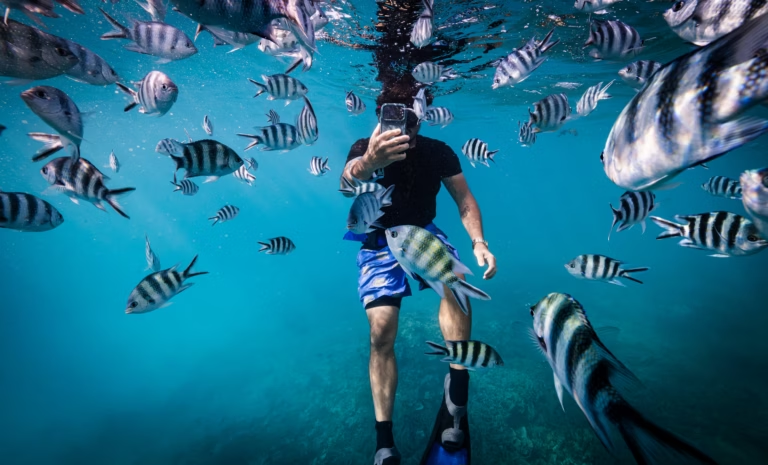
The area is surrounded by some of the clearest waters in the archipelago and offers excellent snorkeling. The only way to get here is by boat, as part of a boat tour from Praslin.
Nearby, just one kilometer from Praslin, lies the island of Curieuse. It surprises visitors with its red soil—unusual for this region—Aldabra giant tortoises roaming freely, and groves of coco de mer palms.
Wooden walkways have been built through the mangrove swamps, making for an easy and very “picturesque” stroll. There are no hotels on the island; it’s open to visitors from 8 a.m. to 5 p.m. Admission for foreigners over 12 years old is 300 rupees, payable by card only. Curios is usually visited in combination with Saint-Pierre, and such a day often ends with a Creole barbecue right on the beach.

St. Anne Marine Park and Moyen's Robinson Island
A 15-minute boat ride from Mahe brings you to St. Anne Marine Park, the first marine reserve in the Seychelles and one of the first in the Indian Ocean. It was established in 1973. It features six islands, crystal-clear water, and coral gardens, and boats depart for the park directly from Eden Promenade. Admission to the park costs 200 rupees.
The park’s crowning jewel, the tiny town of Moyen, looks as if it stepped right out of a Robinson Crusoe novel. Today, it’s known as the smallest national park in the world. Hidden among the tropical greenery are the ruins of old settlements, a small forest chapel, and—most intriguingly—pirate graves. Two of the headstones even bear the inscription, “Unhappily Unknown.”
There’s a legend associated with the island about buried treasure that no one has ever found, despite searching tirelessly. You can walk around Moyen along the trail in about forty-five minutes, encountering giant tortoises every now and then along the way. Admission to the island itself is charged separately. In the waters surrounding the park, you can spot sea turtles, stingrays, and, if you’re lucky, dolphins. On some tours, visitors take a semi-submersible boat with transparent sides for this purpose.
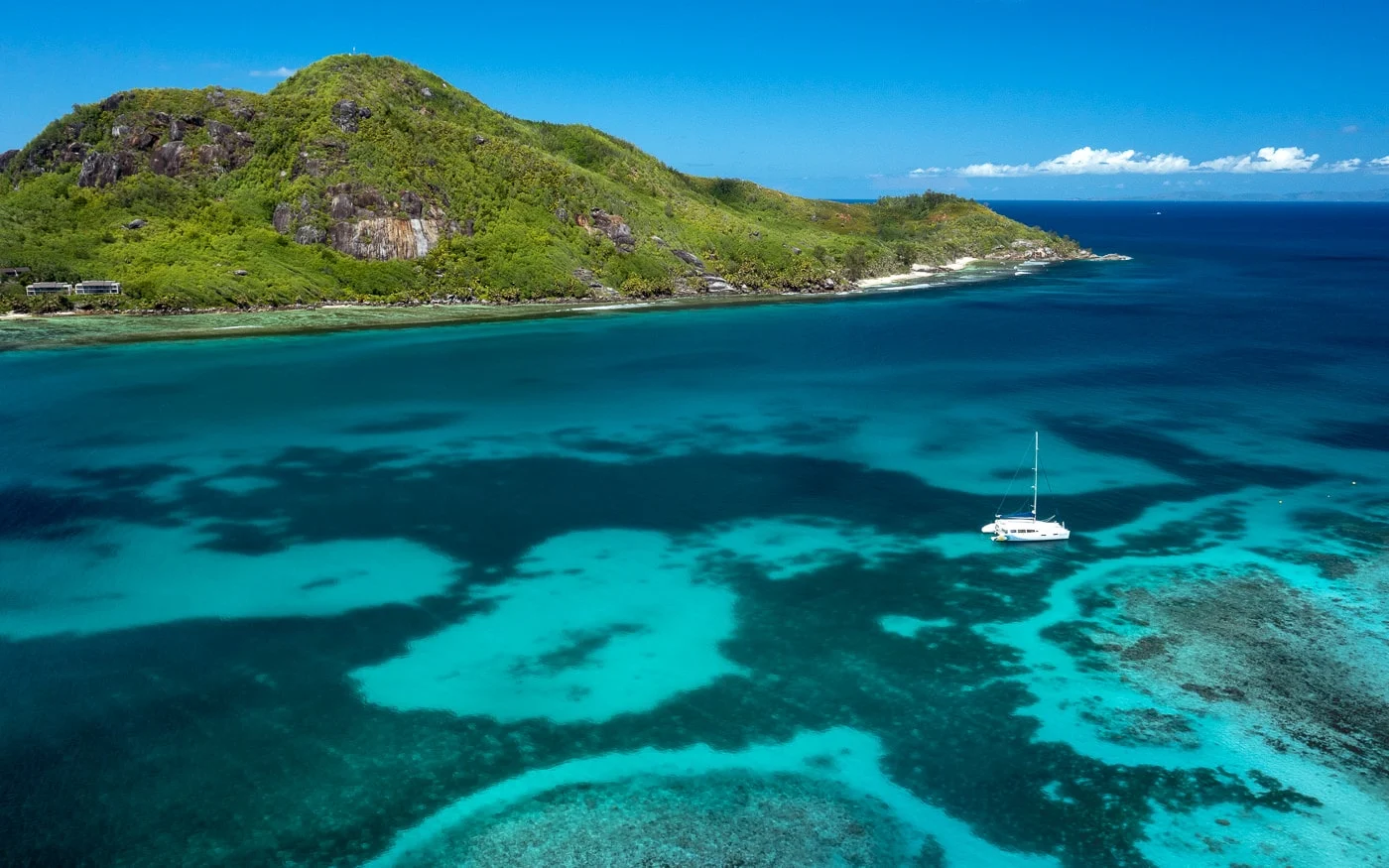
La Digue Island
La Digue is best known for Anse Source d’Argent Beach. But this sleepy, almost car-free island—where bicycles are the main mode of transportation—has more to offer than just its most famous landmark. Instagram Spots in the Seychelles
The island’s longest beach, Grand Anse, lies on the southeastern coast. The wide strip of white sand and the powerful ocean waves make for far more dramatic photos than the tranquil lagoons. However, from April through October, the southeast monsoon brings strong surf and currents here, so during those months, people come here to take photos rather than to swim.
For a real adventure, head to Anse Marron at the southern tip. It’s a natural pool with turquoise water, tucked away among huge boulders. The hiking trail winds over rocks and, in some places, right through the water, and you shouldn’t attempt it without a local guide. For those who aren’t up for the climb, the only other option is to take a boat.
It’s also worth stopping by L’Union Estate, which lies along the route to Anse Source d’Argent. For 150 rupees, you’ll gain access to an enclosure with giant tortoises, an old copra mill, and a French colonial mansion nestled among former vanilla plantations.
Félicité: 750-million-year-old granite
There are places on the archipelago that look as if they were put together by a giant set designer. The private island of Felicite is one such place. Guests are greeted here by pinkish-gray granite boulders that are about 750 million years old, a tropical forest that stretches right down to the water’s edge, and white beaches framed by palm trees. The landscape looks like it belongs in a dinosaur movie, even though the granite here is five times older than any of them.
The only hotel, Six Senses Zil Pasyon, is located at the northern tip and occupies just one-third of the island. The rest remains untouched wilderness. Forest trails lead to a lookout point at the top of the hill and to rare coco de mer palms, while Bissa turtles nest on the beaches, where thousands of hatchlings emerge each year.
It takes about twenty minutes by boat from Praslin to Felicité; it’s even faster from La Digue, and you can fly there by helicopter from Mahé in about the same amount of time. The tiny islands of Coco, Grande-Sœur, and Petite-Sœur are located nearby, and it’s easy to combine them into a single boat tour.

How to Plan a Route Between Instamap Locations in the Seychelles
The main hub here is Mahe. From here, it takes about an hour to get to Praslin on the Cat Cocos high-speed ferry, or 15 minutes by Air Seychelles flight, and the Cat Rose ferry takes the same 15 minutes to get from Praslin to La Digue.
People get around La Digue by bicycle or electric cart. The island’s last oxcart has long since become more of a tourist attraction than a means of transportation. To get to Sainte-Anne Marine Park, you head from the Eden Promenade, and to reach the private islands, you take a boat or a helicopter.
The light here is predictable. The softest shots are taken before 10 a.m. and at sunset, from about 5:30 p.m. to 6:30 p.m.
Be sure to factor in entrance fees in your budget—they add up faster than you’d think. Curios costs 300 rupees, the botanical garden 250, Sainte-Anne 200, L’Union Estate and the Anse Major trail are 150 each, the Copolia trail is 100, Sauzier Falls is 50, plus a separate entrance fee for Moyenne. National parks only accept card payments.
From a practical standpoint, you’ll want to bring water, comfortable hiking shoes, and a waterproof case for underwater shots. If you’re filming with a drone, please respect other people’s privacy and protected areas. For more ideas on where to go between shoots, check out our guide “Where to Go as a Tourist in the Seychelles,” and our team will arrange convenient transfers between the islands to fit your itinerary.
And here are two more formalities you should know about in advance. You don’t need a visa for the Seychelles, but all visitors without exception—including children—must obtain an electronic Travel Authorization. It must be submitted online no earlier than 30 days before departure, and a standard application costs approximately 10 euros plus service fees.
There is also an eco-tourism fee. Starting January 1, 2026, small hotels and guesthouses are exempt from this fee, while larger hotels charge 75–100 rupees per person per night. The same amount applies to stays on a yacht, and children under 12 are exempt. The fee is collected on-site along with the bill for your stay. While it’s a modest amount compared to the overall cost of the trip, it’s best not to be caught off guard by it at the front desk.

The Best Instagram Spots in the Seychelles—From the Water
If you look closely, the best locations in the second installment share a common trait. You can’t reach Saint-Pierre, Curieux, Moyenne, and Félicité by land. And it’s from the water that they truly reveal themselves, because a tiny island photographed from a boat at sunset looks completely different than it does from the shore.
That’s why a boat trip here isn’t just an add-on to the itinerary—it’s half of all the best shots. We organize cruises and island-hopping tours to these destinations on Boombastic speedboats and yachts, ranging from short day trips to multi-day expeditions with overnight stays on board. And since it would be a shame not to cast a line in these waters, it’s easy to add fishing to the trip. For many guests, this becomes the highlight of their day at sea.
The Seychelles rarely disappoint in photos. It’s much harder to see the whole country, rather than just the five most overhyped beaches. The jungle lookouts, the red earth of Curieuse, the pirate trails of Moyenne, and the ancient granite of Felicité are all worth venturing off the beaten path for.
The Boombastic Tours team will take care of everything else—from the itinerary and the perfect lighting to having the boat in just the right spot. Drop us a line, and we’ll help you plan a trip that will leave you with not just a couple of postcard-perfect photos, but a whole story to tell.