
In this article, we’ll explain how the underwater topography of the Seychelles differs from the rest of the Indian Ocean, where to look for sharks, turtles, and shipwrecks, where to go with just a snorkel mask if you’ve never dived before, — and during which months it makes sense to plan all of this.
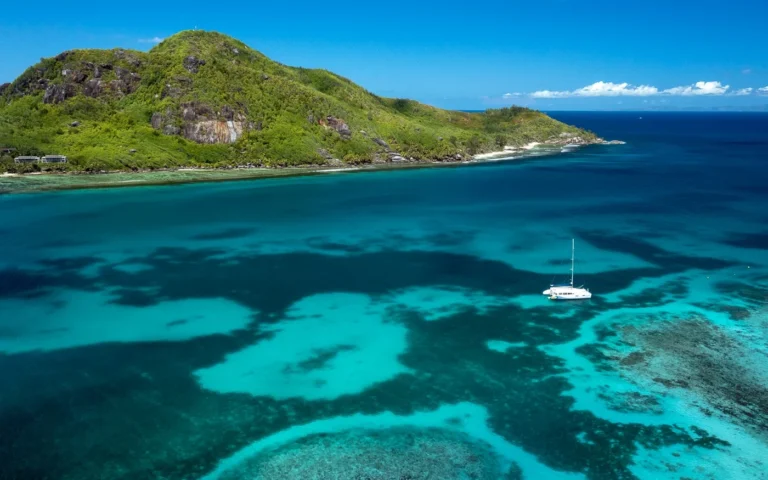
The inner islands of the Seychelles lie on a shallow plateau, and underwater, the landscape looks completely different from that of the atolls. Instead of flat coral fields, there are piles of granite boulders overgrown with soft corals and gorgonians, canyons, sheer walls, and pinnacles rising from the seafloor almost to the surface. Nowhere else in this ocean is there a seafloor landscape like this.
Thirty percent of the country’s ocean area has protected status—that’s 410,000 square kilometers, an area larger than Germany. This status was achieved through a deal that no one had ever done before: part of the country’s foreign debt was exchanged for a commitment to protect the ocean. The goal was set in 2012, when 0.4 percent of the country’s marine area was protected, and the goal was achieved in March 2020—ten years ahead of the global target.
Let’s get one thing straight: snorkeling here isn’t quite as impressive as in the Maldives, since some of the reefs have seen better days. Diving, on the other hand, is top-notch. It’s the main reason to fly out here.
When to Go to the Seychelles for Diving
There are two best times to visit: March–May and September–November. These are the inter-monsoon periods: the ocean calms down, visibility reaches thirty meters, the water warms up to thirty degrees, and the boats can finally reach distant destinations.
From June through August, the southeast monsoon arrives. The water cools to about twenty-five, becomes rich in plankton, and visibility drops to fifteen to twenty meters. But it is precisely the plankton that attracts the whale shark here. Its season runs roughly from August through November, peaking in October. And let’s be clear: no tour operator can offer any guarantees.
The encounters became noticeably less frequent, and there were years when no shark dives were conducted at all.

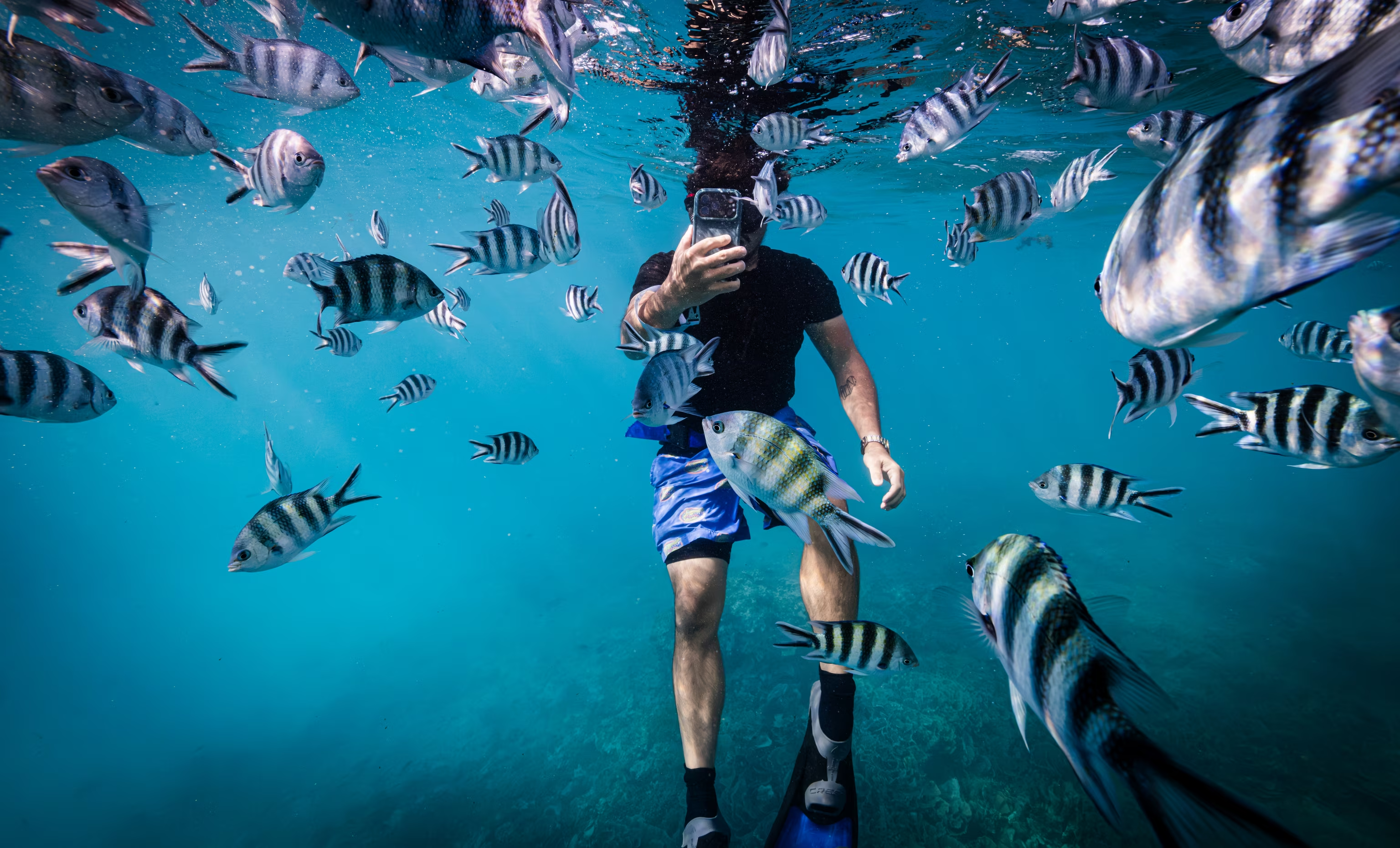
The easiest place to start is Aquarium: there’s almost no current, and on the seafloor you’ll find everything that makes people put on a mask for the first time—parrotfish, moray eels, clownfish in anemones, turtles, and octopuses. Next door is Lighthouse, a drift dive along granite cliffs at depths of 17–32 meters, where green sea turtles and wrasse swim, and manta rays sometimes pass by.
This is where the real action begins. Brissare Rocks and Dragon’s Teeth are two rocky islets to the north, where strong currents draw in barracudas and small sharks. L’Ilot is a tiny granite outcrop that you can circle entirely in a single dive.
And the main attraction here is Shark Bank—a granite plateau about eight kilometers to the northwest, where the depth ranges from 20 to 40 meters. This is a cleaning station: those who are unlikely to be found elsewhere come here to be cleaned—whitetip sharks, eagle rays, napoleon wrasses, large groupers, and occasionally hammerhead and whale sharks. It’s an open area; during the monsoon, waves can reach up to two meters.
An important clarification: You can’t go snorkeling at Shark Bank, no matter what the ads promise. The depths aren’t right.
Nearby points are about a fifteen-minute walk. Medium-distance ones take 20–45 minutes. Far-off points can only be reached in calm weather and only by speedboat; otherwise, the trip takes up the entire daylight hours.

The Story of a Tanker
In 1970, the British tanker Ennerdale was leaving Victoria to refuel a frigate. It had not yet left the calm waters off the city when it struck a granite rock that was not marked on any map. The 216-meter-long vessel, fully loaded with oil, sank to the bottom in half an hour. Every single person was rescued.
But there is a cruel irony in all this: the ship was sunk by the very granite that divers come here to see. An uncharted pinnacle in the middle of a bay that was considered safe.
It was determined that salvaging the tanker was impossible, so the hull was deliberately blown up: they waited until the wind was blowing away from the shore, opened the tanks, and discharged the oil into the open ocean. The explosives were delivered by helicopters.
Today, it lies at a depth of thirty meters, listing to port. The hull is shattered, but the wheelhouse is intact, and you can go inside it. The huge bronze propeller is a sight to behold. This dive is for experienced divers only, and visibility here is unpredictable.
There’s plenty of other dive sites nearby as well: the Dredger at 25 meters, the Aldebaran at 30–40 meters, and the Twin Barges—two barges at 16 and 23 meters—which are perfect for night dives. All of them have long since become overgrown with coral and turned into full-fledged reefs.

Praslen and La Digue
The region’s main highlight is South Marianne: caves, boulders, pinnacles, and a strong current where you drift past eagle rays, reef sharks, wrasse, and giant moray eels. This location is for experienced divers only.
The waters are calmer at Aride Bank, where nurse sharks hide among the rocks, as well as at Booby Rock and Ave Maria Rocks with their granite tunnels. In total, there are up to seventeen dive sites around Praslen at depths ranging from eight to twenty meters.
Night diving deserves special mention. After sunset, the rocks come to life: soft corals unfurl, spiny lobsters and crabs crawl out of crevices, and the seabed, so familiar by day, becomes unrecognizable.
If you only have a mask
St. Anne Marine Park was established in 1973 around six islands five kilometers from Victoria—it is the first marine protected area in the entire southwestern Indian Ocean. It features 14 square kilometers of coral gardens and seagrass beds, and manta rays regularly visit the area from April through December. Surf Island is home to the country’s only snorkeling trail. We wrote about this and other popular spots in our guide to tourist attractions.
Port Lone and Bae Ternay—shallow, calm waters, with more than sixty species of fish. The best spot for first-timers and for kids. Plus, Port Lone is the only park you can simply walk to.
At Anse Lazio, divers explore the rocks from both ends of the beach, and conditions change literally from day to day: the right side might be murky, while the left—at the very same hour—might offer a close-up view of a turtle. At Anse Sources d’Argent, the reef forms a lagoon where the water is rarely deeper than waist-high. People head to Île Cocos for the island itself, even though the corals there aren’t what they used to be—but along the way, there’s the Félicité Reef with its bissa and eagle rays.
The east coast of La Digue is incredibly beautiful, but it’s dangerous for snorkeling. The waves and currents there leave no room for error.

How to Swim with a Whale Shark in the Seychelles
There is a program that few people know about. Since 1996, a local marine conservation organization has been monitoring whale sharks and tagging them—and it was this work that led the government to designate the species as protected in 2003. You can join the program.
Here’s how it works. First, a microlight circling the island searches for sharks from the air. If one is spotted, a boat carrying researchers and guests sets out from Bo-Vallon. Then you enter the water under the guidance of a marine biologist while the animal is tagged, and the proceeds go toward the program itself.
You don’t have to be a diver—it’s just snorkeling. And this is perhaps the most authentic way to see the largest fish on the planet: not as a tourist attraction, but as someone actively involved in the work that protects this fish.
Why Corals Aren't What They Used to Be
We’ve mentioned twice that the reefs aren’t in perfect condition, so now it’s worth explaining why. The reason is bleaching: overheated water causes the coral to expel the algae that feed it, and it turns white. If the heat subsides quickly, the coral survives. If not, it dies.
Aldabra provides the clearest picture of this in terms of numbers, as the reef there is monitored annually. By early 2022, six years after a severe bleaching event, hard coral cover had recovered to 43–107 percent of its previous level: in some areas it had fully recovered, while in others it had not. But in 2024 and 2025, bleaching occurred again. The windows of opportunity for recovery are shrinking, and this is the main story of the local underwater world for the coming years.
That’s no reason not to go. It’s a reason to go right now—and to be careful in the water.

Terms and Conditions
Admission to the parks is charged for visitors over the age of twelve: Curieuse—300 rupees; Sainte-Anne, Baie Ternay, Port-Lone, and Île Cocos—200 rupees each. The parks are open from 8 a.m. to 5 p.m., and only credit cards are accepted on site. Harpoons and fishing gear are not allowed, nor is collecting shells or coral. For those booking through a tour operator, the fees are usually already included in the package.
Now, about safety. Medical care in the archipelago is limited, especially on the remote islands; there is a hyperbaric chamber at the Victoria Hospital on Mahe and another one on Silhouette. Insurance with dive coverage isn’t just a formality here: a decompression session costs about three thousand dollars, and the policy covers that amount.
And a couple of little things that can make or break your vacation. Plan your last day of diving in advance: you can’t board a plane right after diving, and the only way to leave here is by plane. Be sure to use sunscreen without oxybenzone or octinoxate—the regular kind kills coral. Bring reef shoes: a stingray sting is excruciating and requires immediate medical attention, and at Bo Vallon, sea urchins come out at low tide.
Aldabra — Major League
Aldabra is the world’s largest raised atoll, consisting of four islands forming a ring, more than a thousand kilometers from Mahé. About 150,000 giant tortoises live on land here, the largest population on the planet; and there are only two places on Earth where these tortoises have survived at all—here and the Galápagos.
Underwater, you’ll find dugongs, canyons, walls, and the largest population of coconut crabs. You can only get there with prior approval and only on a boat that makes a special trip there.
We organize these itineraries as expeditions to the outer islands—with accommodations on board and a program tailored to your goals.
The archipelago’s underwater world doesn’t reveal itself on the first dive. It requires the right season, the right boat, and someone on board who knows where the currents have shifted today. Then everything falls into place.
The Boombastic Tours team organizes private cruises with customized itineraries—from a relaxing day of snorkeling in a marine park to trips to remote spots that few others visit. And in the evening, enjoy fresh catch or a dinner prepared by our chef right on board. Email us—we’ll put together an itinerary tailored to your skill level and dates.